Ugo Giovanni Falagario, Francesca Sanguedolce, Angelo Cormio, Antonella Ninivaggi, Marco Finati, Francesco Guzzi, Gian Maria Busetto, Carlo Bettocchi, Daniele Castellani, Giuseppe Carrieri, Luigi Cormio
{"title":"新的组织学前列腺炎症评分有助于确定前列腺活检中基质和腺体炎症与前列腺癌风险之间的关系。","authors":"Ugo Giovanni Falagario, Francesca Sanguedolce, Angelo Cormio, Antonella Ninivaggi, Marco Finati, Francesco Guzzi, Gian Maria Busetto, Carlo Bettocchi, Daniele Castellani, Giuseppe Carrieri, Luigi Cormio","doi":"10.3390/diagnostics15020166","DOIUrl":null,"url":null,"abstract":"<p><p><b>Background:</b> There is emerging evidence of an inverse association between prostatic inflammation (PI) and prostate cancer (PCa) diagnosis and outcome. The Irani score, a validated system that scores PI according to the grade of stromal infiltration (Irani G) and the aggressiveness of glandular infiltration (Irani A), has indeed been found to be inversely associated with PCa diagnosis and outcome, but the presence of two categories (G and A) makes the performance of this score suboptimal. This study aimed to determine whether a novel prostatic inflammation score (PIS) that combines Irani G and A scores better defined the risk of being diagnosed with PCa at prostate biopsy (PBx). <b>Methods:</b> Between January 2013 and December 2023, the Irani scores were routinely assessed on hematoxylin and eosin-stained PBx cores. The novel PIS was obtained by combining Irani G and A scores by their kernel distribution. PIS 1 included patients who scored G 0-1/A 0-1, PIS 2 those who scored G 2-3/A 0-1, and PIS 3 included those who scored G 0-3/A 2-3. Logistic regression analysis was used to test the association between the novel PIS and the risk of being diagnosed with PCa and clinically significant (cs) PCa at PBx. <b>Results:</b> Among the 4620 eligible patients, PCa and csPCa detection rate was 47% and 25%, respectively. Overall, 3088 (66.8%) had low Irani G and 4041 (87.5%) had low Irani A scores. Using PIS, 2971 (64%) were classified as PIS 1, 1070 (23%) as PIS 2, and 579 (13%) as PIS 3. Notably, almost one-quarter of patients had heterogeneous Irani features. Multivariable analysis pointed out a significant association between PIS and the risk of being diagnosed with PCa and csPCa; the higher the PIS, the lower the likelihood of such diagnoses. Limitations included the absence of external validation. <b>Conclusions:</b> The novel PIS, easily obtained during routine pathology examination, was significantly associated with the risk of being diagnosed with PCa and csPCa at PBx. While PI seems to be overall protective over PCa, the different types (stromal vs. glandular) of inflammation depicted by PIS seem to express a different risk.</p>","PeriodicalId":11225,"journal":{"name":"Diagnostics","volume":"15 2","pages":""},"PeriodicalIF":3.8000,"publicationDate":"2025-01-13","publicationTypes":"Journal Article","fieldsOfStudy":null,"isOpenAccess":false,"openAccessPdf":"https://www.ncbi.nlm.nih.gov/pmc/articles/PMC11763971/pdf/","citationCount":"0","resultStr":"{\"title\":\"The Novel Histological Prostatic Inflammation Score Helps Defining the Association Between Stromal and Glandular Inflammation with the Risk of Prostate Cancer at Prostate Biopsy.\",\"authors\":\"Ugo Giovanni Falagario, Francesca Sanguedolce, Angelo Cormio, Antonella Ninivaggi, Marco Finati, Francesco Guzzi, Gian Maria Busetto, Carlo Bettocchi, Daniele Castellani, Giuseppe Carrieri, Luigi Cormio\",\"doi\":\"10.3390/diagnostics15020166\",\"DOIUrl\":null,\"url\":null,\"abstract\":\"<p><p><b>Background:</b> There is emerging evidence of an inverse association between prostatic inflammation (PI) and prostate cancer (PCa) diagnosis and outcome. The Irani score, a validated system that scores PI according to the grade of stromal infiltration (Irani G) and the aggressiveness of glandular infiltration (Irani A), has indeed been found to be inversely associated with PCa diagnosis and outcome, but the presence of two categories (G and A) makes the performance of this score suboptimal. This study aimed to determine whether a novel prostatic inflammation score (PIS) that combines Irani G and A scores better defined the risk of being diagnosed with PCa at prostate biopsy (PBx). <b>Methods:</b> Between January 2013 and December 2023, the Irani scores were routinely assessed on hematoxylin and eosin-stained PBx cores. The novel PIS was obtained by combining Irani G and A scores by their kernel distribution. PIS 1 included patients who scored G 0-1/A 0-1, PIS 2 those who scored G 2-3/A 0-1, and PIS 3 included those who scored G 0-3/A 2-3. Logistic regression analysis was used to test the association between the novel PIS and the risk of being diagnosed with PCa and clinically significant (cs) PCa at PBx. <b>Results:</b> Among the 4620 eligible patients, PCa and csPCa detection rate was 47% and 25%, respectively. Overall, 3088 (66.8%) had low Irani G and 4041 (87.5%) had low Irani A scores. Using PIS, 2971 (64%) were classified as PIS 1, 1070 (23%) as PIS 2, and 579 (13%) as PIS 3. Notably, almost one-quarter of patients had heterogeneous Irani features. Multivariable analysis pointed out a significant association between PIS and the risk of being diagnosed with PCa and csPCa; the higher the PIS, the lower the likelihood of such diagnoses. Limitations included the absence of external validation. <b>Conclusions:</b> The novel PIS, easily obtained during routine pathology examination, was significantly associated with the risk of being diagnosed with PCa and csPCa at PBx. While PI seems to be overall protective over PCa, the different types (stromal vs. glandular) of inflammation depicted by PIS seem to express a different risk.</p>\",\"PeriodicalId\":11225,\"journal\":{\"name\":\"Diagnostics\",\"volume\":\"15 2\",\"pages\":\"\"},\"PeriodicalIF\":3.8000,\"publicationDate\":\"2025-01-13\",\"publicationTypes\":\"Journal Article\",\"fieldsOfStudy\":null,\"isOpenAccess\":false,\"openAccessPdf\":\"https://www.ncbi.nlm.nih.gov/pmc/articles/PMC11763971/pdf/\",\"citationCount\":\"0\",\"resultStr\":null,\"platform\":\"Semanticscholar\",\"paperid\":null,\"PeriodicalName\":\"Diagnostics\",\"FirstCategoryId\":\"3\",\"ListUrlMain\":\"https://doi.org/10.3390/diagnostics15020166\",\"RegionNum\":3,\"RegionCategory\":\"医学\",\"ArticlePicture\":[],\"TitleCN\":null,\"AbstractTextCN\":null,\"PMCID\":null,\"EPubDate\":\"\",\"PubModel\":\"\",\"JCR\":\"Q1\",\"JCRName\":\"MEDICINE, GENERAL & INTERNAL\",\"Score\":null,\"Total\":0}","platform":"Semanticscholar","paperid":null,"PeriodicalName":"Diagnostics","FirstCategoryId":"3","ListUrlMain":"https://doi.org/10.3390/diagnostics15020166","RegionNum":3,"RegionCategory":"医学","ArticlePicture":[],"TitleCN":null,"AbstractTextCN":null,"PMCID":null,"EPubDate":"","PubModel":"","JCR":"Q1","JCRName":"MEDICINE, GENERAL & INTERNAL","Score":null,"Total":0}
The Novel Histological Prostatic Inflammation Score Helps Defining the Association Between Stromal and Glandular Inflammation with the Risk of Prostate Cancer at Prostate Biopsy.
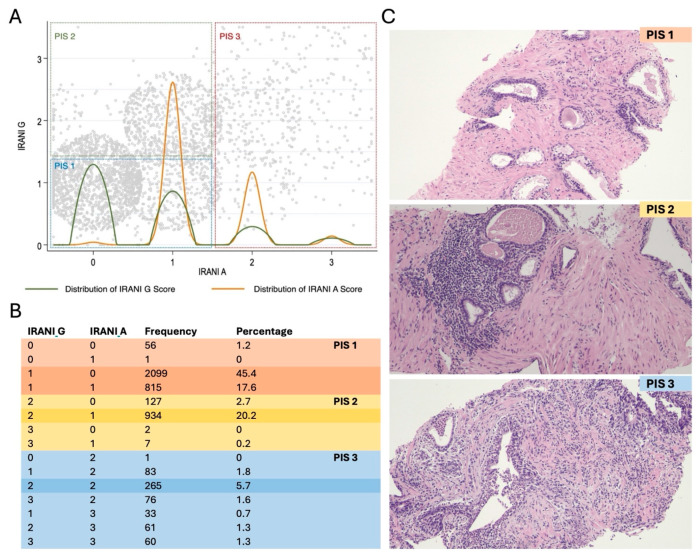
Background: There is emerging evidence of an inverse association between prostatic inflammation (PI) and prostate cancer (PCa) diagnosis and outcome. The Irani score, a validated system that scores PI according to the grade of stromal infiltration (Irani G) and the aggressiveness of glandular infiltration (Irani A), has indeed been found to be inversely associated with PCa diagnosis and outcome, but the presence of two categories (G and A) makes the performance of this score suboptimal. This study aimed to determine whether a novel prostatic inflammation score (PIS) that combines Irani G and A scores better defined the risk of being diagnosed with PCa at prostate biopsy (PBx). Methods: Between January 2013 and December 2023, the Irani scores were routinely assessed on hematoxylin and eosin-stained PBx cores. The novel PIS was obtained by combining Irani G and A scores by their kernel distribution. PIS 1 included patients who scored G 0-1/A 0-1, PIS 2 those who scored G 2-3/A 0-1, and PIS 3 included those who scored G 0-3/A 2-3. Logistic regression analysis was used to test the association between the novel PIS and the risk of being diagnosed with PCa and clinically significant (cs) PCa at PBx. Results: Among the 4620 eligible patients, PCa and csPCa detection rate was 47% and 25%, respectively. Overall, 3088 (66.8%) had low Irani G and 4041 (87.5%) had low Irani A scores. Using PIS, 2971 (64%) were classified as PIS 1, 1070 (23%) as PIS 2, and 579 (13%) as PIS 3. Notably, almost one-quarter of patients had heterogeneous Irani features. Multivariable analysis pointed out a significant association between PIS and the risk of being diagnosed with PCa and csPCa; the higher the PIS, the lower the likelihood of such diagnoses. Limitations included the absence of external validation. Conclusions: The novel PIS, easily obtained during routine pathology examination, was significantly associated with the risk of being diagnosed with PCa and csPCa at PBx. While PI seems to be overall protective over PCa, the different types (stromal vs. glandular) of inflammation depicted by PIS seem to express a different risk.
DiagnosticsBiochemistry, Genetics and Molecular Biology-Clinical Biochemistry
CiteScore
4.70
自引率
8.30%
发文量
2699
审稿时长
19.64 days
期刊介绍:
Diagnostics (ISSN 2075-4418) is an international scholarly open access journal on medical diagnostics. It publishes original research articles, reviews, communications and short notes on the research and development of medical diagnostics. There is no restriction on the length of the papers. Our aim is to encourage scientists to publish their experimental and theoretical research in as much detail as possible. Full experimental and/or methodological details must be provided for research articles.




 京公网安备 11010802042870号
京ICP备2023020795号-1
京公网安备 11010802042870号
京ICP备2023020795号-1

 分享
分享
 求助内容:
求助内容: 应助结果提醒方式:
 扫码关注我们
