Simin Fan , Wei Chen , Yanfang Li , Kaixin Guo , Hui Tang , Jintong Ye , Zunming Zhou , Meiao Tan , Haoyang Wei , Xiwen Huang , Keer Huang , Xuehong Ke
{"title":"芪葛汤通过调节sirt6 - ppar α介导的脂肪酸氧化而减轻非酒精性脂肪肝。","authors":"Simin Fan , Wei Chen , Yanfang Li , Kaixin Guo , Hui Tang , Jintong Ye , Zunming Zhou , Meiao Tan , Haoyang Wei , Xiwen Huang , Keer Huang , Xuehong Ke","doi":"10.1016/j.phymed.2025.156395","DOIUrl":null,"url":null,"abstract":"<div><h3>Background</h3><div><em>Sirtuin 6</em> (<em>SIRT6</em>), a potential therapeutic target for non-alcoholic fatty liver disease (NAFLD), has been shown to regulate fatty acid oxidation (FAO) by interacting with <em>peroxisome proliferator-activated receptor α</em> (<em>PPARα</em>). However, the impact of SIRT6-PPARα pathway on NAFLD phenotype has not yet been reported. Qige decoction (QG), a traditional Chinese medicine (TCM) formula, is widely applied to treat disorders of glycolipid metabolism. Our previous experiments showed that QG reduced hepatic steatosis and provided preliminary evidence that QG may promote FAO. However, a thorough understanding of molecular mechanisms by which QG regulates FAO requires further investigation.</div></div><div><h3>Purpose</h3><div>To investigate the role of <em>SIRT6</em>-<em>PPARα</em> signalling pathway on NAFLD phenotype and explore the mechanism by which QG improves NAFLD and its relationship with FAO regulated by <em>SIRT6</em>-<em>PPARα</em> signalling pathway.</div></div><div><h3>Methods</h3><div>In vivo study, NAFLD mice induced by high fat diet (HFD) were divided into two parts. The first part involved four groups: control (CON), model (MOD), <em>PPARα</em> agonist (WY-14,643, WY), and <em>SIRT6</em> inhibitor (OSS-128,167, OS) groups. The second part involved five groups: CON group, MOD group, positive drug (POS) group, low dose QG (QGL) group, and high dose QG (QGH) group. Widely-targeted lipidomic were performed by UHPLC-QTOF/MS to analyse differential lipids (DELs) in the liver, while differentially expressed genes (DEGs) were analysed by transcriptome analysis on the Illumina sequencing platform. In vitro study, co-immunoprecipitation and dual luciferase assay were employed to further identify the molecular mechanisms of <em>SIRT6</em>-<em>PPARα</em> interaction. The lentiviral vector, TG assay, and acetyl-CoA assay were used to clarify the indispensable role of the <em>SIRT6</em>-<em>PPARα</em> signalling pathway on QG amelioration of lipid accumulation in vitro.</div></div><div><h3>Results</h3><div>Down-regulation of <em>SIRT6</em> inhibited <em>PPARα</em>-mediated FAO and aggravated lipid accumulation in hepatocytes both in vivo and in vitro. <em>SIRT6</em> bound to <em>PPARα</em> in HepG2 cells; however, <em>SIRT6</em> activation of the <em>PPARα</em> promoter was not detected. Along with QG reduced hepatocyte lipid accumulation, <em>SIRT6</em>-<em>PPARα</em> signalling pathway was upregulated in vivo and in vitro. However, the alleviating effect of QG on lipid accumulation was blocked by <em>SIRT6</em> silencing in vitro.</div></div><div><h3>Conclusion</h3><div>This study verified that <em>SIRT6</em>-<em>PPARα</em> signalling pathway inhibition exacerbated NAFLD dyslipidaemia and hepatic steatosis. In addition, this study provided the first in-depth analysis of the molecular mechanisms by which QG ameliorates NFALD, involving promotion of FAO through activation of the <em>SIRT6</em>-<em>PPARα</em> signalling pathway. Our study offers significant insights for the clinical application of QG.</div></div>","PeriodicalId":20212,"journal":{"name":"Phytomedicine","volume":"138 ","pages":"Article 156395"},"PeriodicalIF":8.3000,"publicationDate":"2025-03-01","publicationTypes":"Journal Article","fieldsOfStudy":null,"isOpenAccess":false,"openAccessPdf":"","citationCount":"0","resultStr":"{\"title\":\"Qige Decoction attenuated non-alcoholic fatty liver disease through regulating SIRT6-PPARα-mediated fatty acid oxidation\",\"authors\":\"Simin Fan , Wei Chen , Yanfang Li , Kaixin Guo , Hui Tang , Jintong Ye , Zunming Zhou , Meiao Tan , Haoyang Wei , Xiwen Huang , Keer Huang , Xuehong Ke\",\"doi\":\"10.1016/j.phymed.2025.156395\",\"DOIUrl\":null,\"url\":null,\"abstract\":\"<div><h3>Background</h3><div><em>Sirtuin 6</em> (<em>SIRT6</em>), a potential therapeutic target for non-alcoholic fatty liver disease (NAFLD), has been shown to regulate fatty acid oxidation (FAO) by interacting with <em>peroxisome proliferator-activated receptor α</em> (<em>PPARα</em>). However, the impact of SIRT6-PPARα pathway on NAFLD phenotype has not yet been reported. Qige decoction (QG), a traditional Chinese medicine (TCM) formula, is widely applied to treat disorders of glycolipid metabolism. Our previous experiments showed that QG reduced hepatic steatosis and provided preliminary evidence that QG may promote FAO. However, a thorough understanding of molecular mechanisms by which QG regulates FAO requires further investigation.</div></div><div><h3>Purpose</h3><div>To investigate the role of <em>SIRT6</em>-<em>PPARα</em> signalling pathway on NAFLD phenotype and explore the mechanism by which QG improves NAFLD and its relationship with FAO regulated by <em>SIRT6</em>-<em>PPARα</em> signalling pathway.</div></div><div><h3>Methods</h3><div>In vivo study, NAFLD mice induced by high fat diet (HFD) were divided into two parts. The first part involved four groups: control (CON), model (MOD), <em>PPARα</em> agonist (WY-14,643, WY), and <em>SIRT6</em> inhibitor (OSS-128,167, OS) groups. The second part involved five groups: CON group, MOD group, positive drug (POS) group, low dose QG (QGL) group, and high dose QG (QGH) group. Widely-targeted lipidomic were performed by UHPLC-QTOF/MS to analyse differential lipids (DELs) in the liver, while differentially expressed genes (DEGs) were analysed by transcriptome analysis on the Illumina sequencing platform. In vitro study, co-immunoprecipitation and dual luciferase assay were employed to further identify the molecular mechanisms of <em>SIRT6</em>-<em>PPARα</em> interaction. The lentiviral vector, TG assay, and acetyl-CoA assay were used to clarify the indispensable role of the <em>SIRT6</em>-<em>PPARα</em> signalling pathway on QG amelioration of lipid accumulation in vitro.</div></div><div><h3>Results</h3><div>Down-regulation of <em>SIRT6</em> inhibited <em>PPARα</em>-mediated FAO and aggravated lipid accumulation in hepatocytes both in vivo and in vitro. <em>SIRT6</em> bound to <em>PPARα</em> in HepG2 cells; however, <em>SIRT6</em> activation of the <em>PPARα</em> promoter was not detected. Along with QG reduced hepatocyte lipid accumulation, <em>SIRT6</em>-<em>PPARα</em> signalling pathway was upregulated in vivo and in vitro. However, the alleviating effect of QG on lipid accumulation was blocked by <em>SIRT6</em> silencing in vitro.</div></div><div><h3>Conclusion</h3><div>This study verified that <em>SIRT6</em>-<em>PPARα</em> signalling pathway inhibition exacerbated NAFLD dyslipidaemia and hepatic steatosis. In addition, this study provided the first in-depth analysis of the molecular mechanisms by which QG ameliorates NFALD, involving promotion of FAO through activation of the <em>SIRT6</em>-<em>PPARα</em> signalling pathway. Our study offers significant insights for the clinical application of QG.</div></div>\",\"PeriodicalId\":20212,\"journal\":{\"name\":\"Phytomedicine\",\"volume\":\"138 \",\"pages\":\"Article 156395\"},\"PeriodicalIF\":8.3000,\"publicationDate\":\"2025-03-01\",\"publicationTypes\":\"Journal Article\",\"fieldsOfStudy\":null,\"isOpenAccess\":false,\"openAccessPdf\":\"\",\"citationCount\":\"0\",\"resultStr\":null,\"platform\":\"Semanticscholar\",\"paperid\":null,\"PeriodicalName\":\"Phytomedicine\",\"FirstCategoryId\":\"3\",\"ListUrlMain\":\"https://www.sciencedirect.com/science/article/pii/S0944711325000340\",\"RegionNum\":1,\"RegionCategory\":\"医学\",\"ArticlePicture\":[],\"TitleCN\":null,\"AbstractTextCN\":null,\"PMCID\":null,\"EPubDate\":\"2025/1/17 0:00:00\",\"PubModel\":\"Epub\",\"JCR\":\"Q1\",\"JCRName\":\"CHEMISTRY, MEDICINAL\",\"Score\":null,\"Total\":0}","platform":"Semanticscholar","paperid":null,"PeriodicalName":"Phytomedicine","FirstCategoryId":"3","ListUrlMain":"https://www.sciencedirect.com/science/article/pii/S0944711325000340","RegionNum":1,"RegionCategory":"医学","ArticlePicture":[],"TitleCN":null,"AbstractTextCN":null,"PMCID":null,"EPubDate":"2025/1/17 0:00:00","PubModel":"Epub","JCR":"Q1","JCRName":"CHEMISTRY, MEDICINAL","Score":null,"Total":0}
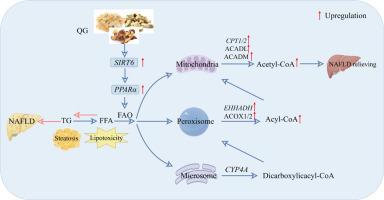
Sirtuin 6 (SIRT6), a potential therapeutic target for non-alcoholic fatty liver disease (NAFLD), has been shown to regulate fatty acid oxidation (FAO) by interacting with peroxisome proliferator-activated receptor α (PPARα). However, the impact of SIRT6-PPARα pathway on NAFLD phenotype has not yet been reported. Qige decoction (QG), a traditional Chinese medicine (TCM) formula, is widely applied to treat disorders of glycolipid metabolism. Our previous experiments showed that QG reduced hepatic steatosis and provided preliminary evidence that QG may promote FAO. However, a thorough understanding of molecular mechanisms by which QG regulates FAO requires further investigation.
Purpose
To investigate the role of SIRT6-PPARα signalling pathway on NAFLD phenotype and explore the mechanism by which QG improves NAFLD and its relationship with FAO regulated by SIRT6-PPARα signalling pathway.
Methods
In vivo study, NAFLD mice induced by high fat diet (HFD) were divided into two parts. The first part involved four groups: control (CON), model (MOD), PPARα agonist (WY-14,643, WY), and SIRT6 inhibitor (OSS-128,167, OS) groups. The second part involved five groups: CON group, MOD group, positive drug (POS) group, low dose QG (QGL) group, and high dose QG (QGH) group. Widely-targeted lipidomic were performed by UHPLC-QTOF/MS to analyse differential lipids (DELs) in the liver, while differentially expressed genes (DEGs) were analysed by transcriptome analysis on the Illumina sequencing platform. In vitro study, co-immunoprecipitation and dual luciferase assay were employed to further identify the molecular mechanisms of SIRT6-PPARα interaction. The lentiviral vector, TG assay, and acetyl-CoA assay were used to clarify the indispensable role of the SIRT6-PPARα signalling pathway on QG amelioration of lipid accumulation in vitro.
Results
Down-regulation of SIRT6 inhibited PPARα-mediated FAO and aggravated lipid accumulation in hepatocytes both in vivo and in vitro. SIRT6 bound to PPARα in HepG2 cells; however, SIRT6 activation of the PPARα promoter was not detected. Along with QG reduced hepatocyte lipid accumulation, SIRT6-PPARα signalling pathway was upregulated in vivo and in vitro. However, the alleviating effect of QG on lipid accumulation was blocked by SIRT6 silencing in vitro.
Conclusion
This study verified that SIRT6-PPARα signalling pathway inhibition exacerbated NAFLD dyslipidaemia and hepatic steatosis. In addition, this study provided the first in-depth analysis of the molecular mechanisms by which QG ameliorates NFALD, involving promotion of FAO through activation of the SIRT6-PPARα signalling pathway. Our study offers significant insights for the clinical application of QG.
期刊介绍:
Phytomedicine is a therapy-oriented journal that publishes innovative studies on the efficacy, safety, quality, and mechanisms of action of specified plant extracts, phytopharmaceuticals, and their isolated constituents. This includes clinical, pharmacological, pharmacokinetic, and toxicological studies of herbal medicinal products, preparations, and purified compounds with defined and consistent quality, ensuring reproducible pharmacological activity. Founded in 1994, Phytomedicine aims to focus and stimulate research in this field and establish internationally accepted scientific standards for pharmacological studies, proof of clinical efficacy, and safety of phytomedicines.





 京公网安备 11010802042870号
京ICP备2023020795号-1
京公网安备 11010802042870号
京ICP备2023020795号-1

 分享
分享
 求助内容:
求助内容: 应助结果提醒方式:
 扫码关注我们
