{"title":"利用线粒体16S rRNA和COI序列对西藏地区长角革螨的遗传多样性进行鉴定和分析。","authors":"Xialing Zhao, Lamu Danqu, Bin Shi, Wenqiang Tang, Zengqiang Liu, Chenyang Xia","doi":"10.1016/j.vprsr.2024.101180","DOIUrl":null,"url":null,"abstract":"<div><div>Ticks serve as vectors and reservoirs for a variety of pathogens, including protozoa, bacteria, and viruses, that cause tick-borne diseases in both humans and livestock. Despite their widespread distribution, their genetic diversity and population structure in Xizang have not been thoroughly investigated. In this study, sheep ticks were identified from four counties by microscopy, followed by genetic analysis of <em>Dermacentor everestianus</em> populations in Xizang based on mitochondrial 16S rRNA and cytochrome oxidase subunit 1 (COI) gene sequences. <em>D. everestianus</em> was the predominant species and 16S rRNA gene sequence analysis revealed nine haplotypes with seven nucleotide variations, showing a mean haplotype diversity (<em>H</em><sub><em>d</em></sub>) of 0.505 and mean nucleotide diversity (<em>P</em><sub><em>i</em></sub>) of 0.00129. Similarly, the COI sequences revealed 28 haplotypes with 26 nucleotide variations, yielding a mean <em>H</em><sub><em>d</em></sub> of 0.828 and a mean <em>P</em><sub><em>i</em></sub> of 0.00279. Molecular variance analysis (AMOVA) indicated that most genetic variation occurs within populations. In addition, neutral test analyses suggested potential bottleneck events in the <em>D. everestianus</em> populations. The haplotype network had a star-like distribution with the common haplotypes A1, A2, B1, and B5. The phylogenetic tree separated haplotypes of both genes into two branches on the haplotype network indicating no distinct geographical clustering. This study is the first to highlight the prevalence of <em>D. everestianus</em> in Xizang, revealing moderate genetic differentiation among the four populations, possibly due to host mobility. This intensive investigation of genetic variation and population structure contributes valuable insights into the current population genetics of <em>D. everestianus</em> in Xizang, China.</div></div>","PeriodicalId":23600,"journal":{"name":"Veterinary parasitology, regional studies and reports","volume":"57 ","pages":"Article 101180"},"PeriodicalIF":1.4000,"publicationDate":"2025-01-01","publicationTypes":"Journal Article","fieldsOfStudy":null,"isOpenAccess":false,"openAccessPdf":"","citationCount":"0","resultStr":"{\"title\":\"Identification and analysis of the genetic diversity of Dermacentor everestianus using mitochondrial 16S rRNA and COI sequences in the Xizang Autonomous Region of China\",\"authors\":\"Xialing Zhao, Lamu Danqu, Bin Shi, Wenqiang Tang, Zengqiang Liu, Chenyang Xia\",\"doi\":\"10.1016/j.vprsr.2024.101180\",\"DOIUrl\":null,\"url\":null,\"abstract\":\"<div><div>Ticks serve as vectors and reservoirs for a variety of pathogens, including protozoa, bacteria, and viruses, that cause tick-borne diseases in both humans and livestock. Despite their widespread distribution, their genetic diversity and population structure in Xizang have not been thoroughly investigated. In this study, sheep ticks were identified from four counties by microscopy, followed by genetic analysis of <em>Dermacentor everestianus</em> populations in Xizang based on mitochondrial 16S rRNA and cytochrome oxidase subunit 1 (COI) gene sequences. <em>D. everestianus</em> was the predominant species and 16S rRNA gene sequence analysis revealed nine haplotypes with seven nucleotide variations, showing a mean haplotype diversity (<em>H</em><sub><em>d</em></sub>) of 0.505 and mean nucleotide diversity (<em>P</em><sub><em>i</em></sub>) of 0.00129. Similarly, the COI sequences revealed 28 haplotypes with 26 nucleotide variations, yielding a mean <em>H</em><sub><em>d</em></sub> of 0.828 and a mean <em>P</em><sub><em>i</em></sub> of 0.00279. Molecular variance analysis (AMOVA) indicated that most genetic variation occurs within populations. In addition, neutral test analyses suggested potential bottleneck events in the <em>D. everestianus</em> populations. The haplotype network had a star-like distribution with the common haplotypes A1, A2, B1, and B5. The phylogenetic tree separated haplotypes of both genes into two branches on the haplotype network indicating no distinct geographical clustering. This study is the first to highlight the prevalence of <em>D. everestianus</em> in Xizang, revealing moderate genetic differentiation among the four populations, possibly due to host mobility. This intensive investigation of genetic variation and population structure contributes valuable insights into the current population genetics of <em>D. everestianus</em> in Xizang, China.</div></div>\",\"PeriodicalId\":23600,\"journal\":{\"name\":\"Veterinary parasitology, regional studies and reports\",\"volume\":\"57 \",\"pages\":\"Article 101180\"},\"PeriodicalIF\":1.4000,\"publicationDate\":\"2025-01-01\",\"publicationTypes\":\"Journal Article\",\"fieldsOfStudy\":null,\"isOpenAccess\":false,\"openAccessPdf\":\"\",\"citationCount\":\"0\",\"resultStr\":null,\"platform\":\"Semanticscholar\",\"paperid\":null,\"PeriodicalName\":\"Veterinary parasitology, regional studies and reports\",\"FirstCategoryId\":\"1085\",\"ListUrlMain\":\"https://www.sciencedirect.com/science/article/pii/S2405939024002168\",\"RegionNum\":0,\"RegionCategory\":null,\"ArticlePicture\":[],\"TitleCN\":null,\"AbstractTextCN\":null,\"PMCID\":null,\"EPubDate\":\"2024/12/2 0:00:00\",\"PubModel\":\"Epub\",\"JCR\":\"Q3\",\"JCRName\":\"PARASITOLOGY\",\"Score\":null,\"Total\":0}","platform":"Semanticscholar","paperid":null,"PeriodicalName":"Veterinary parasitology, regional studies and reports","FirstCategoryId":"1085","ListUrlMain":"https://www.sciencedirect.com/science/article/pii/S2405939024002168","RegionNum":0,"RegionCategory":null,"ArticlePicture":[],"TitleCN":null,"AbstractTextCN":null,"PMCID":null,"EPubDate":"2024/12/2 0:00:00","PubModel":"Epub","JCR":"Q3","JCRName":"PARASITOLOGY","Score":null,"Total":0}
Identification and analysis of the genetic diversity of Dermacentor everestianus using mitochondrial 16S rRNA and COI sequences in the Xizang Autonomous Region of China
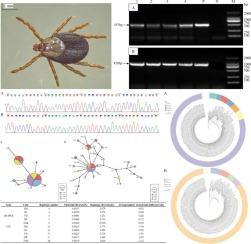
Ticks serve as vectors and reservoirs for a variety of pathogens, including protozoa, bacteria, and viruses, that cause tick-borne diseases in both humans and livestock. Despite their widespread distribution, their genetic diversity and population structure in Xizang have not been thoroughly investigated. In this study, sheep ticks were identified from four counties by microscopy, followed by genetic analysis of Dermacentor everestianus populations in Xizang based on mitochondrial 16S rRNA and cytochrome oxidase subunit 1 (COI) gene sequences. D. everestianus was the predominant species and 16S rRNA gene sequence analysis revealed nine haplotypes with seven nucleotide variations, showing a mean haplotype diversity (Hd) of 0.505 and mean nucleotide diversity (Pi) of 0.00129. Similarly, the COI sequences revealed 28 haplotypes with 26 nucleotide variations, yielding a mean Hd of 0.828 and a mean Pi of 0.00279. Molecular variance analysis (AMOVA) indicated that most genetic variation occurs within populations. In addition, neutral test analyses suggested potential bottleneck events in the D. everestianus populations. The haplotype network had a star-like distribution with the common haplotypes A1, A2, B1, and B5. The phylogenetic tree separated haplotypes of both genes into two branches on the haplotype network indicating no distinct geographical clustering. This study is the first to highlight the prevalence of D. everestianus in Xizang, revealing moderate genetic differentiation among the four populations, possibly due to host mobility. This intensive investigation of genetic variation and population structure contributes valuable insights into the current population genetics of D. everestianus in Xizang, China.
期刊介绍:
Veterinary Parasitology: Regional Studies and Reports focuses on aspects of veterinary parasitology that are of regional concern, which is especially important in this era of climate change and the rapid and often unconstrained travel of people and animals. Relative to regions, this journal will accept papers of the highest quality dealing with all aspects of disease prevention, pathology, treatment, epidemiology, and control of parasites within the field of veterinary medicine. Also, case reports will be considered as they add to information related to local disease and its control; such papers must be concise and represent appropriate medical intervention. Papers on veterinary parasitology from wildlife species are acceptable, but only if they relate to the practice of veterinary medicine. Studies on vector-borne bacterial and viral agents are suitable, but only if the paper deals with vector transmission of these organisms to domesticated animals. Studies dealing with parasite control by means of natural products, both in vivo and in vitro, are more suited for one of the many journals that now specialize in papers of this type. However, due to the regional nature of much of this research, submissions may be considered based upon a case being made by the author(s) to the Editor. Circumstances relating to animal experimentation must meet the International Guiding Principles for Biomedical Research Involving Animals as issued by the Council for International Organizations of Medical Sciences (obtainable from: Executive Secretary C.I.O.M.S., c/o W.H.O., Via Appia, CH-1211 Geneva 27, Switzerland).




 京公网安备 11010802042870号
京ICP备2023020795号-1
京公网安备 11010802042870号
京ICP备2023020795号-1

 分享
分享

 求助内容:
求助内容: 应助结果提醒方式:
 扫码关注我们
