Yang Xia, Chunye Huang, Min Zhong, Hongguang Zhong, Ruiwen Ruan, Jianping Xiong, Yangyang Yao, Jing Zhou, Jun Deng
{"title":"靶向HGF/c-MET信号调节肿瘤微环境:对抗肿瘤免疫逃避的意义","authors":"Yang Xia, Chunye Huang, Min Zhong, Hongguang Zhong, Ruiwen Ruan, Jianping Xiong, Yangyang Yao, Jing Zhou, Jun Deng","doi":"10.1186/s12964-025-02033-1","DOIUrl":null,"url":null,"abstract":"<p><p>The hepatocyte growth factor (HGF) along with its receptor (c-MET) are crucial in preserving standard cellular physiological activities, and imbalances in the c-MET signaling pathway can lead to the development and advancement of tumors. It has been extensively demonstrated that immune checkpoint inhibitors (ICIs) can result in prolonged remission in certain patients. Nevertheless, numerous preclinical studies have shown that MET imbalance hinders the effectiveness of anti-PD-1/PD-L1 treatments through various mechanisms. Consequently, clarifying the link between the c-MET signaling pathway and the tumor microenvironment (TME), as well as uncovering the effects of anti-MET treatment on ICI therapy, is crucial for enhancing the outlook for tumor patients. In this review, we examine the impact of abnormal activation of the HGF/c-MET signaling pathway on the control of the TME and the processes governing PD-L1 expression in cancer cells. The review thoroughly examines both clinical and practical evidence regarding the use of c-MET inhibitors alongside PD-1/PD-L1 inhibitors, emphasizing that focusing on c-MET with immunotherapy enhances the effectiveness of treating MET tumors exhibiting elevated PD-L1 expression.</p>","PeriodicalId":55268,"journal":{"name":"Cell Communication and Signaling","volume":"23 1","pages":"46"},"PeriodicalIF":11.6000,"publicationDate":"2025-01-25","publicationTypes":"Journal Article","fieldsOfStudy":null,"isOpenAccess":false,"openAccessPdf":"https://www.ncbi.nlm.nih.gov/pmc/articles/PMC11762533/pdf/","citationCount":"0","resultStr":"{\"title\":\"Targeting HGF/c-MET signaling to regulate the tumor microenvironment: Implications for counteracting tumor immune evasion.\",\"authors\":\"Yang Xia, Chunye Huang, Min Zhong, Hongguang Zhong, Ruiwen Ruan, Jianping Xiong, Yangyang Yao, Jing Zhou, Jun Deng\",\"doi\":\"10.1186/s12964-025-02033-1\",\"DOIUrl\":null,\"url\":null,\"abstract\":\"<p><p>The hepatocyte growth factor (HGF) along with its receptor (c-MET) are crucial in preserving standard cellular physiological activities, and imbalances in the c-MET signaling pathway can lead to the development and advancement of tumors. It has been extensively demonstrated that immune checkpoint inhibitors (ICIs) can result in prolonged remission in certain patients. Nevertheless, numerous preclinical studies have shown that MET imbalance hinders the effectiveness of anti-PD-1/PD-L1 treatments through various mechanisms. Consequently, clarifying the link between the c-MET signaling pathway and the tumor microenvironment (TME), as well as uncovering the effects of anti-MET treatment on ICI therapy, is crucial for enhancing the outlook for tumor patients. In this review, we examine the impact of abnormal activation of the HGF/c-MET signaling pathway on the control of the TME and the processes governing PD-L1 expression in cancer cells. The review thoroughly examines both clinical and practical evidence regarding the use of c-MET inhibitors alongside PD-1/PD-L1 inhibitors, emphasizing that focusing on c-MET with immunotherapy enhances the effectiveness of treating MET tumors exhibiting elevated PD-L1 expression.</p>\",\"PeriodicalId\":55268,\"journal\":{\"name\":\"Cell Communication and Signaling\",\"volume\":\"23 1\",\"pages\":\"46\"},\"PeriodicalIF\":11.6000,\"publicationDate\":\"2025-01-25\",\"publicationTypes\":\"Journal Article\",\"fieldsOfStudy\":null,\"isOpenAccess\":false,\"openAccessPdf\":\"https://www.ncbi.nlm.nih.gov/pmc/articles/PMC11762533/pdf/\",\"citationCount\":\"0\",\"resultStr\":null,\"platform\":\"Semanticscholar\",\"paperid\":null,\"PeriodicalName\":\"Cell Communication and Signaling\",\"FirstCategoryId\":\"99\",\"ListUrlMain\":\"https://doi.org/10.1186/s12964-025-02033-1\",\"RegionNum\":2,\"RegionCategory\":\"生物学\",\"ArticlePicture\":[],\"TitleCN\":null,\"AbstractTextCN\":null,\"PMCID\":null,\"EPubDate\":\"\",\"PubModel\":\"\",\"JCR\":\"Q1\",\"JCRName\":\"CELL BIOLOGY\",\"Score\":null,\"Total\":0}","platform":"Semanticscholar","paperid":null,"PeriodicalName":"Cell Communication and Signaling","FirstCategoryId":"99","ListUrlMain":"https://doi.org/10.1186/s12964-025-02033-1","RegionNum":2,"RegionCategory":"生物学","ArticlePicture":[],"TitleCN":null,"AbstractTextCN":null,"PMCID":null,"EPubDate":"","PubModel":"","JCR":"Q1","JCRName":"CELL BIOLOGY","Score":null,"Total":0}
Targeting HGF/c-MET signaling to regulate the tumor microenvironment: Implications for counteracting tumor immune evasion.
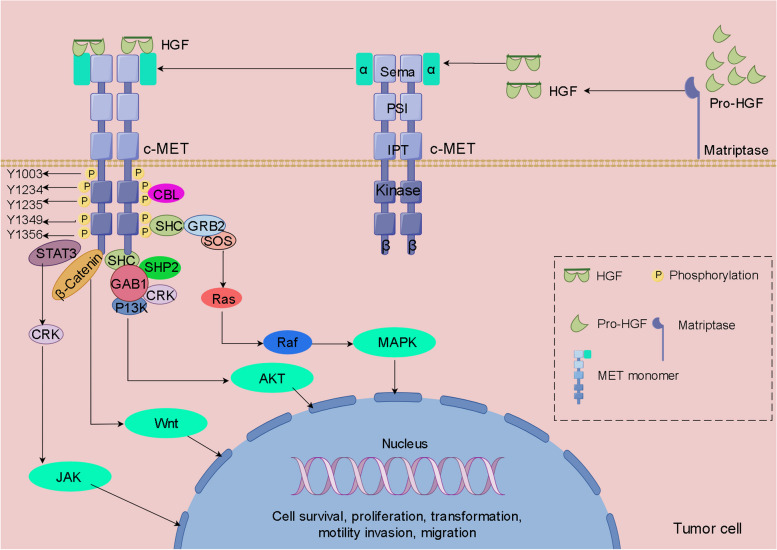
The hepatocyte growth factor (HGF) along with its receptor (c-MET) are crucial in preserving standard cellular physiological activities, and imbalances in the c-MET signaling pathway can lead to the development and advancement of tumors. It has been extensively demonstrated that immune checkpoint inhibitors (ICIs) can result in prolonged remission in certain patients. Nevertheless, numerous preclinical studies have shown that MET imbalance hinders the effectiveness of anti-PD-1/PD-L1 treatments through various mechanisms. Consequently, clarifying the link between the c-MET signaling pathway and the tumor microenvironment (TME), as well as uncovering the effects of anti-MET treatment on ICI therapy, is crucial for enhancing the outlook for tumor patients. In this review, we examine the impact of abnormal activation of the HGF/c-MET signaling pathway on the control of the TME and the processes governing PD-L1 expression in cancer cells. The review thoroughly examines both clinical and practical evidence regarding the use of c-MET inhibitors alongside PD-1/PD-L1 inhibitors, emphasizing that focusing on c-MET with immunotherapy enhances the effectiveness of treating MET tumors exhibiting elevated PD-L1 expression.
期刊介绍:
Cell Communication and Signaling (CCS) is a peer-reviewed, open-access scientific journal that focuses on cellular signaling pathways in both normal and pathological conditions. It publishes original research, reviews, and commentaries, welcoming studies that utilize molecular, morphological, biochemical, structural, and cell biology approaches. CCS also encourages interdisciplinary work and innovative models, including in silico, in vitro, and in vivo approaches, to facilitate investigations of cell signaling pathways, networks, and behavior.
Starting from January 2019, CCS is proud to announce its affiliation with the International Cell Death Society. The journal now encourages submissions covering all aspects of cell death, including apoptotic and non-apoptotic mechanisms, cell death in model systems, autophagy, clearance of dying cells, and the immunological and pathological consequences of dying cells in the tissue microenvironment.






 京公网安备 11010802042870号
京ICP备2023020795号-1
京公网安备 11010802042870号
京ICP备2023020795号-1

 分享
分享
 求助内容:
求助内容: 应助结果提醒方式:
 扫码关注我们
