{"title":"研究炎症细胞因子与口咽癌之间的因果关系:孟德尔随机化。","authors":"Sibo Xu, Yiguo Li, Wei Chen, Ke Wang","doi":"10.1007/s12672-025-01809-8","DOIUrl":null,"url":null,"abstract":"<p><strong>Objectives: </strong>This study aims to use Mendelian randomisation to identify the causal relationship between a spectrum of 41 inflammatory cytokines and the development of oropharyngeal cancer.</p><p><strong>Methods: </strong>This study investigated genetic variants that have been associated with oral and oropharyngeal cancer using data from a large GWAS. Inflammatory cytokine data were obtained from 8293 asymptomatic individuals. The study primarily used inverse variance weighted and MR-Egger methods to determine the causal relationship between inflammatory cytokines and cancer incidence, complemented by a series of sensitivity analyses including MR-Egger, simple mode, weighted mode, weighted median and leave-one-out approaches.</p><p><strong>Results: </strong>Our study demonstrates that higher levels of interleukin-7 (IL-7) and interleukin-5 (IL-5) slightly increase the odds of oropharyngeal cancer by 0.07% [OR: 1.0007, p = 0.005] and 0.04% [OR: 1.0004, p = 0.015], corresponding to a modest increase. Similarly, increased PDGF-bb and CTACK levels are modestly associated with increased odds of oral and oropharyngeal cancer by 0.22% [OR: 1.0022, p = 0.031] and 0.17% [OR: 1.0017, p = 0.043], respectively.</p><p><strong>Conclusion: </strong>This investigation posits that IL-5 and IL-7 may be pertinent factors in the etiology of Oropharyngeal cancer, while PDGF bb and CTACK are likely implicated in the pathogenesis of both oral and oropharyngeal cancers.</p>","PeriodicalId":11148,"journal":{"name":"Discover. Oncology","volume":"16 1","pages":"92"},"PeriodicalIF":2.9000,"publicationDate":"2025-01-27","publicationTypes":"Journal Article","fieldsOfStudy":null,"isOpenAccess":false,"openAccessPdf":"https://www.ncbi.nlm.nih.gov/pmc/articles/PMC11772633/pdf/","citationCount":"0","resultStr":"{\"title\":\"Investigating causal relationship among inflammatory cytokines and oropharyngeal cancer: Mendelian randomization.\",\"authors\":\"Sibo Xu, Yiguo Li, Wei Chen, Ke Wang\",\"doi\":\"10.1007/s12672-025-01809-8\",\"DOIUrl\":null,\"url\":null,\"abstract\":\"<p><strong>Objectives: </strong>This study aims to use Mendelian randomisation to identify the causal relationship between a spectrum of 41 inflammatory cytokines and the development of oropharyngeal cancer.</p><p><strong>Methods: </strong>This study investigated genetic variants that have been associated with oral and oropharyngeal cancer using data from a large GWAS. Inflammatory cytokine data were obtained from 8293 asymptomatic individuals. The study primarily used inverse variance weighted and MR-Egger methods to determine the causal relationship between inflammatory cytokines and cancer incidence, complemented by a series of sensitivity analyses including MR-Egger, simple mode, weighted mode, weighted median and leave-one-out approaches.</p><p><strong>Results: </strong>Our study demonstrates that higher levels of interleukin-7 (IL-7) and interleukin-5 (IL-5) slightly increase the odds of oropharyngeal cancer by 0.07% [OR: 1.0007, p = 0.005] and 0.04% [OR: 1.0004, p = 0.015], corresponding to a modest increase. Similarly, increased PDGF-bb and CTACK levels are modestly associated with increased odds of oral and oropharyngeal cancer by 0.22% [OR: 1.0022, p = 0.031] and 0.17% [OR: 1.0017, p = 0.043], respectively.</p><p><strong>Conclusion: </strong>This investigation posits that IL-5 and IL-7 may be pertinent factors in the etiology of Oropharyngeal cancer, while PDGF bb and CTACK are likely implicated in the pathogenesis of both oral and oropharyngeal cancers.</p>\",\"PeriodicalId\":11148,\"journal\":{\"name\":\"Discover. Oncology\",\"volume\":\"16 1\",\"pages\":\"92\"},\"PeriodicalIF\":2.9000,\"publicationDate\":\"2025-01-27\",\"publicationTypes\":\"Journal Article\",\"fieldsOfStudy\":null,\"isOpenAccess\":false,\"openAccessPdf\":\"https://www.ncbi.nlm.nih.gov/pmc/articles/PMC11772633/pdf/\",\"citationCount\":\"0\",\"resultStr\":null,\"platform\":\"Semanticscholar\",\"paperid\":null,\"PeriodicalName\":\"Discover. Oncology\",\"FirstCategoryId\":\"3\",\"ListUrlMain\":\"https://doi.org/10.1007/s12672-025-01809-8\",\"RegionNum\":4,\"RegionCategory\":\"医学\",\"ArticlePicture\":[],\"TitleCN\":null,\"AbstractTextCN\":null,\"PMCID\":null,\"EPubDate\":\"\",\"PubModel\":\"\",\"JCR\":\"Q3\",\"JCRName\":\"ENDOCRINOLOGY & METABOLISM\",\"Score\":null,\"Total\":0}","platform":"Semanticscholar","paperid":null,"PeriodicalName":"Discover. Oncology","FirstCategoryId":"3","ListUrlMain":"https://doi.org/10.1007/s12672-025-01809-8","RegionNum":4,"RegionCategory":"医学","ArticlePicture":[],"TitleCN":null,"AbstractTextCN":null,"PMCID":null,"EPubDate":"","PubModel":"","JCR":"Q3","JCRName":"ENDOCRINOLOGY & METABOLISM","Score":null,"Total":0}
引用次数: 0
摘要
目的:本研究旨在使用孟德尔随机化来确定41种炎症细胞因子谱与口咽癌发展之间的因果关系。方法:本研究使用来自大型GWAS的数据调查了与口腔癌和口咽癌相关的遗传变异。从8293名无症状个体中获得炎症细胞因子数据。本研究主要采用方差反加权法和MR-Egger法确定炎症因子与癌症发病率的因果关系,并辅以MR-Egger、简单模型、加权模型、加权中位数法和留一法等一系列敏感性分析。结果:我们的研究表明,高水平的白细胞介素-7 (IL-7)和白细胞介素-5 (IL-5)使口咽癌的发病率略微增加0.07% [OR: 1.0007, p = 0.005]和0.04% [OR: 1.0004, p = 0.015],对应于适度增加。同样,PDGF-bb和CTACK水平的升高与口腔癌和口咽癌的发病率分别升高0.22% [OR: 1.0022, p = 0.031]和0.17% [OR: 1.0017, p = 0.043]。结论:本研究认为IL-5和IL-7可能是口咽癌发病的相关因素,而PDGF bb和CTACK可能参与口腔癌和口咽癌的发病。
Investigating causal relationship among inflammatory cytokines and oropharyngeal cancer: Mendelian randomization.
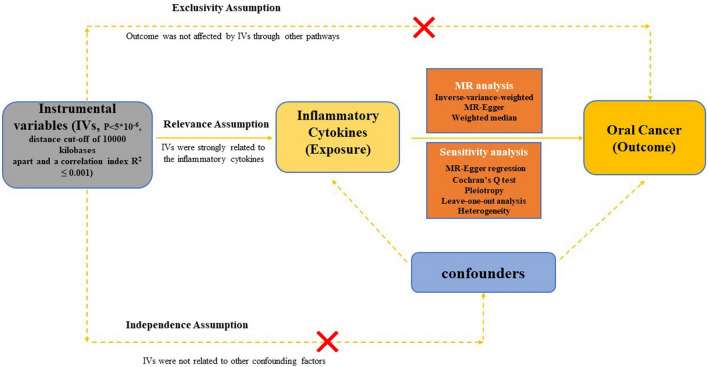
Objectives: This study aims to use Mendelian randomisation to identify the causal relationship between a spectrum of 41 inflammatory cytokines and the development of oropharyngeal cancer.
Methods: This study investigated genetic variants that have been associated with oral and oropharyngeal cancer using data from a large GWAS. Inflammatory cytokine data were obtained from 8293 asymptomatic individuals. The study primarily used inverse variance weighted and MR-Egger methods to determine the causal relationship between inflammatory cytokines and cancer incidence, complemented by a series of sensitivity analyses including MR-Egger, simple mode, weighted mode, weighted median and leave-one-out approaches.
Results: Our study demonstrates that higher levels of interleukin-7 (IL-7) and interleukin-5 (IL-5) slightly increase the odds of oropharyngeal cancer by 0.07% [OR: 1.0007, p = 0.005] and 0.04% [OR: 1.0004, p = 0.015], corresponding to a modest increase. Similarly, increased PDGF-bb and CTACK levels are modestly associated with increased odds of oral and oropharyngeal cancer by 0.22% [OR: 1.0022, p = 0.031] and 0.17% [OR: 1.0017, p = 0.043], respectively.
Conclusion: This investigation posits that IL-5 and IL-7 may be pertinent factors in the etiology of Oropharyngeal cancer, while PDGF bb and CTACK are likely implicated in the pathogenesis of both oral and oropharyngeal cancers.






 京公网安备 11010802042870号
京ICP备2023020795号-1
京公网安备 11010802042870号
京ICP备2023020795号-1

 分享
分享
 求助内容:
求助内容: 应助结果提醒方式:
 扫码关注我们
