Eva Maria Støa, Bent Rønnestad, Jan Helgerud, Jan-Michael Johansen, Ingvild Tronstad Andersen, Torkil Rogneflåten, Anders Sørensen, Øyvind Støren
{"title":"年轻精英自行车运动员的短时间骑行表现:与最大有氧能力有关,而与最大累积缺氧无关。","authors":"Eva Maria Støa, Bent Rønnestad, Jan Helgerud, Jan-Michael Johansen, Ingvild Tronstad Andersen, Torkil Rogneflåten, Anders Sørensen, Øyvind Støren","doi":"10.3389/fphys.2024.1536874","DOIUrl":null,"url":null,"abstract":"<p><strong>Purpose: </strong>To explore the relationships between performance variables and physiological variables in a short-time (2-3 min) cycling time trial (TT) on a cycle ergometer.</p><p><strong>Methods: </strong>Fifteen young elite cyclists (age: 17.3 ± 0.7 years, maximal oxygen uptake (VO<sub>2max</sub>): 76.6 ± 5.2 mL⋅kg<sup>-1</sup>⋅min<sup>-1</sup>) participated in this study. Maximal aerobic power (MAP), maximal anaerobic power (MANP), time to exhaustion at 130% of maximal aerobic power (TTE), maximal accumulated oxygen deficit (MAOD) in the TT, anaerobic power reserve (APR) and lactate threshold (LT) was tested. MAP was calculated as VO<sub>2max</sub>/oxygen cost of cycling (C<sub>C</sub>), MANP was determined as mean power output (W) during a 10 s maximal cycling sprint test, and MAOD was calculated as (VO<sub>2</sub> demand - VO<sub>2</sub> measured) ∙ time. APR was calculated as the relative difference between MAP and MANP.</p><p><strong>Results: </strong>There was a strong correlation between MAP and TT time (r = -0.91, p < 0.01) with a standard error of estimate (SEE) of 4.4%, and a moderate association between MANP and TT time (r = -0.47, p = 0.04). Neither MAOD, TTE, LT nor APR correlated with TT.</p><p><strong>Conclusion: </strong>MAP was highly correlated with TT with a SEE of 4.4%. Since neither TTE nor MAOD correlated with TT, this indicates that these two variables do not play a significant role in differentiating short-time endurance cycling performance. We suggest training for improving MAP and, or MANP to improve short-time endurance cycling performance.</p>","PeriodicalId":12477,"journal":{"name":"Frontiers in Physiology","volume":"15 ","pages":"1536874"},"PeriodicalIF":4.3000,"publicationDate":"2025-01-10","publicationTypes":"Journal Article","fieldsOfStudy":null,"isOpenAccess":false,"openAccessPdf":"https://www.ncbi.nlm.nih.gov/pmc/articles/PMC11757254/pdf/","citationCount":"0","resultStr":"{\"title\":\"Short-time cycling performance in young elite cyclists: related to maximal aerobic power and not to maximal accumulated oxygen deficit.\",\"authors\":\"Eva Maria Støa, Bent Rønnestad, Jan Helgerud, Jan-Michael Johansen, Ingvild Tronstad Andersen, Torkil Rogneflåten, Anders Sørensen, Øyvind Støren\",\"doi\":\"10.3389/fphys.2024.1536874\",\"DOIUrl\":null,\"url\":null,\"abstract\":\"<p><strong>Purpose: </strong>To explore the relationships between performance variables and physiological variables in a short-time (2-3 min) cycling time trial (TT) on a cycle ergometer.</p><p><strong>Methods: </strong>Fifteen young elite cyclists (age: 17.3 ± 0.7 years, maximal oxygen uptake (VO<sub>2max</sub>): 76.6 ± 5.2 mL⋅kg<sup>-1</sup>⋅min<sup>-1</sup>) participated in this study. Maximal aerobic power (MAP), maximal anaerobic power (MANP), time to exhaustion at 130% of maximal aerobic power (TTE), maximal accumulated oxygen deficit (MAOD) in the TT, anaerobic power reserve (APR) and lactate threshold (LT) was tested. MAP was calculated as VO<sub>2max</sub>/oxygen cost of cycling (C<sub>C</sub>), MANP was determined as mean power output (W) during a 10 s maximal cycling sprint test, and MAOD was calculated as (VO<sub>2</sub> demand - VO<sub>2</sub> measured) ∙ time. APR was calculated as the relative difference between MAP and MANP.</p><p><strong>Results: </strong>There was a strong correlation between MAP and TT time (r = -0.91, p < 0.01) with a standard error of estimate (SEE) of 4.4%, and a moderate association between MANP and TT time (r = -0.47, p = 0.04). Neither MAOD, TTE, LT nor APR correlated with TT.</p><p><strong>Conclusion: </strong>MAP was highly correlated with TT with a SEE of 4.4%. Since neither TTE nor MAOD correlated with TT, this indicates that these two variables do not play a significant role in differentiating short-time endurance cycling performance. We suggest training for improving MAP and, or MANP to improve short-time endurance cycling performance.</p>\",\"PeriodicalId\":12477,\"journal\":{\"name\":\"Frontiers in Physiology\",\"volume\":\"15 \",\"pages\":\"1536874\"},\"PeriodicalIF\":4.3000,\"publicationDate\":\"2025-01-10\",\"publicationTypes\":\"Journal Article\",\"fieldsOfStudy\":null,\"isOpenAccess\":false,\"openAccessPdf\":\"https://www.ncbi.nlm.nih.gov/pmc/articles/PMC11757254/pdf/\",\"citationCount\":\"0\",\"resultStr\":null,\"platform\":\"Semanticscholar\",\"paperid\":null,\"PeriodicalName\":\"Frontiers in Physiology\",\"FirstCategoryId\":\"3\",\"ListUrlMain\":\"https://doi.org/10.3389/fphys.2024.1536874\",\"RegionNum\":3,\"RegionCategory\":\"医学\",\"ArticlePicture\":[],\"TitleCN\":null,\"AbstractTextCN\":null,\"PMCID\":null,\"EPubDate\":\"2024/1/1 0:00:00\",\"PubModel\":\"eCollection\",\"JCR\":\"Q2\",\"JCRName\":\"PHYSIOLOGY\",\"Score\":null,\"Total\":0}","platform":"Semanticscholar","paperid":null,"PeriodicalName":"Frontiers in Physiology","FirstCategoryId":"3","ListUrlMain":"https://doi.org/10.3389/fphys.2024.1536874","RegionNum":3,"RegionCategory":"医学","ArticlePicture":[],"TitleCN":null,"AbstractTextCN":null,"PMCID":null,"EPubDate":"2024/1/1 0:00:00","PubModel":"eCollection","JCR":"Q2","JCRName":"PHYSIOLOGY","Score":null,"Total":0}
引用次数: 0
摘要
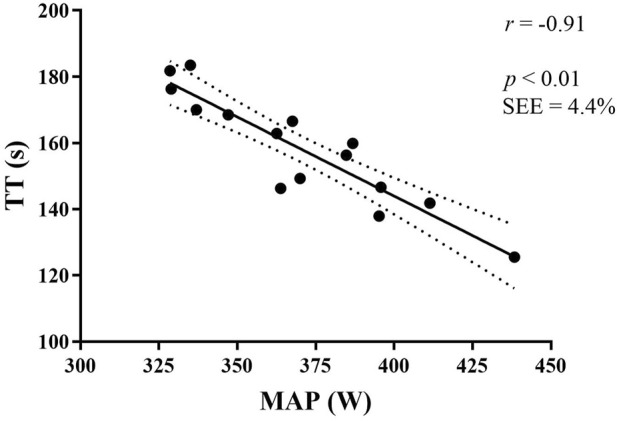
目的:探讨短时间(2-3 min)自行车计时赛(TT)中运动表现变量与生理变量之间的关系。方法:选取年龄17.3±0.7岁,最大摄氧量(VO2max) 76.6±5.2 mL⋅kg-1⋅min-1的15名青年优秀自行车运动员作为研究对象。测试了最大有氧能力(MAP)、最大无氧能力(MANP)、最大有氧能力130%时的衰竭时间(TTE)、最大累积氧亏(MAOD)、无氧能力储备(APR)和乳酸门槛(LT)。MAP计算为最大耗氧量(VO2max) /循环耗氧量(CC), MANP计算为10 s最大循环冲刺试验的平均功率输出(W), mad计算为(VO2需求-测量VO2)∙时间。APR计算为MAP与MANP的相对差值。结果:MAP与TT时间有很强的相关性(r = -0.91, p < 0.01),估计标准误差(SEE)为4.4%;MANP与TT时间有中度相关性(r = -0.47, p = 0.04)。mod、TTE、LT和APR与TT均无相关性。结论:MAP与TT高度相关,SEE为4.4%。由于TTE和MAOD都与TT无关,这表明这两个变量在区分短时间耐力循环性能方面没有显著作用。我们建议通过提高MAP和MANP的训练来提高短时间耐力骑行的表现。
Short-time cycling performance in young elite cyclists: related to maximal aerobic power and not to maximal accumulated oxygen deficit.
Purpose: To explore the relationships between performance variables and physiological variables in a short-time (2-3 min) cycling time trial (TT) on a cycle ergometer.
Methods: Fifteen young elite cyclists (age: 17.3 ± 0.7 years, maximal oxygen uptake (VO2max): 76.6 ± 5.2 mL⋅kg-1⋅min-1) participated in this study. Maximal aerobic power (MAP), maximal anaerobic power (MANP), time to exhaustion at 130% of maximal aerobic power (TTE), maximal accumulated oxygen deficit (MAOD) in the TT, anaerobic power reserve (APR) and lactate threshold (LT) was tested. MAP was calculated as VO2max/oxygen cost of cycling (CC), MANP was determined as mean power output (W) during a 10 s maximal cycling sprint test, and MAOD was calculated as (VO2 demand - VO2 measured) ∙ time. APR was calculated as the relative difference between MAP and MANP.
Results: There was a strong correlation between MAP and TT time (r = -0.91, p < 0.01) with a standard error of estimate (SEE) of 4.4%, and a moderate association between MANP and TT time (r = -0.47, p = 0.04). Neither MAOD, TTE, LT nor APR correlated with TT.
Conclusion: MAP was highly correlated with TT with a SEE of 4.4%. Since neither TTE nor MAOD correlated with TT, this indicates that these two variables do not play a significant role in differentiating short-time endurance cycling performance. We suggest training for improving MAP and, or MANP to improve short-time endurance cycling performance.
期刊介绍:
Frontiers in Physiology is a leading journal in its field, publishing rigorously peer-reviewed research on the physiology of living systems, from the subcellular and molecular domains to the intact organism, and its interaction with the environment. Field Chief Editor George E. Billman at the Ohio State University Columbus is supported by an outstanding Editorial Board of international researchers. This multidisciplinary open-access journal is at the forefront of disseminating and communicating scientific knowledge and impactful discoveries to researchers, academics, clinicians and the public worldwide.






 京公网安备 11010802042870号
京ICP备2023020795号-1
京公网安备 11010802042870号
京ICP备2023020795号-1

 分享
分享
 求助内容:
求助内容: 应助结果提醒方式:
 扫码关注我们
