{"title":"2005-2017年台湾地区乳腺癌、结直肠癌、口腔癌及子宫颈癌DALY趋势","authors":"Chun-Hui Lin, Cheng-Chieh Hsieh, Si-Yu Chen, Hong-Ru Chen, Szu-Chieh Chen","doi":"10.1016/j.heliyon.2025.e41686","DOIUrl":null,"url":null,"abstract":"<p><strong>Objectives: </strong>This study used the Disability-Adjusted Life Years (DALYs) to quantify the long-term trends for four cancers (oral cancer, colorectal cancer, breast cancer, and cervical cancer) that have undergone cancer screening in Taiwan.</p><p><strong>Methods: </strong>DALYs were calculated as the sum of Years of Life Lost (YLL) due to premature mortality and Years Lived with Disability (YLD). YLLs were determined using cancer-specific mortality data from the Health Promotion Administration (HPA), Ministry of Health and Welfare, based on age-specific life expectancy. YLDs were estimated by combining the incidence rates of the cancers, average disability durations, and disability weights, with data sourced from the Taiwan Cancer Registry. Results were expressed as DALYs per 100,000 population.</p><p><strong>Results: </strong>The disease burden has significantly increased over the past 12 years. Oral cancer rose from 263 to 368 DALYs per 100,000 population (40 % increase), colorectal cancer from 343 to 563 DALYs (64 % increase), and breast cancer from 446 to 782 DALYs (75 % increase), while the burden of cervical cancer decreased from 168 to 147 DALYs per 100,000 population from 2010 to 2017, showing a 13 % reduction. At the cancer stages, the impact of YLDs was mostly at cancer stage IV (oral cancer), cancer stage 0 (colorectal and cervical cancer), and stage I (breast cancer).</p><p><strong>Conclusion: </strong>Oral cancer increased by 40 %, colorectal cancer by 64 %, and breast cancer by 75 % from 2005 to 2017, while cervical cancer decreased by 13 % between 2010 and 2017. YLD contributions were highest in stage IV for oral cancer, stage 0 for colorectal and cervical cancers, and stage I for breast cancer. The highest DALYs consistently occurred in the 50-69 age group across all cancer types, highlighting the significant burden on middle-aged populations.</p>","PeriodicalId":12894,"journal":{"name":"Heliyon","volume":"11 1","pages":"e41686"},"PeriodicalIF":3.6000,"publicationDate":"2025-01-06","publicationTypes":"Journal Article","fieldsOfStudy":null,"isOpenAccess":false,"openAccessPdf":"https://www.ncbi.nlm.nih.gov/pmc/articles/PMC11760321/pdf/","citationCount":"0","resultStr":"{\"title\":\"The trend of DALY of breast, colorectal, oral, and cervical cancers in Taiwan in 2005-2017.\",\"authors\":\"Chun-Hui Lin, Cheng-Chieh Hsieh, Si-Yu Chen, Hong-Ru Chen, Szu-Chieh Chen\",\"doi\":\"10.1016/j.heliyon.2025.e41686\",\"DOIUrl\":null,\"url\":null,\"abstract\":\"<p><strong>Objectives: </strong>This study used the Disability-Adjusted Life Years (DALYs) to quantify the long-term trends for four cancers (oral cancer, colorectal cancer, breast cancer, and cervical cancer) that have undergone cancer screening in Taiwan.</p><p><strong>Methods: </strong>DALYs were calculated as the sum of Years of Life Lost (YLL) due to premature mortality and Years Lived with Disability (YLD). YLLs were determined using cancer-specific mortality data from the Health Promotion Administration (HPA), Ministry of Health and Welfare, based on age-specific life expectancy. YLDs were estimated by combining the incidence rates of the cancers, average disability durations, and disability weights, with data sourced from the Taiwan Cancer Registry. Results were expressed as DALYs per 100,000 population.</p><p><strong>Results: </strong>The disease burden has significantly increased over the past 12 years. Oral cancer rose from 263 to 368 DALYs per 100,000 population (40 % increase), colorectal cancer from 343 to 563 DALYs (64 % increase), and breast cancer from 446 to 782 DALYs (75 % increase), while the burden of cervical cancer decreased from 168 to 147 DALYs per 100,000 population from 2010 to 2017, showing a 13 % reduction. At the cancer stages, the impact of YLDs was mostly at cancer stage IV (oral cancer), cancer stage 0 (colorectal and cervical cancer), and stage I (breast cancer).</p><p><strong>Conclusion: </strong>Oral cancer increased by 40 %, colorectal cancer by 64 %, and breast cancer by 75 % from 2005 to 2017, while cervical cancer decreased by 13 % between 2010 and 2017. YLD contributions were highest in stage IV for oral cancer, stage 0 for colorectal and cervical cancers, and stage I for breast cancer. The highest DALYs consistently occurred in the 50-69 age group across all cancer types, highlighting the significant burden on middle-aged populations.</p>\",\"PeriodicalId\":12894,\"journal\":{\"name\":\"Heliyon\",\"volume\":\"11 1\",\"pages\":\"e41686\"},\"PeriodicalIF\":3.6000,\"publicationDate\":\"2025-01-06\",\"publicationTypes\":\"Journal Article\",\"fieldsOfStudy\":null,\"isOpenAccess\":false,\"openAccessPdf\":\"https://www.ncbi.nlm.nih.gov/pmc/articles/PMC11760321/pdf/\",\"citationCount\":\"0\",\"resultStr\":null,\"platform\":\"Semanticscholar\",\"paperid\":null,\"PeriodicalName\":\"Heliyon\",\"FirstCategoryId\":\"103\",\"ListUrlMain\":\"https://doi.org/10.1016/j.heliyon.2025.e41686\",\"RegionNum\":3,\"RegionCategory\":\"综合性期刊\",\"ArticlePicture\":[],\"TitleCN\":null,\"AbstractTextCN\":null,\"PMCID\":null,\"EPubDate\":\"2025/1/15 0:00:00\",\"PubModel\":\"eCollection\",\"JCR\":\"Q1\",\"JCRName\":\"MULTIDISCIPLINARY SCIENCES\",\"Score\":null,\"Total\":0}","platform":"Semanticscholar","paperid":null,"PeriodicalName":"Heliyon","FirstCategoryId":"103","ListUrlMain":"https://doi.org/10.1016/j.heliyon.2025.e41686","RegionNum":3,"RegionCategory":"综合性期刊","ArticlePicture":[],"TitleCN":null,"AbstractTextCN":null,"PMCID":null,"EPubDate":"2025/1/15 0:00:00","PubModel":"eCollection","JCR":"Q1","JCRName":"MULTIDISCIPLINARY SCIENCES","Score":null,"Total":0}
The trend of DALY of breast, colorectal, oral, and cervical cancers in Taiwan in 2005-2017.
Objectives: This study used the Disability-Adjusted Life Years (DALYs) to quantify the long-term trends for four cancers (oral cancer, colorectal cancer, breast cancer, and cervical cancer) that have undergone cancer screening in Taiwan.
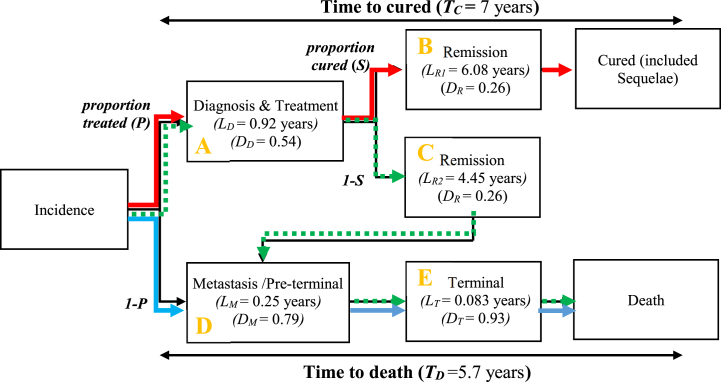
Methods: DALYs were calculated as the sum of Years of Life Lost (YLL) due to premature mortality and Years Lived with Disability (YLD). YLLs were determined using cancer-specific mortality data from the Health Promotion Administration (HPA), Ministry of Health and Welfare, based on age-specific life expectancy. YLDs were estimated by combining the incidence rates of the cancers, average disability durations, and disability weights, with data sourced from the Taiwan Cancer Registry. Results were expressed as DALYs per 100,000 population.
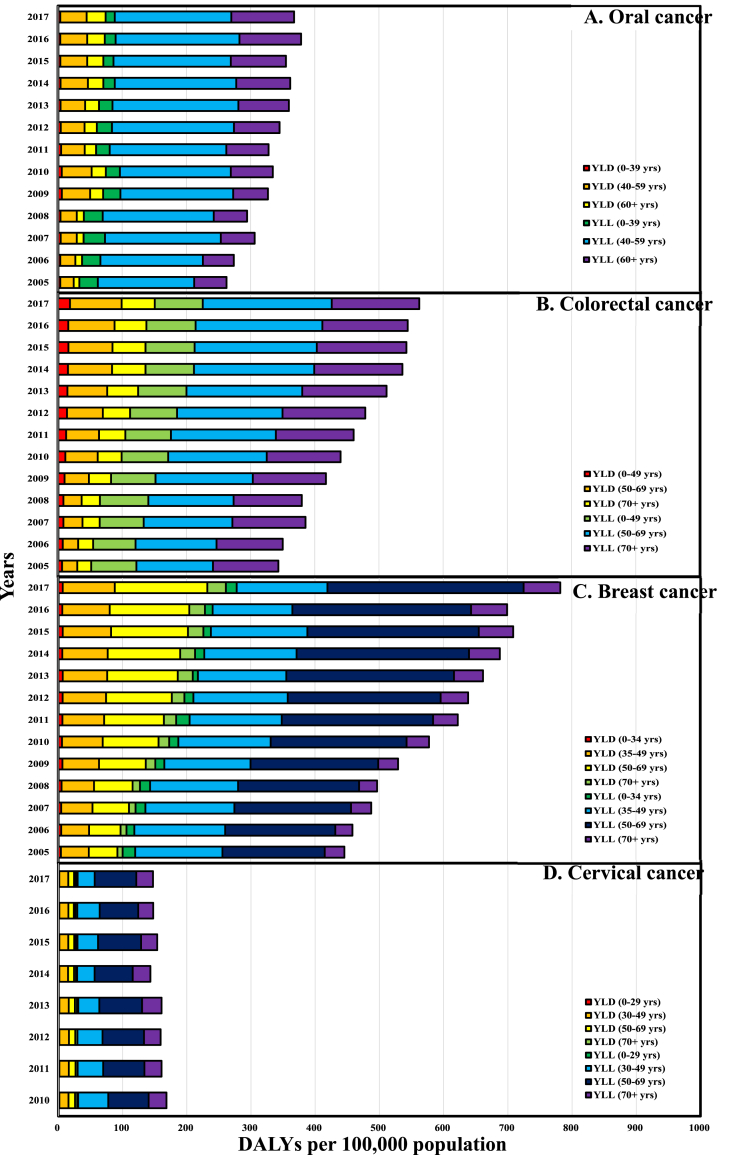
Results: The disease burden has significantly increased over the past 12 years. Oral cancer rose from 263 to 368 DALYs per 100,000 population (40 % increase), colorectal cancer from 343 to 563 DALYs (64 % increase), and breast cancer from 446 to 782 DALYs (75 % increase), while the burden of cervical cancer decreased from 168 to 147 DALYs per 100,000 population from 2010 to 2017, showing a 13 % reduction. At the cancer stages, the impact of YLDs was mostly at cancer stage IV (oral cancer), cancer stage 0 (colorectal and cervical cancer), and stage I (breast cancer).
Conclusion: Oral cancer increased by 40 %, colorectal cancer by 64 %, and breast cancer by 75 % from 2005 to 2017, while cervical cancer decreased by 13 % between 2010 and 2017. YLD contributions were highest in stage IV for oral cancer, stage 0 for colorectal and cervical cancers, and stage I for breast cancer. The highest DALYs consistently occurred in the 50-69 age group across all cancer types, highlighting the significant burden on middle-aged populations.
期刊介绍:
Heliyon is an all-science, open access journal that is part of the Cell Press family. Any paper reporting scientifically accurate and valuable research, which adheres to accepted ethical and scientific publishing standards, will be considered for publication. Our growing team of dedicated section editors, along with our in-house team, handle your paper and manage the publication process end-to-end, giving your research the editorial support it deserves.






 京公网安备 11010802042870号
京ICP备2023020795号-1
京公网安备 11010802042870号
京ICP备2023020795号-1

 分享
分享
 求助内容:
求助内容: 应助结果提醒方式:
 扫码关注我们
