{"title":"大肠杆菌GcvB小RNA对芳香氨基酸代谢的转录后调控。","authors":"Takeshi Kanda, Toshiko Sekijima, Masatoshi Miyakoshi","doi":"10.1128/spectrum.02035-24","DOIUrl":null,"url":null,"abstract":"<p><p><i>Escherichia coli</i> synthesizes aromatic amino acids (AAAs) through the common pathway to produce the precursor, chorismate, and the three terminal pathways to convert chorismate into Phe, Tyr, and Trp. <i>E. coli</i> also imports exogenous AAAs through five transporters. GcvB small RNA post-transcriptionally regulates more than 50 genes involved in amino acid uptake and biosynthesis in <i>E. coli</i>, but the full extent of GcvB regulon is still underestimated. This study examined all genes involved in AAA biosynthesis and transport using translation reporter assay and qRT-PCR analysis. In addition to previously verified targets, <i>aroC</i>, <i>aroP</i>, and <i>trpE</i>, we identified new target genes that were significantly repressed by GcvB primarily via the R1 seed region. Exceptionally, GcvB strongly inhibits the expression of <i>aroG</i>, which encodes the major isozyme of the first reaction in the common pathway, through direct base pairing between the <i>aroG</i> translation initiation region and the GcvB R3 seed sequence. RNase E mediates the degradation of target mRNAs except <i>aroC</i> and <i>aroP</i> via its C-terminal domain. GcvB overexpression prolongs the lag phase and reduces the growth rate in minimal media supplemented with AAAs and confers resistance to an antibiotic compound, azaserine, by repressing AAA transporters.IMPORTANCE<i>E. coli</i> strains have been genetically modified in relevant transcription factors and biosynthetic enzymes for industrial use in the fermentative production of aromatic amino acids (AAAs) and their derivative compounds. This study focuses on GcvB small RNA, a global regulator of amino acid metabolism in <i>E. coli</i>, and identifies new GcvB targets involved in AAA biosynthesis and uptake. GcvB represses the expression of the first and last enzymes of the common pathway and the first enzymes of Trp and Phe terminal pathways. GcvB also limits import of AAAs. This paper documents the impact of RNA-mediated regulation on AAA metabolism in <i>E. coli</i>.</p>","PeriodicalId":18670,"journal":{"name":"Microbiology spectrum","volume":" ","pages":"e0203524"},"PeriodicalIF":3.8000,"publicationDate":"2025-03-04","publicationTypes":"Journal Article","fieldsOfStudy":null,"isOpenAccess":false,"openAccessPdf":"https://www.ncbi.nlm.nih.gov/pmc/articles/PMC11878033/pdf/","citationCount":"0","resultStr":"{\"title\":\"Post-transcriptional regulation of aromatic amino acid metabolism by GcvB small RNA in <i>Escherichia coli</i>.\",\"authors\":\"Takeshi Kanda, Toshiko Sekijima, Masatoshi Miyakoshi\",\"doi\":\"10.1128/spectrum.02035-24\",\"DOIUrl\":null,\"url\":null,\"abstract\":\"<p><p><i>Escherichia coli</i> synthesizes aromatic amino acids (AAAs) through the common pathway to produce the precursor, chorismate, and the three terminal pathways to convert chorismate into Phe, Tyr, and Trp. <i>E. coli</i> also imports exogenous AAAs through five transporters. GcvB small RNA post-transcriptionally regulates more than 50 genes involved in amino acid uptake and biosynthesis in <i>E. coli</i>, but the full extent of GcvB regulon is still underestimated. This study examined all genes involved in AAA biosynthesis and transport using translation reporter assay and qRT-PCR analysis. In addition to previously verified targets, <i>aroC</i>, <i>aroP</i>, and <i>trpE</i>, we identified new target genes that were significantly repressed by GcvB primarily via the R1 seed region. Exceptionally, GcvB strongly inhibits the expression of <i>aroG</i>, which encodes the major isozyme of the first reaction in the common pathway, through direct base pairing between the <i>aroG</i> translation initiation region and the GcvB R3 seed sequence. RNase E mediates the degradation of target mRNAs except <i>aroC</i> and <i>aroP</i> via its C-terminal domain. GcvB overexpression prolongs the lag phase and reduces the growth rate in minimal media supplemented with AAAs and confers resistance to an antibiotic compound, azaserine, by repressing AAA transporters.IMPORTANCE<i>E. coli</i> strains have been genetically modified in relevant transcription factors and biosynthetic enzymes for industrial use in the fermentative production of aromatic amino acids (AAAs) and their derivative compounds. This study focuses on GcvB small RNA, a global regulator of amino acid metabolism in <i>E. coli</i>, and identifies new GcvB targets involved in AAA biosynthesis and uptake. GcvB represses the expression of the first and last enzymes of the common pathway and the first enzymes of Trp and Phe terminal pathways. GcvB also limits import of AAAs. This paper documents the impact of RNA-mediated regulation on AAA metabolism in <i>E. coli</i>.</p>\",\"PeriodicalId\":18670,\"journal\":{\"name\":\"Microbiology spectrum\",\"volume\":\" \",\"pages\":\"e0203524\"},\"PeriodicalIF\":3.8000,\"publicationDate\":\"2025-03-04\",\"publicationTypes\":\"Journal Article\",\"fieldsOfStudy\":null,\"isOpenAccess\":false,\"openAccessPdf\":\"https://www.ncbi.nlm.nih.gov/pmc/articles/PMC11878033/pdf/\",\"citationCount\":\"0\",\"resultStr\":null,\"platform\":\"Semanticscholar\",\"paperid\":null,\"PeriodicalName\":\"Microbiology spectrum\",\"FirstCategoryId\":\"99\",\"ListUrlMain\":\"https://doi.org/10.1128/spectrum.02035-24\",\"RegionNum\":2,\"RegionCategory\":\"生物学\",\"ArticlePicture\":[],\"TitleCN\":null,\"AbstractTextCN\":null,\"PMCID\":null,\"EPubDate\":\"2025/1/27 0:00:00\",\"PubModel\":\"Epub\",\"JCR\":\"Q2\",\"JCRName\":\"MICROBIOLOGY\",\"Score\":null,\"Total\":0}","platform":"Semanticscholar","paperid":null,"PeriodicalName":"Microbiology spectrum","FirstCategoryId":"99","ListUrlMain":"https://doi.org/10.1128/spectrum.02035-24","RegionNum":2,"RegionCategory":"生物学","ArticlePicture":[],"TitleCN":null,"AbstractTextCN":null,"PMCID":null,"EPubDate":"2025/1/27 0:00:00","PubModel":"Epub","JCR":"Q2","JCRName":"MICROBIOLOGY","Score":null,"Total":0}
Post-transcriptional regulation of aromatic amino acid metabolism by GcvB small RNA in Escherichia coli.
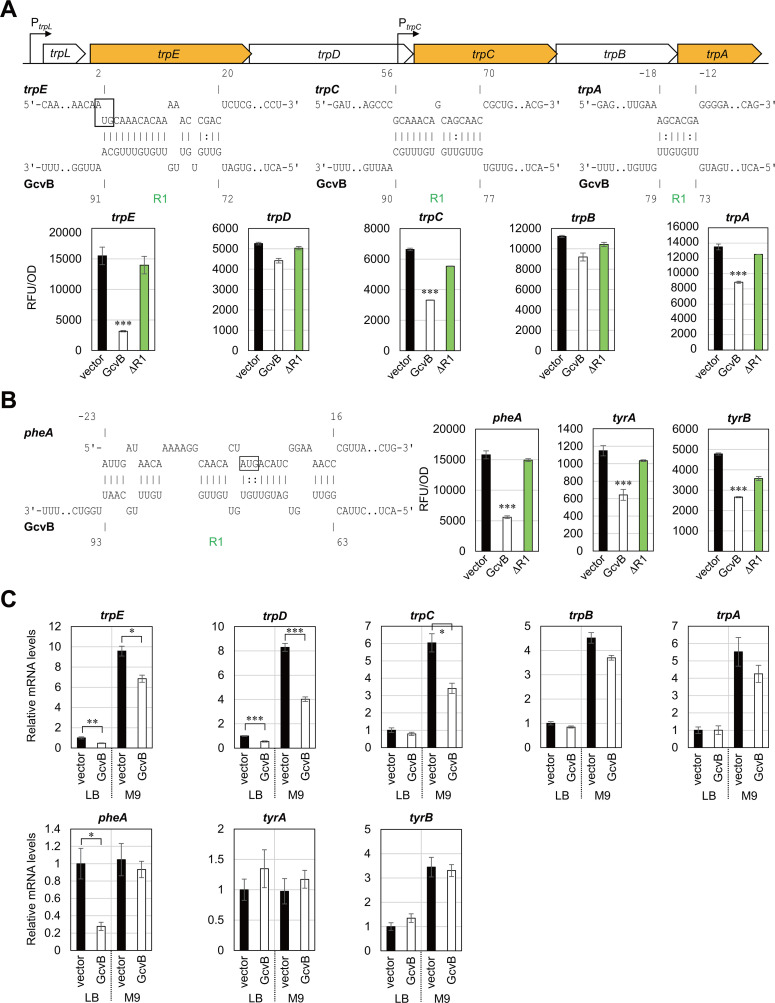
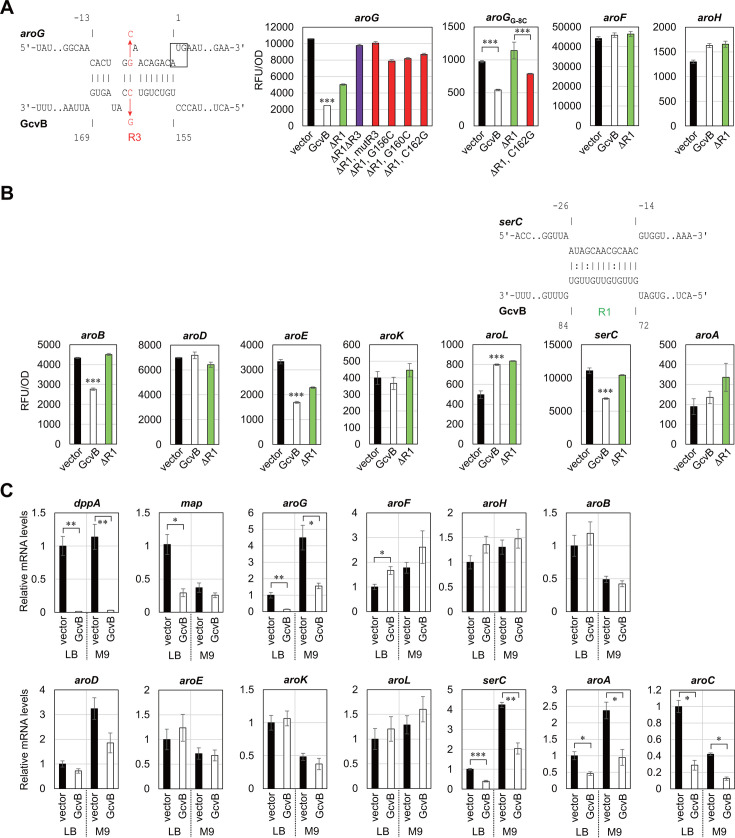
Escherichia coli synthesizes aromatic amino acids (AAAs) through the common pathway to produce the precursor, chorismate, and the three terminal pathways to convert chorismate into Phe, Tyr, and Trp. E. coli also imports exogenous AAAs through five transporters. GcvB small RNA post-transcriptionally regulates more than 50 genes involved in amino acid uptake and biosynthesis in E. coli, but the full extent of GcvB regulon is still underestimated. This study examined all genes involved in AAA biosynthesis and transport using translation reporter assay and qRT-PCR analysis. In addition to previously verified targets, aroC, aroP, and trpE, we identified new target genes that were significantly repressed by GcvB primarily via the R1 seed region. Exceptionally, GcvB strongly inhibits the expression of aroG, which encodes the major isozyme of the first reaction in the common pathway, through direct base pairing between the aroG translation initiation region and the GcvB R3 seed sequence. RNase E mediates the degradation of target mRNAs except aroC and aroP via its C-terminal domain. GcvB overexpression prolongs the lag phase and reduces the growth rate in minimal media supplemented with AAAs and confers resistance to an antibiotic compound, azaserine, by repressing AAA transporters.IMPORTANCEE. coli strains have been genetically modified in relevant transcription factors and biosynthetic enzymes for industrial use in the fermentative production of aromatic amino acids (AAAs) and their derivative compounds. This study focuses on GcvB small RNA, a global regulator of amino acid metabolism in E. coli, and identifies new GcvB targets involved in AAA biosynthesis and uptake. GcvB represses the expression of the first and last enzymes of the common pathway and the first enzymes of Trp and Phe terminal pathways. GcvB also limits import of AAAs. This paper documents the impact of RNA-mediated regulation on AAA metabolism in E. coli.
期刊介绍:
Microbiology Spectrum publishes commissioned review articles on topics in microbiology representing ten content areas: Archaea; Food Microbiology; Bacterial Genetics, Cell Biology, and Physiology; Clinical Microbiology; Environmental Microbiology and Ecology; Eukaryotic Microbes; Genomics, Computational, and Synthetic Microbiology; Immunology; Pathogenesis; and Virology. Reviews are interrelated, with each review linking to other related content. A large board of Microbiology Spectrum editors aids in the development of topics for potential reviews and in the identification of an editor, or editors, who shepherd each collection.





 京公网安备 11010802042870号
京ICP备2023020795号-1
京公网安备 11010802042870号
京ICP备2023020795号-1

 分享
分享
 求助内容:
求助内容: 应助结果提醒方式:
 扫码关注我们
