Chunyan Liu, Qinan Yin, Zhaoying Wu, Wenhui Li, Jun Huang, Bo Chen, Yanjun Yang, Xuewei Zheng, Li Zeng, Jingjing Wang
{"title":"卵巢癌的炎症和免疫逃逸:途径和治疗机会。","authors":"Chunyan Liu, Qinan Yin, Zhaoying Wu, Wenhui Li, Jun Huang, Bo Chen, Yanjun Yang, Xuewei Zheng, Li Zeng, Jingjing Wang","doi":"10.2147/JIR.S503479","DOIUrl":null,"url":null,"abstract":"<p><p>Ovarian cancer (OC) remains one of the most lethal gynecological malignancies, largely due to its late-stage diagnosis and high recurrence rates. Chronic inflammation is a critical driver of OC progression, contributing to immune evasion, tumor growth, and metastasis. Inflammatory cytokines, including IL-6, TNF-α, and IL-8, as well as key signaling pathways such as nuclear factor kappa B (NF-kB) and signal transducer and activator of transcription 3 (STAT3), are upregulated in OC, promoting a tumor-promoting environment. The tumor microenvironment (TME) is characterized by immune cells like tumor-associated macrophages (TAMs) and regulatory T cells (Tregs), which suppress anti-tumor immune responses, facilitating immune evasion. Furthermore, OC cells utilize immune checkpoint pathways, including PD-1/PD-L1, to inhibit cytotoxic T cell activity. Targeting these inflammatory and immune evasion mechanisms offers promising therapeutic strategies. COX-2 inhibitors, Janus kinase/signal transducer and activator of transcription (JAK/STAT) pathway blockers, and NF-kB inhibitors have shown potential in preclinical studies, while immune checkpoint inhibitors targeting PD-1/PD-L1 and CTLA-4 have been explored with mixed results in OC. Additionally, emerging research on the microbiome and inflammation-related biomarkers, such as microRNAs (miRNAs) and exosomes, points to new opportunities for early detection and precision medicine. Future approaches to OC treatment must focus on personalized strategies that target the inflammatory TME, integrating anti-inflammatory therapies with immunotherapy to enhance patient outcomes. Continued research into the interplay between inflammation and immune evasion in OC is essential for developing effective, long-lasting treatments.</p>","PeriodicalId":16107,"journal":{"name":"Journal of Inflammation Research","volume":"18 ","pages":"895-909"},"PeriodicalIF":4.1000,"publicationDate":"2025-01-21","publicationTypes":"Journal Article","fieldsOfStudy":null,"isOpenAccess":false,"openAccessPdf":"https://www.ncbi.nlm.nih.gov/pmc/articles/PMC11762012/pdf/","citationCount":"0","resultStr":"{\"title\":\"Inflammation and Immune Escape in Ovarian Cancer: Pathways and Therapeutic Opportunities.\",\"authors\":\"Chunyan Liu, Qinan Yin, Zhaoying Wu, Wenhui Li, Jun Huang, Bo Chen, Yanjun Yang, Xuewei Zheng, Li Zeng, Jingjing Wang\",\"doi\":\"10.2147/JIR.S503479\",\"DOIUrl\":null,\"url\":null,\"abstract\":\"<p><p>Ovarian cancer (OC) remains one of the most lethal gynecological malignancies, largely due to its late-stage diagnosis and high recurrence rates. Chronic inflammation is a critical driver of OC progression, contributing to immune evasion, tumor growth, and metastasis. Inflammatory cytokines, including IL-6, TNF-α, and IL-8, as well as key signaling pathways such as nuclear factor kappa B (NF-kB) and signal transducer and activator of transcription 3 (STAT3), are upregulated in OC, promoting a tumor-promoting environment. The tumor microenvironment (TME) is characterized by immune cells like tumor-associated macrophages (TAMs) and regulatory T cells (Tregs), which suppress anti-tumor immune responses, facilitating immune evasion. Furthermore, OC cells utilize immune checkpoint pathways, including PD-1/PD-L1, to inhibit cytotoxic T cell activity. Targeting these inflammatory and immune evasion mechanisms offers promising therapeutic strategies. COX-2 inhibitors, Janus kinase/signal transducer and activator of transcription (JAK/STAT) pathway blockers, and NF-kB inhibitors have shown potential in preclinical studies, while immune checkpoint inhibitors targeting PD-1/PD-L1 and CTLA-4 have been explored with mixed results in OC. Additionally, emerging research on the microbiome and inflammation-related biomarkers, such as microRNAs (miRNAs) and exosomes, points to new opportunities for early detection and precision medicine. Future approaches to OC treatment must focus on personalized strategies that target the inflammatory TME, integrating anti-inflammatory therapies with immunotherapy to enhance patient outcomes. Continued research into the interplay between inflammation and immune evasion in OC is essential for developing effective, long-lasting treatments.</p>\",\"PeriodicalId\":16107,\"journal\":{\"name\":\"Journal of Inflammation Research\",\"volume\":\"18 \",\"pages\":\"895-909\"},\"PeriodicalIF\":4.1000,\"publicationDate\":\"2025-01-21\",\"publicationTypes\":\"Journal Article\",\"fieldsOfStudy\":null,\"isOpenAccess\":false,\"openAccessPdf\":\"https://www.ncbi.nlm.nih.gov/pmc/articles/PMC11762012/pdf/\",\"citationCount\":\"0\",\"resultStr\":null,\"platform\":\"Semanticscholar\",\"paperid\":null,\"PeriodicalName\":\"Journal of Inflammation Research\",\"FirstCategoryId\":\"3\",\"ListUrlMain\":\"https://doi.org/10.2147/JIR.S503479\",\"RegionNum\":2,\"RegionCategory\":\"医学\",\"ArticlePicture\":[],\"TitleCN\":null,\"AbstractTextCN\":null,\"PMCID\":null,\"EPubDate\":\"2025/1/1 0:00:00\",\"PubModel\":\"eCollection\",\"JCR\":\"Q2\",\"JCRName\":\"IMMUNOLOGY\",\"Score\":null,\"Total\":0}","platform":"Semanticscholar","paperid":null,"PeriodicalName":"Journal of Inflammation Research","FirstCategoryId":"3","ListUrlMain":"https://doi.org/10.2147/JIR.S503479","RegionNum":2,"RegionCategory":"医学","ArticlePicture":[],"TitleCN":null,"AbstractTextCN":null,"PMCID":null,"EPubDate":"2025/1/1 0:00:00","PubModel":"eCollection","JCR":"Q2","JCRName":"IMMUNOLOGY","Score":null,"Total":0}
引用次数: 0
摘要
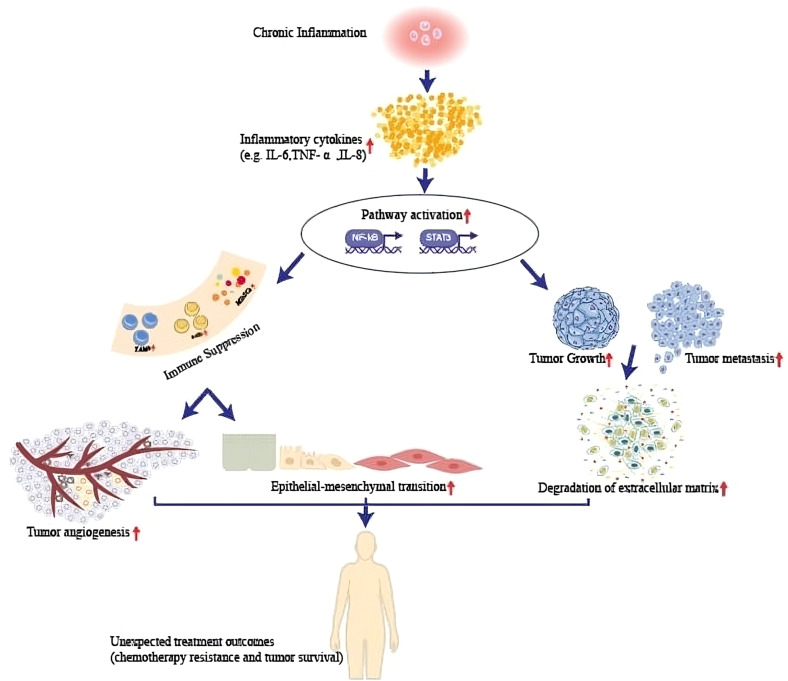
卵巢癌(OC)仍然是最致命的妇科恶性肿瘤之一,主要是由于其晚期诊断和高复发率。慢性炎症是肿瘤进展的关键驱动因素,有助于免疫逃避、肿瘤生长和转移。炎症细胞因子,包括IL-6、TNF-α和IL-8,以及关键的信号通路,如核因子κ B (NF-kB)和转录信号换能器和激活因子3 (STAT3),在OC中上调,促进肿瘤促进环境。肿瘤微环境(tumor microenvironment, TME)以肿瘤相关巨噬细胞(tumor-associated macrophages, tam)和调节性T细胞(regulatory T cells, Tregs)等免疫细胞为特征,它们抑制抗肿瘤免疫应答,促进免疫逃避。此外,OC细胞利用免疫检查点途径,包括PD-1/PD-L1,来抑制细胞毒性T细胞的活性。针对这些炎症和免疫逃避机制提供了有希望的治疗策略。COX-2抑制剂、Janus激酶/信号换能器和转录激活剂(JAK/STAT)通路阻断剂和NF-kB抑制剂在临床前研究中显示出潜力,而针对PD-1/PD-L1和CTLA-4的免疫检查点抑制剂在OC中的研究结果不一。此外,对微生物组和炎症相关生物标志物(如microRNAs (miRNAs)和外泌体)的新兴研究为早期检测和精准医疗提供了新的机会。未来的OC治疗方法必须专注于针对炎症性TME的个性化策略,将抗炎治疗与免疫治疗相结合,以提高患者的预后。继续研究炎症和免疫逃避之间的相互作用对于开发有效、持久的治疗方法至关重要。
Inflammation and Immune Escape in Ovarian Cancer: Pathways and Therapeutic Opportunities.
Ovarian cancer (OC) remains one of the most lethal gynecological malignancies, largely due to its late-stage diagnosis and high recurrence rates. Chronic inflammation is a critical driver of OC progression, contributing to immune evasion, tumor growth, and metastasis. Inflammatory cytokines, including IL-6, TNF-α, and IL-8, as well as key signaling pathways such as nuclear factor kappa B (NF-kB) and signal transducer and activator of transcription 3 (STAT3), are upregulated in OC, promoting a tumor-promoting environment. The tumor microenvironment (TME) is characterized by immune cells like tumor-associated macrophages (TAMs) and regulatory T cells (Tregs), which suppress anti-tumor immune responses, facilitating immune evasion. Furthermore, OC cells utilize immune checkpoint pathways, including PD-1/PD-L1, to inhibit cytotoxic T cell activity. Targeting these inflammatory and immune evasion mechanisms offers promising therapeutic strategies. COX-2 inhibitors, Janus kinase/signal transducer and activator of transcription (JAK/STAT) pathway blockers, and NF-kB inhibitors have shown potential in preclinical studies, while immune checkpoint inhibitors targeting PD-1/PD-L1 and CTLA-4 have been explored with mixed results in OC. Additionally, emerging research on the microbiome and inflammation-related biomarkers, such as microRNAs (miRNAs) and exosomes, points to new opportunities for early detection and precision medicine. Future approaches to OC treatment must focus on personalized strategies that target the inflammatory TME, integrating anti-inflammatory therapies with immunotherapy to enhance patient outcomes. Continued research into the interplay between inflammation and immune evasion in OC is essential for developing effective, long-lasting treatments.
期刊介绍:
An international, peer-reviewed, open access, online journal that welcomes laboratory and clinical findings on the molecular basis, cell biology and pharmacology of inflammation.





 京公网安备 11010802042870号
京ICP备2023020795号-1
京公网安备 11010802042870号
京ICP备2023020795号-1

 分享
分享
 求助内容:
求助内容: 应助结果提醒方式:
 扫码关注我们
