Yutong Li , Jianhang Miao , Chizhuai Liu , Jiahua Tao , Sifan Zhou , Xingyu Song , Yecheng Zou , Yuyang Huang , Linkun Zhong
{"title":"苦参酚O调节甲状腺乳头状癌GALNT7/NF-κB轴介导的巨噬细胞M2极化和Efferocytosis。","authors":"Yutong Li , Jianhang Miao , Chizhuai Liu , Jiahua Tao , Sifan Zhou , Xingyu Song , Yecheng Zou , Yuyang Huang , Linkun Zhong","doi":"10.1016/j.phymed.2025.156373","DOIUrl":null,"url":null,"abstract":"<div><h3>Background</h3><div>The incidence of papillary thyroid carcinoma (PTC) is on the rise globally. It is frequently associated with early lymphatic metastasis, and the poor prognosis tends to be poor once metastasis or recurrence occurs, even with current treatment modalities. Kushenol O, a novel extract derived from <em>Sophora flavescens</em>, has shown remarkable anticancer properties. However, its specific role in the treatment of PTC remains to be elucidated.</div></div><div><h3>Purpose</h3><div>This objective of this study is to examine the effects of kushenol O on the proliferation and invasion capacity of PTC cells, as well as to delve into its potential mechanisms of action.</div></div><div><h3>Methods</h3><div>Multi-omics was employed to identify the potential therapeutic targets for PTC. Single-cell RNA sequencing (scRNA-seq) investigated how these targets influence the remodeling of the tumor immune microenvironment (TIME). Kushenol O was employed to treat the PTC cell lines, with assessments conducted on its effects regarding cell viability, apoptosis, oxidative stress, and invasiveness. Molecular simulation was used to validate kushenol O's affinity for the therapeutic targets and biological toxicity. The impact of kushenol O was further evaluated using qRT-PCR and EdU assays, while cytotoxicity was measured by the CCK-8.</div></div><div><h3>Results</h3><div>GALNT7 is a potential new target for the treatment of PTC. It may regulate the macrophage M2 polarization and efferocytosis in the TIME of PTC through regulating the NF-κB axis. Kushenol O inhibits PTC cells proliferation and promotes apoptosis by inhibiting the expression of GALNT7, induces a decrease in SOD levels and an increase in MDA levels by inhibiting mitochondrial function, and promotes the accumulation of ROS, which inhibits G1 phase and promotes early apoptosis.</div></div><div><h3>Conclusions</h3><div>Kushenol O may inhibit the inflammation–cancer transformation and tumor progression of PTC by inhibiting GALNT7 and thus regulating NF-κB axis. These findings highlight the potential of kushenol O as immunomodulator or therapeutic agent, which may have important clinical implications.</div></div>","PeriodicalId":20212,"journal":{"name":"Phytomedicine","volume":"138 ","pages":"Article 156373"},"PeriodicalIF":11.3000,"publicationDate":"2025-03-01","publicationTypes":"Journal Article","fieldsOfStudy":null,"isOpenAccess":false,"openAccessPdf":"","citationCount":"0","resultStr":"{\"title\":\"Kushenol O Regulates GALNT7/NF-κB axis-Mediated Macrophage M2 Polarization and Efferocytosis in Papillary Thyroid Carcinoma\",\"authors\":\"Yutong Li , Jianhang Miao , Chizhuai Liu , Jiahua Tao , Sifan Zhou , Xingyu Song , Yecheng Zou , Yuyang Huang , Linkun Zhong\",\"doi\":\"10.1016/j.phymed.2025.156373\",\"DOIUrl\":null,\"url\":null,\"abstract\":\"<div><h3>Background</h3><div>The incidence of papillary thyroid carcinoma (PTC) is on the rise globally. It is frequently associated with early lymphatic metastasis, and the poor prognosis tends to be poor once metastasis or recurrence occurs, even with current treatment modalities. Kushenol O, a novel extract derived from <em>Sophora flavescens</em>, has shown remarkable anticancer properties. However, its specific role in the treatment of PTC remains to be elucidated.</div></div><div><h3>Purpose</h3><div>This objective of this study is to examine the effects of kushenol O on the proliferation and invasion capacity of PTC cells, as well as to delve into its potential mechanisms of action.</div></div><div><h3>Methods</h3><div>Multi-omics was employed to identify the potential therapeutic targets for PTC. Single-cell RNA sequencing (scRNA-seq) investigated how these targets influence the remodeling of the tumor immune microenvironment (TIME). Kushenol O was employed to treat the PTC cell lines, with assessments conducted on its effects regarding cell viability, apoptosis, oxidative stress, and invasiveness. Molecular simulation was used to validate kushenol O's affinity for the therapeutic targets and biological toxicity. The impact of kushenol O was further evaluated using qRT-PCR and EdU assays, while cytotoxicity was measured by the CCK-8.</div></div><div><h3>Results</h3><div>GALNT7 is a potential new target for the treatment of PTC. It may regulate the macrophage M2 polarization and efferocytosis in the TIME of PTC through regulating the NF-κB axis. Kushenol O inhibits PTC cells proliferation and promotes apoptosis by inhibiting the expression of GALNT7, induces a decrease in SOD levels and an increase in MDA levels by inhibiting mitochondrial function, and promotes the accumulation of ROS, which inhibits G1 phase and promotes early apoptosis.</div></div><div><h3>Conclusions</h3><div>Kushenol O may inhibit the inflammation–cancer transformation and tumor progression of PTC by inhibiting GALNT7 and thus regulating NF-κB axis. These findings highlight the potential of kushenol O as immunomodulator or therapeutic agent, which may have important clinical implications.</div></div>\",\"PeriodicalId\":20212,\"journal\":{\"name\":\"Phytomedicine\",\"volume\":\"138 \",\"pages\":\"Article 156373\"},\"PeriodicalIF\":11.3000,\"publicationDate\":\"2025-03-01\",\"publicationTypes\":\"Journal Article\",\"fieldsOfStudy\":null,\"isOpenAccess\":false,\"openAccessPdf\":\"\",\"citationCount\":\"0\",\"resultStr\":null,\"platform\":\"Semanticscholar\",\"paperid\":null,\"PeriodicalName\":\"Phytomedicine\",\"FirstCategoryId\":\"3\",\"ListUrlMain\":\"https://www.sciencedirect.com/science/article/pii/S0944711325000121\",\"RegionNum\":1,\"RegionCategory\":\"医学\",\"ArticlePicture\":[],\"TitleCN\":null,\"AbstractTextCN\":null,\"PMCID\":null,\"EPubDate\":\"2025/1/13 0:00:00\",\"PubModel\":\"Epub\",\"JCR\":\"Q1\",\"JCRName\":\"CHEMISTRY, MEDICINAL\",\"Score\":null,\"Total\":0}","platform":"Semanticscholar","paperid":null,"PeriodicalName":"Phytomedicine","FirstCategoryId":"3","ListUrlMain":"https://www.sciencedirect.com/science/article/pii/S0944711325000121","RegionNum":1,"RegionCategory":"医学","ArticlePicture":[],"TitleCN":null,"AbstractTextCN":null,"PMCID":null,"EPubDate":"2025/1/13 0:00:00","PubModel":"Epub","JCR":"Q1","JCRName":"CHEMISTRY, MEDICINAL","Score":null,"Total":0}
Kushenol O Regulates GALNT7/NF-κB axis-Mediated Macrophage M2 Polarization and Efferocytosis in Papillary Thyroid Carcinoma
Background
The incidence of papillary thyroid carcinoma (PTC) is on the rise globally. It is frequently associated with early lymphatic metastasis, and the poor prognosis tends to be poor once metastasis or recurrence occurs, even with current treatment modalities. Kushenol O, a novel extract derived from Sophora flavescens, has shown remarkable anticancer properties. However, its specific role in the treatment of PTC remains to be elucidated.
Purpose
This objective of this study is to examine the effects of kushenol O on the proliferation and invasion capacity of PTC cells, as well as to delve into its potential mechanisms of action.
Methods
Multi-omics was employed to identify the potential therapeutic targets for PTC. Single-cell RNA sequencing (scRNA-seq) investigated how these targets influence the remodeling of the tumor immune microenvironment (TIME). Kushenol O was employed to treat the PTC cell lines, with assessments conducted on its effects regarding cell viability, apoptosis, oxidative stress, and invasiveness. Molecular simulation was used to validate kushenol O's affinity for the therapeutic targets and biological toxicity. The impact of kushenol O was further evaluated using qRT-PCR and EdU assays, while cytotoxicity was measured by the CCK-8.
Results
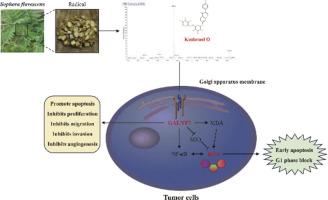
GALNT7 is a potential new target for the treatment of PTC. It may regulate the macrophage M2 polarization and efferocytosis in the TIME of PTC through regulating the NF-κB axis. Kushenol O inhibits PTC cells proliferation and promotes apoptosis by inhibiting the expression of GALNT7, induces a decrease in SOD levels and an increase in MDA levels by inhibiting mitochondrial function, and promotes the accumulation of ROS, which inhibits G1 phase and promotes early apoptosis.
Conclusions
Kushenol O may inhibit the inflammation–cancer transformation and tumor progression of PTC by inhibiting GALNT7 and thus regulating NF-κB axis. These findings highlight the potential of kushenol O as immunomodulator or therapeutic agent, which may have important clinical implications.
期刊介绍:
Phytomedicine is a therapy-oriented journal that publishes innovative studies on the efficacy, safety, quality, and mechanisms of action of specified plant extracts, phytopharmaceuticals, and their isolated constituents. This includes clinical, pharmacological, pharmacokinetic, and toxicological studies of herbal medicinal products, preparations, and purified compounds with defined and consistent quality, ensuring reproducible pharmacological activity. Founded in 1994, Phytomedicine aims to focus and stimulate research in this field and establish internationally accepted scientific standards for pharmacological studies, proof of clinical efficacy, and safety of phytomedicines.





 京公网安备 11010802042870号
京ICP备2023020795号-1
京公网安备 11010802042870号
京ICP备2023020795号-1

 分享
分享
 求助内容:
求助内容: 应助结果提醒方式:
 扫码关注我们
