Dingyue Zhang, Mingxiang Zuo, Jinhui Zhou, Siyu Ouyang, Shuang Liu, Jianming Yuan, Chiyi Ou, Qinghua Chen, Dongsheng Yu, Du Cheng and Jin Wang
{"title":"利用非阳离子纳米凝胶,化疗药物与microRNA联合治疗肝癌。","authors":"Dingyue Zhang, Mingxiang Zuo, Jinhui Zhou, Siyu Ouyang, Shuang Liu, Jianming Yuan, Chiyi Ou, Qinghua Chen, Dongsheng Yu, Du Cheng and Jin Wang","doi":"10.1039/D4TB02256D","DOIUrl":null,"url":null,"abstract":"<p >High drug resistance remains a challenge for chemotherapy against hepatocellular carcinoma (HCC). Combining chemotherapeutic agents with microRNA (miRNA), which simultaneously regulates multiple pathways, offers a promising approach to improve therapeutic efficacy against HCC. Although cationic amphiphilic copolymers have been used to co-deliver these agents, their effectiveness is often limited by low co-encapsulation efficiency and inherent cationic toxicity. In this study, we developed a facile approach to co-deliver doxorubicin (DOX) and miRNA-26a (miR-26a) using a non-cationic nanogel. The incorporation of an amphiphilic monomer and a lysosomal enzyme-sensitive crosslinker endows the nanomedicine with several advantages, including high co-encapsulation efficiency, lysosomal escape, and minimal toxicity. miR-26a significantly increased the sensitivity of HCC to DOX by 3.35-fold through targeting multiple pathways, and promoted DOX penetration within tumor tissue through reducing type I collagen content, thereby showing significant synergistic anticancer effects. This study provides a facile and biosafe nanoplatform for the efficient co-delivery of DOX and miRNA with synergistic drug effect.</p>","PeriodicalId":83,"journal":{"name":"Journal of Materials Chemistry B","volume":" 8","pages":" 2753-2766"},"PeriodicalIF":6.2000,"publicationDate":"2025-01-18","publicationTypes":"Journal Article","fieldsOfStudy":null,"isOpenAccess":false,"openAccessPdf":"","citationCount":"0","resultStr":"{\"title\":\"A facile combined therapy of chemotherapeutic agent and microRNA for hepatocellular carcinoma using non-cationic nanogel†\",\"authors\":\"Dingyue Zhang, Mingxiang Zuo, Jinhui Zhou, Siyu Ouyang, Shuang Liu, Jianming Yuan, Chiyi Ou, Qinghua Chen, Dongsheng Yu, Du Cheng and Jin Wang\",\"doi\":\"10.1039/D4TB02256D\",\"DOIUrl\":null,\"url\":null,\"abstract\":\"<p >High drug resistance remains a challenge for chemotherapy against hepatocellular carcinoma (HCC). Combining chemotherapeutic agents with microRNA (miRNA), which simultaneously regulates multiple pathways, offers a promising approach to improve therapeutic efficacy against HCC. Although cationic amphiphilic copolymers have been used to co-deliver these agents, their effectiveness is often limited by low co-encapsulation efficiency and inherent cationic toxicity. In this study, we developed a facile approach to co-deliver doxorubicin (DOX) and miRNA-26a (miR-26a) using a non-cationic nanogel. The incorporation of an amphiphilic monomer and a lysosomal enzyme-sensitive crosslinker endows the nanomedicine with several advantages, including high co-encapsulation efficiency, lysosomal escape, and minimal toxicity. miR-26a significantly increased the sensitivity of HCC to DOX by 3.35-fold through targeting multiple pathways, and promoted DOX penetration within tumor tissue through reducing type I collagen content, thereby showing significant synergistic anticancer effects. This study provides a facile and biosafe nanoplatform for the efficient co-delivery of DOX and miRNA with synergistic drug effect.</p>\",\"PeriodicalId\":83,\"journal\":{\"name\":\"Journal of Materials Chemistry B\",\"volume\":\" 8\",\"pages\":\" 2753-2766\"},\"PeriodicalIF\":6.2000,\"publicationDate\":\"2025-01-18\",\"publicationTypes\":\"Journal Article\",\"fieldsOfStudy\":null,\"isOpenAccess\":false,\"openAccessPdf\":\"\",\"citationCount\":\"0\",\"resultStr\":null,\"platform\":\"Semanticscholar\",\"paperid\":null,\"PeriodicalName\":\"Journal of Materials Chemistry B\",\"FirstCategoryId\":\"1\",\"ListUrlMain\":\"https://pubs.rsc.org/en/content/articlelanding/2025/tb/d4tb02256d\",\"RegionNum\":3,\"RegionCategory\":\"医学\",\"ArticlePicture\":[],\"TitleCN\":null,\"AbstractTextCN\":null,\"PMCID\":null,\"EPubDate\":\"\",\"PubModel\":\"\",\"JCR\":\"Q1\",\"JCRName\":\"MATERIALS SCIENCE, BIOMATERIALS\",\"Score\":null,\"Total\":0}","platform":"Semanticscholar","paperid":null,"PeriodicalName":"Journal of Materials Chemistry B","FirstCategoryId":"1","ListUrlMain":"https://pubs.rsc.org/en/content/articlelanding/2025/tb/d4tb02256d","RegionNum":3,"RegionCategory":"医学","ArticlePicture":[],"TitleCN":null,"AbstractTextCN":null,"PMCID":null,"EPubDate":"","PubModel":"","JCR":"Q1","JCRName":"MATERIALS SCIENCE, BIOMATERIALS","Score":null,"Total":0}
A facile combined therapy of chemotherapeutic agent and microRNA for hepatocellular carcinoma using non-cationic nanogel†
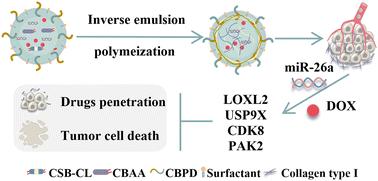
High drug resistance remains a challenge for chemotherapy against hepatocellular carcinoma (HCC). Combining chemotherapeutic agents with microRNA (miRNA), which simultaneously regulates multiple pathways, offers a promising approach to improve therapeutic efficacy against HCC. Although cationic amphiphilic copolymers have been used to co-deliver these agents, their effectiveness is often limited by low co-encapsulation efficiency and inherent cationic toxicity. In this study, we developed a facile approach to co-deliver doxorubicin (DOX) and miRNA-26a (miR-26a) using a non-cationic nanogel. The incorporation of an amphiphilic monomer and a lysosomal enzyme-sensitive crosslinker endows the nanomedicine with several advantages, including high co-encapsulation efficiency, lysosomal escape, and minimal toxicity. miR-26a significantly increased the sensitivity of HCC to DOX by 3.35-fold through targeting multiple pathways, and promoted DOX penetration within tumor tissue through reducing type I collagen content, thereby showing significant synergistic anticancer effects. This study provides a facile and biosafe nanoplatform for the efficient co-delivery of DOX and miRNA with synergistic drug effect.
期刊介绍:
Journal of Materials Chemistry A, B & C cover high quality studies across all fields of materials chemistry. The journals focus on those theoretical or experimental studies that report new understanding, applications, properties and synthesis of materials. Journal of Materials Chemistry A, B & C are separated by the intended application of the material studied. Broadly, applications in energy and sustainability are of interest to Journal of Materials Chemistry A, applications in biology and medicine are of interest to Journal of Materials Chemistry B, and applications in optical, magnetic and electronic devices are of interest to Journal of Materials Chemistry C.Journal of Materials Chemistry B is a Transformative Journal and Plan S compliant. Example topic areas within the scope of Journal of Materials Chemistry B are listed below. This list is neither exhaustive nor exclusive:
Antifouling coatings
Biocompatible materials
Bioelectronics
Bioimaging
Biomimetics
Biomineralisation
Bionics
Biosensors
Diagnostics
Drug delivery
Gene delivery
Immunobiology
Nanomedicine
Regenerative medicine & Tissue engineering
Scaffolds
Soft robotics
Stem cells
Therapeutic devices




 京公网安备 11010802042870号
京ICP备2023020795号-1
京公网安备 11010802042870号
京ICP备2023020795号-1

 分享
分享
 求助内容:
求助内容: 应助结果提醒方式:
 扫码关注我们
