{"title":"通过二维信号路径分类利用 RIS 进行近场定位","authors":"Jeongwan Kang;Seung-Woo Ko;Sunwoo Kim","doi":"10.1109/TWC.2025.3531055","DOIUrl":null,"url":null,"abstract":"In this paper, we propose a two-dimensional signal path classification (2D-SPC) for reconfigurable intelligent surface (RIS)-assisted near-field (NF) localization. In the NF regime, multiple RIS-driven signal paths (SPs) can contribute to precise localization if these are decomposable and the reflected locations on the RIS are known, referred to as SP decomposition (SPD) and SP labeling (SPL), respectively. To this end, each RIS element modulates the incoming SP’s phase by shifting it by one of the values in the phase shift profile (PSP) lists satisfying resolution requirements. By interworking with a conventional orthogonal frequency division multiplexing (OFDM) waveform, the user equipment can construct a 2D spectrum map that couples each SP’s time-of-arrival (ToA) and PSP. Then, we design SPL by mapping the SPs with the corresponding reflected RIS elements when they share the same PSP. Given two unlabeled SPs, we derive a geometric discriminant by checking whether the current label is correct. It can be extended to more than three SPs by sorting them using pairwise geometric discriminants between adjacent ones. From simulation results, it has been demonstrated that the proposed 2D-SPC achieves consistent localization accuracy while poor accuracy in a benchmark, even if insufficient PSPs are given.","PeriodicalId":13431,"journal":{"name":"IEEE Transactions on Wireless Communications","volume":"24 4","pages":"3417-3432"},"PeriodicalIF":10.7000,"publicationDate":"2025-01-27","publicationTypes":"Journal Article","fieldsOfStudy":null,"isOpenAccess":false,"openAccessPdf":"","citationCount":"0","resultStr":"{\"title\":\"Near-Field Localization With RIS via Two-Dimensional Signal Path Classification\",\"authors\":\"Jeongwan Kang;Seung-Woo Ko;Sunwoo Kim\",\"doi\":\"10.1109/TWC.2025.3531055\",\"DOIUrl\":null,\"url\":null,\"abstract\":\"In this paper, we propose a two-dimensional signal path classification (2D-SPC) for reconfigurable intelligent surface (RIS)-assisted near-field (NF) localization. In the NF regime, multiple RIS-driven signal paths (SPs) can contribute to precise localization if these are decomposable and the reflected locations on the RIS are known, referred to as SP decomposition (SPD) and SP labeling (SPL), respectively. To this end, each RIS element modulates the incoming SP’s phase by shifting it by one of the values in the phase shift profile (PSP) lists satisfying resolution requirements. By interworking with a conventional orthogonal frequency division multiplexing (OFDM) waveform, the user equipment can construct a 2D spectrum map that couples each SP’s time-of-arrival (ToA) and PSP. Then, we design SPL by mapping the SPs with the corresponding reflected RIS elements when they share the same PSP. Given two unlabeled SPs, we derive a geometric discriminant by checking whether the current label is correct. It can be extended to more than three SPs by sorting them using pairwise geometric discriminants between adjacent ones. From simulation results, it has been demonstrated that the proposed 2D-SPC achieves consistent localization accuracy while poor accuracy in a benchmark, even if insufficient PSPs are given.\",\"PeriodicalId\":13431,\"journal\":{\"name\":\"IEEE Transactions on Wireless Communications\",\"volume\":\"24 4\",\"pages\":\"3417-3432\"},\"PeriodicalIF\":10.7000,\"publicationDate\":\"2025-01-27\",\"publicationTypes\":\"Journal Article\",\"fieldsOfStudy\":null,\"isOpenAccess\":false,\"openAccessPdf\":\"\",\"citationCount\":\"0\",\"resultStr\":null,\"platform\":\"Semanticscholar\",\"paperid\":null,\"PeriodicalName\":\"IEEE Transactions on Wireless Communications\",\"FirstCategoryId\":\"94\",\"ListUrlMain\":\"https://ieeexplore.ieee.org/document/10855343/\",\"RegionNum\":1,\"RegionCategory\":\"计算机科学\",\"ArticlePicture\":[],\"TitleCN\":null,\"AbstractTextCN\":null,\"PMCID\":null,\"EPubDate\":\"\",\"PubModel\":\"\",\"JCR\":\"Q1\",\"JCRName\":\"ENGINEERING, ELECTRICAL & ELECTRONIC\",\"Score\":null,\"Total\":0}","platform":"Semanticscholar","paperid":null,"PeriodicalName":"IEEE Transactions on Wireless Communications","FirstCategoryId":"94","ListUrlMain":"https://ieeexplore.ieee.org/document/10855343/","RegionNum":1,"RegionCategory":"计算机科学","ArticlePicture":[],"TitleCN":null,"AbstractTextCN":null,"PMCID":null,"EPubDate":"","PubModel":"","JCR":"Q1","JCRName":"ENGINEERING, ELECTRICAL & ELECTRONIC","Score":null,"Total":0}
Near-Field Localization With RIS via Two-Dimensional Signal Path Classification
In this paper, we propose a two-dimensional signal path classification (2D-SPC) for reconfigurable intelligent surface (RIS)-assisted near-field (NF) localization. In the NF regime, multiple RIS-driven signal paths (SPs) can contribute to precise localization if these are decomposable and the reflected locations on the RIS are known, referred to as SP decomposition (SPD) and SP labeling (SPL), respectively. To this end, each RIS element modulates the incoming SP’s phase by shifting it by one of the values in the phase shift profile (PSP) lists satisfying resolution requirements. By interworking with a conventional orthogonal frequency division multiplexing (OFDM) waveform, the user equipment can construct a 2D spectrum map that couples each SP’s time-of-arrival (ToA) and PSP. Then, we design SPL by mapping the SPs with the corresponding reflected RIS elements when they share the same PSP. Given two unlabeled SPs, we derive a geometric discriminant by checking whether the current label is correct. It can be extended to more than three SPs by sorting them using pairwise geometric discriminants between adjacent ones. From simulation results, it has been demonstrated that the proposed 2D-SPC achieves consistent localization accuracy while poor accuracy in a benchmark, even if insufficient PSPs are given.
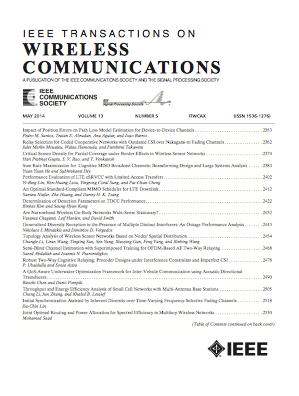
期刊介绍:
The IEEE Transactions on Wireless Communications is a prestigious publication that showcases cutting-edge advancements in wireless communications. It welcomes both theoretical and practical contributions in various areas. The scope of the Transactions encompasses a wide range of topics, including modulation and coding, detection and estimation, propagation and channel characterization, and diversity techniques. The journal also emphasizes the physical and link layer communication aspects of network architectures and protocols.
The journal is open to papers on specific topics or non-traditional topics related to specific application areas. This includes simulation tools and methodologies, orthogonal frequency division multiplexing, MIMO systems, and wireless over optical technologies.
Overall, the IEEE Transactions on Wireless Communications serves as a platform for high-quality manuscripts that push the boundaries of wireless communications and contribute to advancements in the field.




 京公网安备 11010802042870号
京ICP备2023020795号-1
京公网安备 11010802042870号
京ICP备2023020795号-1

 分享
分享
 求助内容:
求助内容: 应助结果提醒方式:
 扫码关注我们
