John A. Tomko, Kiumars Aryana, Yifan Wu, Guoqing Zhou, Qiyan Zhang, Pat Wongwiset, Virginia Wheeler, Oleg V. Prezhdo, Patrick E. Hopkins
{"title":"二氧化钒中超快载流子动力学:非平衡态对光致相变的贡献","authors":"John A. Tomko, Kiumars Aryana, Yifan Wu, Guoqing Zhou, Qiyan Zhang, Pat Wongwiset, Virginia Wheeler, Oleg V. Prezhdo, Patrick E. Hopkins","doi":"10.1021/acs.jpclett.4c02951","DOIUrl":null,"url":null,"abstract":"Vanadium oxide (VO<sub>2</sub>) is an exotic phase-change material with diverse applications ranging from thermochromic smart windows to thermal sensors, neuromorphic computing, and tunable metasurfaces. Nonetheless, the mechanism responsible for its metal–insulator phase transition remains a subject of vigorous debate. Here, we investigate the ultrafast dynamics of the photoinduced phase transition in VO<sub>2</sub> under low perturbation conditions. By experimentally examining carrier relaxation dynamics at energy levels near the VO<sub>2</sub> band gap (0.6–0.92 eV), we note that numerous optical features do not correspond to the first-order phase transition. Previous studies indeed induced such a phase transition, but they relied on fluences at least an order of magnitude higher, leading to temperature increases well above the transition threshold (340 K). Instead, for excitation fluences that correspond to lattice temperatures only in slight excess of the phase transition (absolute temperatures < 500 K), we find that the marked changes in optical properties are dominated by a shift in the electronic density of states/Fermi level. We find that this effect is a lattice-driven process and does not occur until sufficient energy has been transferred from the excited electrons into the phonon subsystem.","PeriodicalId":62,"journal":{"name":"The Journal of Physical Chemistry Letters","volume":"47 1","pages":""},"PeriodicalIF":4.5000,"publicationDate":"2025-01-28","publicationTypes":"Journal Article","fieldsOfStudy":null,"isOpenAccess":false,"openAccessPdf":"","citationCount":"0","resultStr":"{\"title\":\"Ultrafast Charge Carrier Dynamics in Vanadium Dioxide, VO2: Nonequilibrium Contributions to the Photoinduced Phase Transitions\",\"authors\":\"John A. Tomko, Kiumars Aryana, Yifan Wu, Guoqing Zhou, Qiyan Zhang, Pat Wongwiset, Virginia Wheeler, Oleg V. Prezhdo, Patrick E. Hopkins\",\"doi\":\"10.1021/acs.jpclett.4c02951\",\"DOIUrl\":null,\"url\":null,\"abstract\":\"Vanadium oxide (VO<sub>2</sub>) is an exotic phase-change material with diverse applications ranging from thermochromic smart windows to thermal sensors, neuromorphic computing, and tunable metasurfaces. Nonetheless, the mechanism responsible for its metal–insulator phase transition remains a subject of vigorous debate. Here, we investigate the ultrafast dynamics of the photoinduced phase transition in VO<sub>2</sub> under low perturbation conditions. By experimentally examining carrier relaxation dynamics at energy levels near the VO<sub>2</sub> band gap (0.6–0.92 eV), we note that numerous optical features do not correspond to the first-order phase transition. Previous studies indeed induced such a phase transition, but they relied on fluences at least an order of magnitude higher, leading to temperature increases well above the transition threshold (340 K). Instead, for excitation fluences that correspond to lattice temperatures only in slight excess of the phase transition (absolute temperatures < 500 K), we find that the marked changes in optical properties are dominated by a shift in the electronic density of states/Fermi level. We find that this effect is a lattice-driven process and does not occur until sufficient energy has been transferred from the excited electrons into the phonon subsystem.\",\"PeriodicalId\":62,\"journal\":{\"name\":\"The Journal of Physical Chemistry Letters\",\"volume\":\"47 1\",\"pages\":\"\"},\"PeriodicalIF\":4.5000,\"publicationDate\":\"2025-01-28\",\"publicationTypes\":\"Journal Article\",\"fieldsOfStudy\":null,\"isOpenAccess\":false,\"openAccessPdf\":\"\",\"citationCount\":\"0\",\"resultStr\":null,\"platform\":\"Semanticscholar\",\"paperid\":null,\"PeriodicalName\":\"The Journal of Physical Chemistry Letters\",\"FirstCategoryId\":\"1\",\"ListUrlMain\":\"https://doi.org/10.1021/acs.jpclett.4c02951\",\"RegionNum\":2,\"RegionCategory\":\"化学\",\"ArticlePicture\":[],\"TitleCN\":null,\"AbstractTextCN\":null,\"PMCID\":null,\"EPubDate\":\"\",\"PubModel\":\"\",\"JCR\":\"Q2\",\"JCRName\":\"CHEMISTRY, PHYSICAL\",\"Score\":null,\"Total\":0}","platform":"Semanticscholar","paperid":null,"PeriodicalName":"The Journal of Physical Chemistry Letters","FirstCategoryId":"1","ListUrlMain":"https://doi.org/10.1021/acs.jpclett.4c02951","RegionNum":2,"RegionCategory":"化学","ArticlePicture":[],"TitleCN":null,"AbstractTextCN":null,"PMCID":null,"EPubDate":"","PubModel":"","JCR":"Q2","JCRName":"CHEMISTRY, PHYSICAL","Score":null,"Total":0}
Ultrafast Charge Carrier Dynamics in Vanadium Dioxide, VO2: Nonequilibrium Contributions to the Photoinduced Phase Transitions
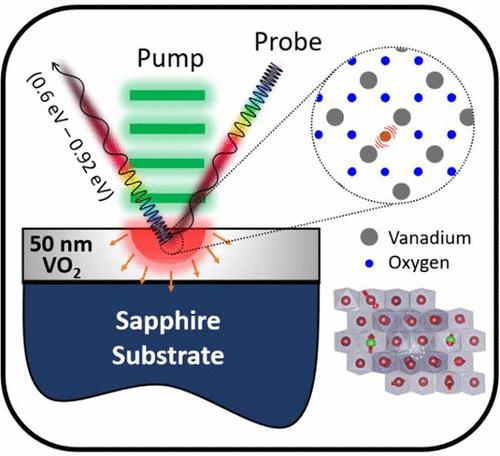
Vanadium oxide (VO2) is an exotic phase-change material with diverse applications ranging from thermochromic smart windows to thermal sensors, neuromorphic computing, and tunable metasurfaces. Nonetheless, the mechanism responsible for its metal–insulator phase transition remains a subject of vigorous debate. Here, we investigate the ultrafast dynamics of the photoinduced phase transition in VO2 under low perturbation conditions. By experimentally examining carrier relaxation dynamics at energy levels near the VO2 band gap (0.6–0.92 eV), we note that numerous optical features do not correspond to the first-order phase transition. Previous studies indeed induced such a phase transition, but they relied on fluences at least an order of magnitude higher, leading to temperature increases well above the transition threshold (340 K). Instead, for excitation fluences that correspond to lattice temperatures only in slight excess of the phase transition (absolute temperatures < 500 K), we find that the marked changes in optical properties are dominated by a shift in the electronic density of states/Fermi level. We find that this effect is a lattice-driven process and does not occur until sufficient energy has been transferred from the excited electrons into the phonon subsystem.
期刊介绍:
The Journal of Physical Chemistry (JPC) Letters is devoted to reporting new and original experimental and theoretical basic research of interest to physical chemists, biophysical chemists, chemical physicists, physicists, material scientists, and engineers. An important criterion for acceptance is that the paper reports a significant scientific advance and/or physical insight such that rapid publication is essential. Two issues of JPC Letters are published each month.




 京公网安备 11010802042870号
京ICP备2023020795号-1
京公网安备 11010802042870号
京ICP备2023020795号-1

 分享
分享
 求助内容:
求助内容: 应助结果提醒方式:
 扫码关注我们
