Rune Kvåle, Giske Ursin, Christian Ekanger, Bjørn Møller
{"title":"2000年后北欧国家前列腺癌死亡率大幅下降。","authors":"Rune Kvåle, Giske Ursin, Christian Ekanger, Bjørn Møller","doi":"10.2340/1651-226X.2025.41334","DOIUrl":null,"url":null,"abstract":"<p><strong>Background and purpose: </strong>In the late 1990s, the Nordic countries, with Norway at the top, were among the countries with the highest prostate cancer mortality in the world. We present updated mortality rates from the Nordic countries and discuss possible interpretations of changes in trends.</p><p><strong>Material and methods: </strong>Age-standardized rates for prostate-specific mortality in 1985-2022, estimated lifetime risk of death (0-84 years) and annual changes in mortality were obtained from the NORDCAN database. Joinpoint regression was used to evaluate trend changes for the period 1985-2022. For comparison, rates from other European countries from 2022 were retrieved from the GLOBOCAN database.</p><p><strong>Results: </strong>Between 1995-99 and 2018-22, mortality in men aged 40-84 years decreased from 38% in Denmark to 59% in Norway. By 2022 Norway had the second lowest mortality among the Nordic countries overall, and the lowest under 85 years. The life-time risk of dying from prostate cancer declined from 5.6-7.1% in 1995-99 to 3.1-4.2% in the last 5-year period. During the last years mortality has decreased most rapidly in Sweden (4.5% annually from 2016) and Norway (4.3% annually from 2014). The Nordic countries are no longer among the countries with the highest mortality in Europe.</p><p><strong>Interpretation: </strong>Mortality from prostate cancer has decreased significantly in the Nordic countries over the last decades. Possible explanatory factors are likely to include improvements in prostate cancer management strategies and treatment.</p>","PeriodicalId":7110,"journal":{"name":"Acta Oncologica","volume":"64 ","pages":"114-119"},"PeriodicalIF":2.7000,"publicationDate":"2025-01-27","publicationTypes":"Journal Article","fieldsOfStudy":null,"isOpenAccess":false,"openAccessPdf":"https://www.ncbi.nlm.nih.gov/pmc/articles/PMC11794998/pdf/","citationCount":"0","resultStr":"{\"title\":\"Considerable decline in prostate cancer mortality in Nordic countries after 2000.\",\"authors\":\"Rune Kvåle, Giske Ursin, Christian Ekanger, Bjørn Møller\",\"doi\":\"10.2340/1651-226X.2025.41334\",\"DOIUrl\":null,\"url\":null,\"abstract\":\"<p><strong>Background and purpose: </strong>In the late 1990s, the Nordic countries, with Norway at the top, were among the countries with the highest prostate cancer mortality in the world. We present updated mortality rates from the Nordic countries and discuss possible interpretations of changes in trends.</p><p><strong>Material and methods: </strong>Age-standardized rates for prostate-specific mortality in 1985-2022, estimated lifetime risk of death (0-84 years) and annual changes in mortality were obtained from the NORDCAN database. Joinpoint regression was used to evaluate trend changes for the period 1985-2022. For comparison, rates from other European countries from 2022 were retrieved from the GLOBOCAN database.</p><p><strong>Results: </strong>Between 1995-99 and 2018-22, mortality in men aged 40-84 years decreased from 38% in Denmark to 59% in Norway. By 2022 Norway had the second lowest mortality among the Nordic countries overall, and the lowest under 85 years. The life-time risk of dying from prostate cancer declined from 5.6-7.1% in 1995-99 to 3.1-4.2% in the last 5-year period. During the last years mortality has decreased most rapidly in Sweden (4.5% annually from 2016) and Norway (4.3% annually from 2014). The Nordic countries are no longer among the countries with the highest mortality in Europe.</p><p><strong>Interpretation: </strong>Mortality from prostate cancer has decreased significantly in the Nordic countries over the last decades. Possible explanatory factors are likely to include improvements in prostate cancer management strategies and treatment.</p>\",\"PeriodicalId\":7110,\"journal\":{\"name\":\"Acta Oncologica\",\"volume\":\"64 \",\"pages\":\"114-119\"},\"PeriodicalIF\":2.7000,\"publicationDate\":\"2025-01-27\",\"publicationTypes\":\"Journal Article\",\"fieldsOfStudy\":null,\"isOpenAccess\":false,\"openAccessPdf\":\"https://www.ncbi.nlm.nih.gov/pmc/articles/PMC11794998/pdf/\",\"citationCount\":\"0\",\"resultStr\":null,\"platform\":\"Semanticscholar\",\"paperid\":null,\"PeriodicalName\":\"Acta Oncologica\",\"FirstCategoryId\":\"3\",\"ListUrlMain\":\"https://doi.org/10.2340/1651-226X.2025.41334\",\"RegionNum\":3,\"RegionCategory\":\"医学\",\"ArticlePicture\":[],\"TitleCN\":null,\"AbstractTextCN\":null,\"PMCID\":null,\"EPubDate\":\"\",\"PubModel\":\"\",\"JCR\":\"Q3\",\"JCRName\":\"ONCOLOGY\",\"Score\":null,\"Total\":0}","platform":"Semanticscholar","paperid":null,"PeriodicalName":"Acta Oncologica","FirstCategoryId":"3","ListUrlMain":"https://doi.org/10.2340/1651-226X.2025.41334","RegionNum":3,"RegionCategory":"医学","ArticlePicture":[],"TitleCN":null,"AbstractTextCN":null,"PMCID":null,"EPubDate":"","PubModel":"","JCR":"Q3","JCRName":"ONCOLOGY","Score":null,"Total":0}
Considerable decline in prostate cancer mortality in Nordic countries after 2000.
Background and purpose: In the late 1990s, the Nordic countries, with Norway at the top, were among the countries with the highest prostate cancer mortality in the world. We present updated mortality rates from the Nordic countries and discuss possible interpretations of changes in trends.
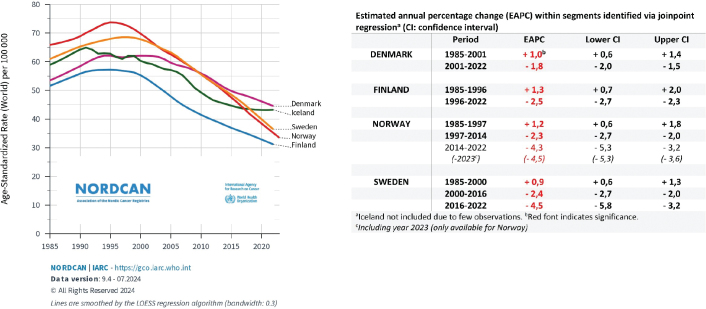
Material and methods: Age-standardized rates for prostate-specific mortality in 1985-2022, estimated lifetime risk of death (0-84 years) and annual changes in mortality were obtained from the NORDCAN database. Joinpoint regression was used to evaluate trend changes for the period 1985-2022. For comparison, rates from other European countries from 2022 were retrieved from the GLOBOCAN database.
Results: Between 1995-99 and 2018-22, mortality in men aged 40-84 years decreased from 38% in Denmark to 59% in Norway. By 2022 Norway had the second lowest mortality among the Nordic countries overall, and the lowest under 85 years. The life-time risk of dying from prostate cancer declined from 5.6-7.1% in 1995-99 to 3.1-4.2% in the last 5-year period. During the last years mortality has decreased most rapidly in Sweden (4.5% annually from 2016) and Norway (4.3% annually from 2014). The Nordic countries are no longer among the countries with the highest mortality in Europe.
Interpretation: Mortality from prostate cancer has decreased significantly in the Nordic countries over the last decades. Possible explanatory factors are likely to include improvements in prostate cancer management strategies and treatment.
期刊介绍:
Acta Oncologica is a journal for the clinical oncologist and accepts articles within all fields of clinical cancer research. Articles on tumour pathology, experimental oncology, radiobiology, cancer epidemiology and medical radio physics are also welcome, especially if they have a clinical aim or interest. Scientific articles on cancer nursing and psychological or social aspects of cancer are also welcomed. Extensive material may be published as Supplements, for which special conditions apply.





 京公网安备 11010802042870号
京ICP备2023020795号-1
京公网安备 11010802042870号
京ICP备2023020795号-1

 分享
分享
 求助内容:
求助内容: 应助结果提醒方式:
 扫码关注我们
