Ami Kumar, Yi-Mei Wang, Ming-Kai Pan, Sheng-Han Kuo
{"title":"用脑电图记录人类小脑生理信号的规程。","authors":"Ami Kumar, Yi-Mei Wang, Ming-Kai Pan, Sheng-Han Kuo","doi":"10.1016/j.xpro.2025.103601","DOIUrl":null,"url":null,"abstract":"<p><p>As Purkinje cells of the cerebellum have a very fast firing rate, techniques with high temporal resolution are required to capture cerebellar physiology. Here, we present a protocol to record physiological signals in humans using cerebellar electroencephalography (cEEG). We describe steps for electrode placement and recording. We then detail solutions for dealing with potential muscle, ocular, and electrical artifacts. This protocol has applications in recording patients with cerebellar disorders such as essential tremor, cerebellar ataxia, and dystonia. For complete details on the use and execution of this protocol, please refer to Pan et al.,<sup>1</sup> Wong et al.,<sup>2</sup> and Wang et al.<sup>3</sup>.</p>","PeriodicalId":34214,"journal":{"name":"STAR Protocols","volume":"6 1","pages":"103601"},"PeriodicalIF":1.3000,"publicationDate":"2025-03-21","publicationTypes":"Journal Article","fieldsOfStudy":null,"isOpenAccess":false,"openAccessPdf":"https://www.ncbi.nlm.nih.gov/pmc/articles/PMC11799949/pdf/","citationCount":"0","resultStr":"{\"title\":\"Protocol for recording physiological signals from the human cerebellum using electroencephalography.\",\"authors\":\"Ami Kumar, Yi-Mei Wang, Ming-Kai Pan, Sheng-Han Kuo\",\"doi\":\"10.1016/j.xpro.2025.103601\",\"DOIUrl\":null,\"url\":null,\"abstract\":\"<p><p>As Purkinje cells of the cerebellum have a very fast firing rate, techniques with high temporal resolution are required to capture cerebellar physiology. Here, we present a protocol to record physiological signals in humans using cerebellar electroencephalography (cEEG). We describe steps for electrode placement and recording. We then detail solutions for dealing with potential muscle, ocular, and electrical artifacts. This protocol has applications in recording patients with cerebellar disorders such as essential tremor, cerebellar ataxia, and dystonia. For complete details on the use and execution of this protocol, please refer to Pan et al.,<sup>1</sup> Wong et al.,<sup>2</sup> and Wang et al.<sup>3</sup>.</p>\",\"PeriodicalId\":34214,\"journal\":{\"name\":\"STAR Protocols\",\"volume\":\"6 1\",\"pages\":\"103601\"},\"PeriodicalIF\":1.3000,\"publicationDate\":\"2025-03-21\",\"publicationTypes\":\"Journal Article\",\"fieldsOfStudy\":null,\"isOpenAccess\":false,\"openAccessPdf\":\"https://www.ncbi.nlm.nih.gov/pmc/articles/PMC11799949/pdf/\",\"citationCount\":\"0\",\"resultStr\":null,\"platform\":\"Semanticscholar\",\"paperid\":null,\"PeriodicalName\":\"STAR Protocols\",\"FirstCategoryId\":\"1085\",\"ListUrlMain\":\"https://doi.org/10.1016/j.xpro.2025.103601\",\"RegionNum\":0,\"RegionCategory\":null,\"ArticlePicture\":[],\"TitleCN\":null,\"AbstractTextCN\":null,\"PMCID\":null,\"EPubDate\":\"2025/1/26 0:00:00\",\"PubModel\":\"Epub\",\"JCR\":\"Q4\",\"JCRName\":\"BIOCHEMICAL RESEARCH METHODS\",\"Score\":null,\"Total\":0}","platform":"Semanticscholar","paperid":null,"PeriodicalName":"STAR Protocols","FirstCategoryId":"1085","ListUrlMain":"https://doi.org/10.1016/j.xpro.2025.103601","RegionNum":0,"RegionCategory":null,"ArticlePicture":[],"TitleCN":null,"AbstractTextCN":null,"PMCID":null,"EPubDate":"2025/1/26 0:00:00","PubModel":"Epub","JCR":"Q4","JCRName":"BIOCHEMICAL RESEARCH METHODS","Score":null,"Total":0}
Protocol for recording physiological signals from the human cerebellum using electroencephalography.
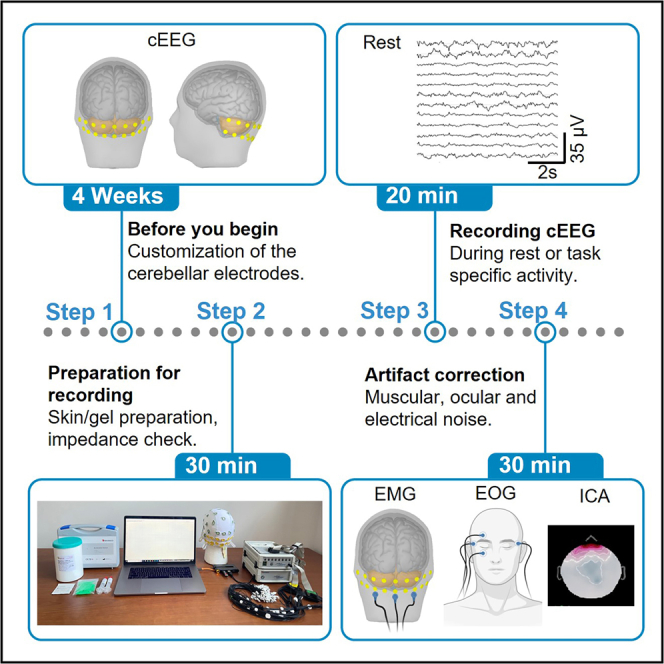
As Purkinje cells of the cerebellum have a very fast firing rate, techniques with high temporal resolution are required to capture cerebellar physiology. Here, we present a protocol to record physiological signals in humans using cerebellar electroencephalography (cEEG). We describe steps for electrode placement and recording. We then detail solutions for dealing with potential muscle, ocular, and electrical artifacts. This protocol has applications in recording patients with cerebellar disorders such as essential tremor, cerebellar ataxia, and dystonia. For complete details on the use and execution of this protocol, please refer to Pan et al.,1 Wong et al.,2 and Wang et al.3.






 京公网安备 11010802042870号
京ICP备2023020795号-1
京公网安备 11010802042870号
京ICP备2023020795号-1

 分享
分享
 求助内容:
求助内容: 应助结果提醒方式:
 扫码关注我们
