{"title":"基于全幻灯片图像的深度学习改进了肺腺癌的预后和治疗反应评估","authors":"Tao Chen, Jialiang Wen, Xinchen Shen, Jiaqi Shen, Jiajun Deng, Mengmeng Zhao, Long Xu, Chunyan Wu, Bentong Yu, Minglei Yang, Minjie Ma, Junqi Wu, Yunlang She, Yifan Zhong, Likun Hou, Yanrui Jin, Chang Chen","doi":"10.1038/s41746-025-01470-z","DOIUrl":null,"url":null,"abstract":"<p>Existing prognostic models are useful for estimating the prognosis of lung adenocarcinoma patients, but there remains room for improvement. In the current study, we developed a deep learning model based on histopathological images to predict the recurrence risk of lung adenocarcinoma patients. The efficiency of the model was then evaluated in independent multicenter cohorts. The model defined high- and low-risk groups successfully stratified prognosis of the entire cohort. Moreover, multivariable Cox analysis identified the model defined risk groups as an independent predictor for disease-free survival. Importantly, combining TNM stage with the established model helped to distinguish subgroups of patients with high-risk stage II and stage III disease who are highly likely to benefit from adjuvant chemotherapy. Overall, our study highlights the significant value of the constructed model to serve as a complementary biomarker for survival stratification and adjuvant therapy selection for lung adenocarcinoma patients after resection.</p>","PeriodicalId":19349,"journal":{"name":"NPJ Digital Medicine","volume":"44 1","pages":""},"PeriodicalIF":15.1000,"publicationDate":"2025-01-29","publicationTypes":"Journal Article","fieldsOfStudy":null,"isOpenAccess":false,"openAccessPdf":"","citationCount":"0","resultStr":"{\"title\":\"Whole slide image based deep learning refines prognosis and therapeutic response evaluation in lung adenocarcinoma\",\"authors\":\"Tao Chen, Jialiang Wen, Xinchen Shen, Jiaqi Shen, Jiajun Deng, Mengmeng Zhao, Long Xu, Chunyan Wu, Bentong Yu, Minglei Yang, Minjie Ma, Junqi Wu, Yunlang She, Yifan Zhong, Likun Hou, Yanrui Jin, Chang Chen\",\"doi\":\"10.1038/s41746-025-01470-z\",\"DOIUrl\":null,\"url\":null,\"abstract\":\"<p>Existing prognostic models are useful for estimating the prognosis of lung adenocarcinoma patients, but there remains room for improvement. In the current study, we developed a deep learning model based on histopathological images to predict the recurrence risk of lung adenocarcinoma patients. The efficiency of the model was then evaluated in independent multicenter cohorts. The model defined high- and low-risk groups successfully stratified prognosis of the entire cohort. Moreover, multivariable Cox analysis identified the model defined risk groups as an independent predictor for disease-free survival. Importantly, combining TNM stage with the established model helped to distinguish subgroups of patients with high-risk stage II and stage III disease who are highly likely to benefit from adjuvant chemotherapy. Overall, our study highlights the significant value of the constructed model to serve as a complementary biomarker for survival stratification and adjuvant therapy selection for lung adenocarcinoma patients after resection.</p>\",\"PeriodicalId\":19349,\"journal\":{\"name\":\"NPJ Digital Medicine\",\"volume\":\"44 1\",\"pages\":\"\"},\"PeriodicalIF\":15.1000,\"publicationDate\":\"2025-01-29\",\"publicationTypes\":\"Journal Article\",\"fieldsOfStudy\":null,\"isOpenAccess\":false,\"openAccessPdf\":\"\",\"citationCount\":\"0\",\"resultStr\":null,\"platform\":\"Semanticscholar\",\"paperid\":null,\"PeriodicalName\":\"NPJ Digital Medicine\",\"FirstCategoryId\":\"3\",\"ListUrlMain\":\"https://doi.org/10.1038/s41746-025-01470-z\",\"RegionNum\":1,\"RegionCategory\":\"医学\",\"ArticlePicture\":[],\"TitleCN\":null,\"AbstractTextCN\":null,\"PMCID\":null,\"EPubDate\":\"\",\"PubModel\":\"\",\"JCR\":\"Q1\",\"JCRName\":\"HEALTH CARE SCIENCES & SERVICES\",\"Score\":null,\"Total\":0}","platform":"Semanticscholar","paperid":null,"PeriodicalName":"NPJ Digital Medicine","FirstCategoryId":"3","ListUrlMain":"https://doi.org/10.1038/s41746-025-01470-z","RegionNum":1,"RegionCategory":"医学","ArticlePicture":[],"TitleCN":null,"AbstractTextCN":null,"PMCID":null,"EPubDate":"","PubModel":"","JCR":"Q1","JCRName":"HEALTH CARE SCIENCES & SERVICES","Score":null,"Total":0}
Whole slide image based deep learning refines prognosis and therapeutic response evaluation in lung adenocarcinoma
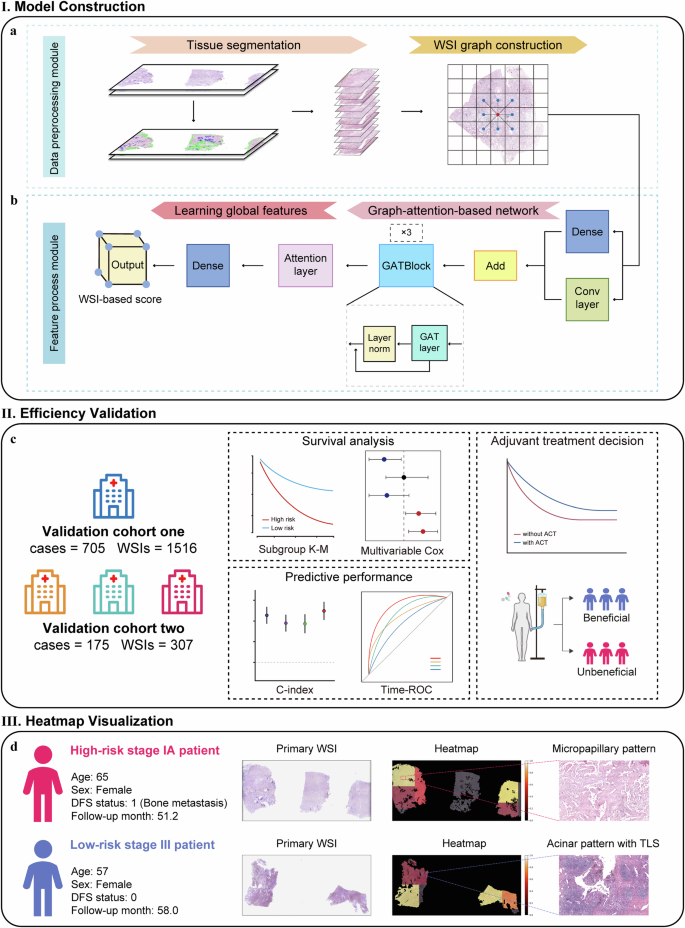
Existing prognostic models are useful for estimating the prognosis of lung adenocarcinoma patients, but there remains room for improvement. In the current study, we developed a deep learning model based on histopathological images to predict the recurrence risk of lung adenocarcinoma patients. The efficiency of the model was then evaluated in independent multicenter cohorts. The model defined high- and low-risk groups successfully stratified prognosis of the entire cohort. Moreover, multivariable Cox analysis identified the model defined risk groups as an independent predictor for disease-free survival. Importantly, combining TNM stage with the established model helped to distinguish subgroups of patients with high-risk stage II and stage III disease who are highly likely to benefit from adjuvant chemotherapy. Overall, our study highlights the significant value of the constructed model to serve as a complementary biomarker for survival stratification and adjuvant therapy selection for lung adenocarcinoma patients after resection.
期刊介绍:
npj Digital Medicine is an online open-access journal that focuses on publishing peer-reviewed research in the field of digital medicine. The journal covers various aspects of digital medicine, including the application and implementation of digital and mobile technologies in clinical settings, virtual healthcare, and the use of artificial intelligence and informatics.
The primary goal of the journal is to support innovation and the advancement of healthcare through the integration of new digital and mobile technologies. When determining if a manuscript is suitable for publication, the journal considers four important criteria: novelty, clinical relevance, scientific rigor, and digital innovation.





 京公网安备 11010802042870号
京ICP备2023020795号-1
京公网安备 11010802042870号
京ICP备2023020795号-1

 分享
分享
 求助内容:
求助内容: 应助结果提醒方式:
 扫码关注我们
