{"title":"下一代无线网络优化的生成人工智能:基础、最新技术和开放挑战","authors":"Fahime Khoramnejad;Ekram Hossain","doi":"10.1109/COMST.2025.3535554","DOIUrl":null,"url":null,"abstract":"Next-generation (xG) wireless networks, with their complex and dynamic nature, present significant challenges to using traditional optimization techniques. Generative Artificial Intelligence (GAI) emerges as a powerful tool due to its unique strengths. Unlike traditional optimization techniques and other machine learning methods, GAI excels at learning from real-world network data, capturing its intricacies. This enables safe, offline exploration of various configurations and generation of diverse, unseen scenarios, empowering proactive, data-driven exploration and optimization for xG networks. Additionally, GAI’s scalability makes it ideal for large-scale xG networks. This paper surveys how GAI-based models unlock optimization opportunities in xG wireless networks. We begin by providing a review of GAI models and some of the major communication paradigms of xG (e.g., Sixth Generation) wireless networks. We then delve into exploring how GAI can be used to improve resource allocation and enhance overall network performance. Additionally, we briefly review the networking requirements for supporting GAI applications in xG wireless networks. The paper further discusses the key challenges and future research directions in leveraging GAI for network optimization. Finally, a case study demonstrates the application of a diffusion-based GAI model for load balancing, carrier aggregation, and backhauling optimization in non-terrestrial networks, a core technology of xG networks. This case study serves as a practical example of how the combination of reinforcement learning and GAI can be implemented to address real-world network optimization problems.","PeriodicalId":55029,"journal":{"name":"IEEE Communications Surveys and Tutorials","volume":"27 6","pages":"3483-3525"},"PeriodicalIF":34.4000,"publicationDate":"2025-01-28","publicationTypes":"Journal Article","fieldsOfStudy":null,"isOpenAccess":false,"openAccessPdf":"","citationCount":"0","resultStr":"{\"title\":\"Generative AI for the Optimization of Next-Generation Wireless Networks: Basics, State-of-the-Art, and Open Challenges\",\"authors\":\"Fahime Khoramnejad;Ekram Hossain\",\"doi\":\"10.1109/COMST.2025.3535554\",\"DOIUrl\":null,\"url\":null,\"abstract\":\"Next-generation (xG) wireless networks, with their complex and dynamic nature, present significant challenges to using traditional optimization techniques. Generative Artificial Intelligence (GAI) emerges as a powerful tool due to its unique strengths. Unlike traditional optimization techniques and other machine learning methods, GAI excels at learning from real-world network data, capturing its intricacies. This enables safe, offline exploration of various configurations and generation of diverse, unseen scenarios, empowering proactive, data-driven exploration and optimization for xG networks. Additionally, GAI’s scalability makes it ideal for large-scale xG networks. This paper surveys how GAI-based models unlock optimization opportunities in xG wireless networks. We begin by providing a review of GAI models and some of the major communication paradigms of xG (e.g., Sixth Generation) wireless networks. We then delve into exploring how GAI can be used to improve resource allocation and enhance overall network performance. Additionally, we briefly review the networking requirements for supporting GAI applications in xG wireless networks. The paper further discusses the key challenges and future research directions in leveraging GAI for network optimization. Finally, a case study demonstrates the application of a diffusion-based GAI model for load balancing, carrier aggregation, and backhauling optimization in non-terrestrial networks, a core technology of xG networks. This case study serves as a practical example of how the combination of reinforcement learning and GAI can be implemented to address real-world network optimization problems.\",\"PeriodicalId\":55029,\"journal\":{\"name\":\"IEEE Communications Surveys and Tutorials\",\"volume\":\"27 6\",\"pages\":\"3483-3525\"},\"PeriodicalIF\":34.4000,\"publicationDate\":\"2025-01-28\",\"publicationTypes\":\"Journal Article\",\"fieldsOfStudy\":null,\"isOpenAccess\":false,\"openAccessPdf\":\"\",\"citationCount\":\"0\",\"resultStr\":null,\"platform\":\"Semanticscholar\",\"paperid\":null,\"PeriodicalName\":\"IEEE Communications Surveys and Tutorials\",\"FirstCategoryId\":\"94\",\"ListUrlMain\":\"https://ieeexplore.ieee.org/document/10855897/\",\"RegionNum\":1,\"RegionCategory\":\"计算机科学\",\"ArticlePicture\":[],\"TitleCN\":null,\"AbstractTextCN\":null,\"PMCID\":null,\"EPubDate\":\"\",\"PubModel\":\"\",\"JCR\":\"Q1\",\"JCRName\":\"COMPUTER SCIENCE, INFORMATION SYSTEMS\",\"Score\":null,\"Total\":0}","platform":"Semanticscholar","paperid":null,"PeriodicalName":"IEEE Communications Surveys and Tutorials","FirstCategoryId":"94","ListUrlMain":"https://ieeexplore.ieee.org/document/10855897/","RegionNum":1,"RegionCategory":"计算机科学","ArticlePicture":[],"TitleCN":null,"AbstractTextCN":null,"PMCID":null,"EPubDate":"","PubModel":"","JCR":"Q1","JCRName":"COMPUTER SCIENCE, INFORMATION SYSTEMS","Score":null,"Total":0}
Generative AI for the Optimization of Next-Generation Wireless Networks: Basics, State-of-the-Art, and Open Challenges
Next-generation (xG) wireless networks, with their complex and dynamic nature, present significant challenges to using traditional optimization techniques. Generative Artificial Intelligence (GAI) emerges as a powerful tool due to its unique strengths. Unlike traditional optimization techniques and other machine learning methods, GAI excels at learning from real-world network data, capturing its intricacies. This enables safe, offline exploration of various configurations and generation of diverse, unseen scenarios, empowering proactive, data-driven exploration and optimization for xG networks. Additionally, GAI’s scalability makes it ideal for large-scale xG networks. This paper surveys how GAI-based models unlock optimization opportunities in xG wireless networks. We begin by providing a review of GAI models and some of the major communication paradigms of xG (e.g., Sixth Generation) wireless networks. We then delve into exploring how GAI can be used to improve resource allocation and enhance overall network performance. Additionally, we briefly review the networking requirements for supporting GAI applications in xG wireless networks. The paper further discusses the key challenges and future research directions in leveraging GAI for network optimization. Finally, a case study demonstrates the application of a diffusion-based GAI model for load balancing, carrier aggregation, and backhauling optimization in non-terrestrial networks, a core technology of xG networks. This case study serves as a practical example of how the combination of reinforcement learning and GAI can be implemented to address real-world network optimization problems.
期刊介绍:
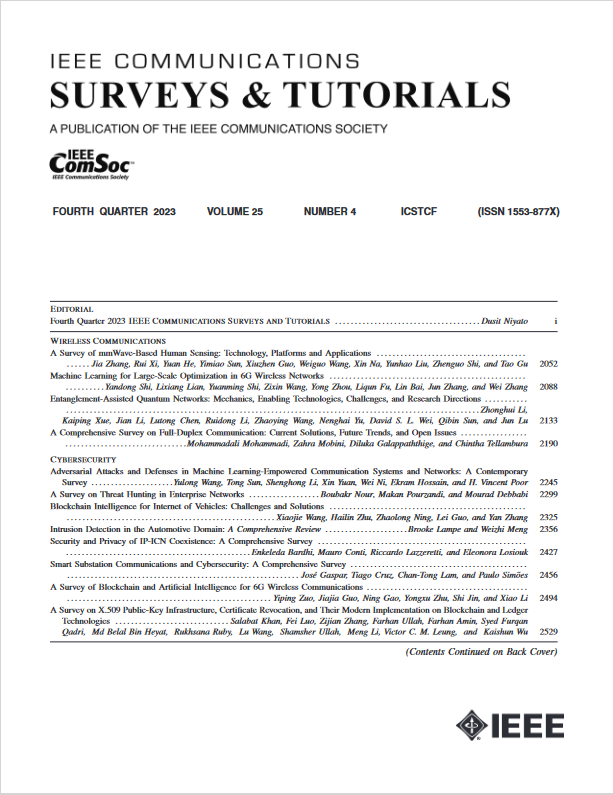
IEEE Communications Surveys & Tutorials is an online journal published by the IEEE Communications Society for tutorials and surveys covering all aspects of the communications field. Telecommunications technology is progressing at a rapid pace, and the IEEE Communications Society is committed to providing researchers and other professionals the information and tools to stay abreast. IEEE Communications Surveys and Tutorials focuses on integrating and adding understanding to the existing literature on communications, putting results in context. Whether searching for in-depth information about a familiar area or an introduction into a new area, IEEE Communications Surveys & Tutorials aims to be the premier source of peer-reviewed, comprehensive tutorials and surveys, and pointers to further sources. IEEE Communications Surveys & Tutorials publishes only articles exclusively written for IEEE Communications Surveys & Tutorials and go through a rigorous review process before their publication in the quarterly issues.
A tutorial article in the IEEE Communications Surveys & Tutorials should be designed to help the reader to become familiar with and learn something specific about a chosen topic. In contrast, the term survey, as applied here, is defined to mean a survey of the literature. A survey article in IEEE Communications Surveys & Tutorials should provide a comprehensive review of developments in a selected area, covering its development from its inception to its current state and beyond, and illustrating its development through liberal citations from the literature. Both tutorials and surveys should be tutorial in nature and should be written in a style comprehensible to readers outside the specialty of the article.




 京公网安备 11010802042870号
京ICP备2023020795号-1
京公网安备 11010802042870号
京ICP备2023020795号-1

 分享
分享
 求助内容:
求助内容: 应助结果提醒方式:
 扫码关注我们
