{"title":"异接瓶刷聚合物在溶液中形成珍珠项链到单分子胶束","authors":"Yiyan Kuang, Elena E. Dormidontova","doi":"10.1021/acs.macromol.4c02451","DOIUrl":null,"url":null,"abstract":"Bottlebrush polymers (BBPs) have attracted considerable attention due to their unique properties and a variety of applications. Using coarse-grained molecular dynamics simulations, we investigate and compare the structural properties of cyclic and linear poly(vinyl alcohol)-<i>graft</i>-poly(ethylene oxide)/poly(ethylene) (PVA-<i>g</i>-PEO/PE) in aqueous solution as a function of hydrophobic side-chain fraction. The side chains of different chemical nature allow the bottlebrush polymer to self-organize into different unimolecular structures. We found that with an increasing polyethylene fraction or PE side-chain length, an amphiphilic BBP self-organizes first into a pearl-necklace structure, which contains several hydrophobic aggregates engulfed and separated by hydrophilic side chains followed by a dumbbell-like structure. When the separation between two neighboring PE side chains becomes less than half of a PE side-chain length (<i>d</i><sub>sep</sub> < <i>l</i><sub>PE</sub>/2), a spherical unimolecular micelle with a single hydrophobic core surrounded by hydrophilic corona forms. Linear heterograft BBPs exhibit a higher propensity for the pearl-necklace regime at lower PE fractions, while for the cyclic heterograft BBPs, the backbone curvature enhances formation of dumbbell-like structures and facilitates packing into a more compact core of unimolecular micelles at higher PE content. The shape anisotropy of linear heterograft BBPs systematically decreases with an increase of PE fraction as the shape changes from 1D worm-like to a 3D spherically symmetric unimolecular micelle, while for cyclic heterograft BBPs, the shape anisotropy increases, reaches a maximum, and decreases reflecting conformational changes from a planar 2D structure to 1D dumbbell to 3D spherical conformations, accordingly. Among the different conformations of heterograft BBPs in solution, a spherical unimolecular micelle with the smallest hydrophobic core exhibits minimal contacts with water and maximum protection by the hydrophilic corona. These results demonstrate that heterograft BBPs offer a variety of conformations controlled by the side-chain length and composition that can be exploited in different applications including encapsulation of hydrophobic moieties for therapeutic or imaging applications.","PeriodicalId":51,"journal":{"name":"Macromolecules","volume":"40 1","pages":""},"PeriodicalIF":5.2000,"publicationDate":"2025-01-28","publicationTypes":"Journal Article","fieldsOfStudy":null,"isOpenAccess":false,"openAccessPdf":"","citationCount":"0","resultStr":"{\"title\":\"Pearl-Necklace to Unimolecular Micelle Formation by Heterograft Bottlebrush Polymers in Solution\",\"authors\":\"Yiyan Kuang, Elena E. Dormidontova\",\"doi\":\"10.1021/acs.macromol.4c02451\",\"DOIUrl\":null,\"url\":null,\"abstract\":\"Bottlebrush polymers (BBPs) have attracted considerable attention due to their unique properties and a variety of applications. Using coarse-grained molecular dynamics simulations, we investigate and compare the structural properties of cyclic and linear poly(vinyl alcohol)-<i>graft</i>-poly(ethylene oxide)/poly(ethylene) (PVA-<i>g</i>-PEO/PE) in aqueous solution as a function of hydrophobic side-chain fraction. The side chains of different chemical nature allow the bottlebrush polymer to self-organize into different unimolecular structures. We found that with an increasing polyethylene fraction or PE side-chain length, an amphiphilic BBP self-organizes first into a pearl-necklace structure, which contains several hydrophobic aggregates engulfed and separated by hydrophilic side chains followed by a dumbbell-like structure. When the separation between two neighboring PE side chains becomes less than half of a PE side-chain length (<i>d</i><sub>sep</sub> < <i>l</i><sub>PE</sub>/2), a spherical unimolecular micelle with a single hydrophobic core surrounded by hydrophilic corona forms. Linear heterograft BBPs exhibit a higher propensity for the pearl-necklace regime at lower PE fractions, while for the cyclic heterograft BBPs, the backbone curvature enhances formation of dumbbell-like structures and facilitates packing into a more compact core of unimolecular micelles at higher PE content. The shape anisotropy of linear heterograft BBPs systematically decreases with an increase of PE fraction as the shape changes from 1D worm-like to a 3D spherically symmetric unimolecular micelle, while for cyclic heterograft BBPs, the shape anisotropy increases, reaches a maximum, and decreases reflecting conformational changes from a planar 2D structure to 1D dumbbell to 3D spherical conformations, accordingly. Among the different conformations of heterograft BBPs in solution, a spherical unimolecular micelle with the smallest hydrophobic core exhibits minimal contacts with water and maximum protection by the hydrophilic corona. These results demonstrate that heterograft BBPs offer a variety of conformations controlled by the side-chain length and composition that can be exploited in different applications including encapsulation of hydrophobic moieties for therapeutic or imaging applications.\",\"PeriodicalId\":51,\"journal\":{\"name\":\"Macromolecules\",\"volume\":\"40 1\",\"pages\":\"\"},\"PeriodicalIF\":5.2000,\"publicationDate\":\"2025-01-28\",\"publicationTypes\":\"Journal Article\",\"fieldsOfStudy\":null,\"isOpenAccess\":false,\"openAccessPdf\":\"\",\"citationCount\":\"0\",\"resultStr\":null,\"platform\":\"Semanticscholar\",\"paperid\":null,\"PeriodicalName\":\"Macromolecules\",\"FirstCategoryId\":\"92\",\"ListUrlMain\":\"https://doi.org/10.1021/acs.macromol.4c02451\",\"RegionNum\":1,\"RegionCategory\":\"化学\",\"ArticlePicture\":[],\"TitleCN\":null,\"AbstractTextCN\":null,\"PMCID\":null,\"EPubDate\":\"\",\"PubModel\":\"\",\"JCR\":\"Q1\",\"JCRName\":\"POLYMER SCIENCE\",\"Score\":null,\"Total\":0}","platform":"Semanticscholar","paperid":null,"PeriodicalName":"Macromolecules","FirstCategoryId":"92","ListUrlMain":"https://doi.org/10.1021/acs.macromol.4c02451","RegionNum":1,"RegionCategory":"化学","ArticlePicture":[],"TitleCN":null,"AbstractTextCN":null,"PMCID":null,"EPubDate":"","PubModel":"","JCR":"Q1","JCRName":"POLYMER SCIENCE","Score":null,"Total":0}
Pearl-Necklace to Unimolecular Micelle Formation by Heterograft Bottlebrush Polymers in Solution
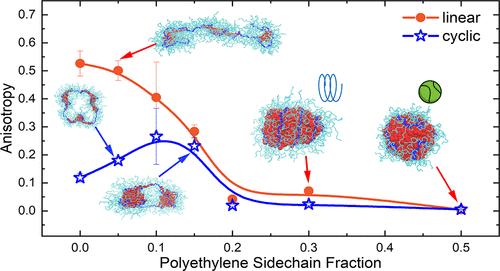
Bottlebrush polymers (BBPs) have attracted considerable attention due to their unique properties and a variety of applications. Using coarse-grained molecular dynamics simulations, we investigate and compare the structural properties of cyclic and linear poly(vinyl alcohol)-graft-poly(ethylene oxide)/poly(ethylene) (PVA-g-PEO/PE) in aqueous solution as a function of hydrophobic side-chain fraction. The side chains of different chemical nature allow the bottlebrush polymer to self-organize into different unimolecular structures. We found that with an increasing polyethylene fraction or PE side-chain length, an amphiphilic BBP self-organizes first into a pearl-necklace structure, which contains several hydrophobic aggregates engulfed and separated by hydrophilic side chains followed by a dumbbell-like structure. When the separation between two neighboring PE side chains becomes less than half of a PE side-chain length (dsep < lPE/2), a spherical unimolecular micelle with a single hydrophobic core surrounded by hydrophilic corona forms. Linear heterograft BBPs exhibit a higher propensity for the pearl-necklace regime at lower PE fractions, while for the cyclic heterograft BBPs, the backbone curvature enhances formation of dumbbell-like structures and facilitates packing into a more compact core of unimolecular micelles at higher PE content. The shape anisotropy of linear heterograft BBPs systematically decreases with an increase of PE fraction as the shape changes from 1D worm-like to a 3D spherically symmetric unimolecular micelle, while for cyclic heterograft BBPs, the shape anisotropy increases, reaches a maximum, and decreases reflecting conformational changes from a planar 2D structure to 1D dumbbell to 3D spherical conformations, accordingly. Among the different conformations of heterograft BBPs in solution, a spherical unimolecular micelle with the smallest hydrophobic core exhibits minimal contacts with water and maximum protection by the hydrophilic corona. These results demonstrate that heterograft BBPs offer a variety of conformations controlled by the side-chain length and composition that can be exploited in different applications including encapsulation of hydrophobic moieties for therapeutic or imaging applications.
期刊介绍:
Macromolecules publishes original, fundamental, and impactful research on all aspects of polymer science. Topics of interest include synthesis (e.g., controlled polymerizations, polymerization catalysis, post polymerization modification, new monomer structures and polymer architectures, and polymerization mechanisms/kinetics analysis); phase behavior, thermodynamics, dynamic, and ordering/disordering phenomena (e.g., self-assembly, gelation, crystallization, solution/melt/solid-state characteristics); structure and properties (e.g., mechanical and rheological properties, surface/interfacial characteristics, electronic and transport properties); new state of the art characterization (e.g., spectroscopy, scattering, microscopy, rheology), simulation (e.g., Monte Carlo, molecular dynamics, multi-scale/coarse-grained modeling), and theoretical methods. Renewable/sustainable polymers, polymer networks, responsive polymers, electro-, magneto- and opto-active macromolecules, inorganic polymers, charge-transporting polymers (ion-containing, semiconducting, and conducting), nanostructured polymers, and polymer composites are also of interest. Typical papers published in Macromolecules showcase important and innovative concepts, experimental methods/observations, and theoretical/computational approaches that demonstrate a fundamental advance in the understanding of polymers.




 京公网安备 11010802042870号
京ICP备2023020795号-1
京公网安备 11010802042870号
京ICP备2023020795号-1

 分享
分享
 求助内容:
求助内容: 应助结果提醒方式:
 扫码关注我们
