Nesma M. Kahk, Fatma E.A. Mohamed, Marwa M. Abdelhakeem, Rania B. Bakr
{"title":"吡唑/1,2,4-三唑作为EGFR/COX-2双抑制剂的优化:设计、合成、抗癌潜力、凋亡诱导和细胞周期分析","authors":"Nesma M. Kahk, Fatma E.A. Mohamed, Marwa M. Abdelhakeem, Rania B. Bakr","doi":"10.1016/j.ejmech.2025.117340","DOIUrl":null,"url":null,"abstract":"<div><div>A novel series of pyrazol-4-yl-1,2,4-triazole-3-thiol derivatives <strong>14a-l</strong> was designed, prepared and characterized by many spectroscopic techniques. All the novel compounds were screened for their anti-proliferative activity towards breast cancer cell line (MCF-7), colon cancer cell line (HT-29) and lung cancer cell line (A-549) utilizing celecoxib, erlotinib and osimertinib as standards. Compounds <strong>14b</strong>, <strong>14g</strong> and <strong>14k</strong> were the most active towards HT-29, MCF-7 and A-549 cell lines, sequentially with IC<sub>50</sub> = 1.20–2.93 μM compared with celecoxib (IC<sub>50</sub> = 16.47–41.45 μM), erlotinib (IC<sub>50</sub> = 1.95–33.57 μM) and osimertinib (IC<sub>50</sub> = 0.75–3.45 μM). These most active derivatives <strong>14b</strong>, <strong>14g</strong> and <strong>14k</strong> were further investigated for their inhibitory potential against COX and EGFR enzymes. These compounds <strong>14b</strong>, <strong>14g</strong> and <strong>14k</strong> suppressed COX-2 (IC<sub>50</sub> = 0.560–4.692 μM), EGFR<sup>WT</sup> (IC<sub>50</sub> = 0.121–0.423 μM) and EGFR<sup>T790M</sup> (IC<sub>50</sub> = 0.076–0.764 μM) enzymes. Compounds <strong>14b</strong>, <strong>14g</strong> and <strong>14k</strong> displayed apoptosis induction by up-regulating Bax and down-regulating Bcl-2 protein levels. Cell cycle analysis recorded that exposure of MFC-7 cells to compound <strong>14g</strong> resulted in a significant increase in the percentage of cells at the G2/M to 39.15 % compared to the standard erlotinib (9.87 %). Docking study of the most potent candidates <strong>14b</strong>, <strong>14g</strong> and <strong>14k</strong> within COX-2, EGFR<sup>WT</sup> and EGFR<sup>T790M</sup> active regions was conducted to suggest the binding mode of these compounds inside these target enzymes.</div></div>","PeriodicalId":314,"journal":{"name":"European Journal of Medicinal Chemistry","volume":"287 ","pages":"Article 117340"},"PeriodicalIF":5.9000,"publicationDate":"2025-04-05","publicationTypes":"Journal Article","fieldsOfStudy":null,"isOpenAccess":false,"openAccessPdf":"","citationCount":"0","resultStr":"{\"title\":\"Optimization of pyrazole/1,2,4-triazole as dual EGFR/COX-2 inhibitors: Design, synthesis, anticancer potential, apoptosis induction and cell cycle analysis\",\"authors\":\"Nesma M. Kahk, Fatma E.A. Mohamed, Marwa M. Abdelhakeem, Rania B. Bakr\",\"doi\":\"10.1016/j.ejmech.2025.117340\",\"DOIUrl\":null,\"url\":null,\"abstract\":\"<div><div>A novel series of pyrazol-4-yl-1,2,4-triazole-3-thiol derivatives <strong>14a-l</strong> was designed, prepared and characterized by many spectroscopic techniques. All the novel compounds were screened for their anti-proliferative activity towards breast cancer cell line (MCF-7), colon cancer cell line (HT-29) and lung cancer cell line (A-549) utilizing celecoxib, erlotinib and osimertinib as standards. Compounds <strong>14b</strong>, <strong>14g</strong> and <strong>14k</strong> were the most active towards HT-29, MCF-7 and A-549 cell lines, sequentially with IC<sub>50</sub> = 1.20–2.93 μM compared with celecoxib (IC<sub>50</sub> = 16.47–41.45 μM), erlotinib (IC<sub>50</sub> = 1.95–33.57 μM) and osimertinib (IC<sub>50</sub> = 0.75–3.45 μM). These most active derivatives <strong>14b</strong>, <strong>14g</strong> and <strong>14k</strong> were further investigated for their inhibitory potential against COX and EGFR enzymes. These compounds <strong>14b</strong>, <strong>14g</strong> and <strong>14k</strong> suppressed COX-2 (IC<sub>50</sub> = 0.560–4.692 μM), EGFR<sup>WT</sup> (IC<sub>50</sub> = 0.121–0.423 μM) and EGFR<sup>T790M</sup> (IC<sub>50</sub> = 0.076–0.764 μM) enzymes. Compounds <strong>14b</strong>, <strong>14g</strong> and <strong>14k</strong> displayed apoptosis induction by up-regulating Bax and down-regulating Bcl-2 protein levels. Cell cycle analysis recorded that exposure of MFC-7 cells to compound <strong>14g</strong> resulted in a significant increase in the percentage of cells at the G2/M to 39.15 % compared to the standard erlotinib (9.87 %). Docking study of the most potent candidates <strong>14b</strong>, <strong>14g</strong> and <strong>14k</strong> within COX-2, EGFR<sup>WT</sup> and EGFR<sup>T790M</sup> active regions was conducted to suggest the binding mode of these compounds inside these target enzymes.</div></div>\",\"PeriodicalId\":314,\"journal\":{\"name\":\"European Journal of Medicinal Chemistry\",\"volume\":\"287 \",\"pages\":\"Article 117340\"},\"PeriodicalIF\":5.9000,\"publicationDate\":\"2025-04-05\",\"publicationTypes\":\"Journal Article\",\"fieldsOfStudy\":null,\"isOpenAccess\":false,\"openAccessPdf\":\"\",\"citationCount\":\"0\",\"resultStr\":null,\"platform\":\"Semanticscholar\",\"paperid\":null,\"PeriodicalName\":\"European Journal of Medicinal Chemistry\",\"FirstCategoryId\":\"3\",\"ListUrlMain\":\"https://www.sciencedirect.com/science/article/pii/S0223523425001059\",\"RegionNum\":2,\"RegionCategory\":\"医学\",\"ArticlePicture\":[],\"TitleCN\":null,\"AbstractTextCN\":null,\"PMCID\":null,\"EPubDate\":\"2025/1/30 0:00:00\",\"PubModel\":\"Epub\",\"JCR\":\"Q1\",\"JCRName\":\"CHEMISTRY, MEDICINAL\",\"Score\":null,\"Total\":0}","platform":"Semanticscholar","paperid":null,"PeriodicalName":"European Journal of Medicinal Chemistry","FirstCategoryId":"3","ListUrlMain":"https://www.sciencedirect.com/science/article/pii/S0223523425001059","RegionNum":2,"RegionCategory":"医学","ArticlePicture":[],"TitleCN":null,"AbstractTextCN":null,"PMCID":null,"EPubDate":"2025/1/30 0:00:00","PubModel":"Epub","JCR":"Q1","JCRName":"CHEMISTRY, MEDICINAL","Score":null,"Total":0}
Optimization of pyrazole/1,2,4-triazole as dual EGFR/COX-2 inhibitors: Design, synthesis, anticancer potential, apoptosis induction and cell cycle analysis
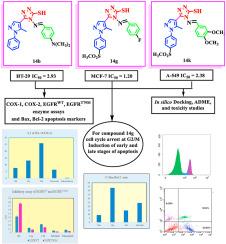
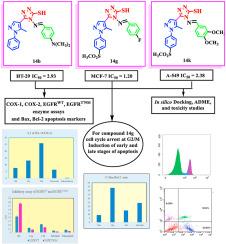
A novel series of pyrazol-4-yl-1,2,4-triazole-3-thiol derivatives 14a-l was designed, prepared and characterized by many spectroscopic techniques. All the novel compounds were screened for their anti-proliferative activity towards breast cancer cell line (MCF-7), colon cancer cell line (HT-29) and lung cancer cell line (A-549) utilizing celecoxib, erlotinib and osimertinib as standards. Compounds 14b, 14g and 14k were the most active towards HT-29, MCF-7 and A-549 cell lines, sequentially with IC50 = 1.20–2.93 μM compared with celecoxib (IC50 = 16.47–41.45 μM), erlotinib (IC50 = 1.95–33.57 μM) and osimertinib (IC50 = 0.75–3.45 μM). These most active derivatives 14b, 14g and 14k were further investigated for their inhibitory potential against COX and EGFR enzymes. These compounds 14b, 14g and 14k suppressed COX-2 (IC50 = 0.560–4.692 μM), EGFRWT (IC50 = 0.121–0.423 μM) and EGFRT790M (IC50 = 0.076–0.764 μM) enzymes. Compounds 14b, 14g and 14k displayed apoptosis induction by up-regulating Bax and down-regulating Bcl-2 protein levels. Cell cycle analysis recorded that exposure of MFC-7 cells to compound 14g resulted in a significant increase in the percentage of cells at the G2/M to 39.15 % compared to the standard erlotinib (9.87 %). Docking study of the most potent candidates 14b, 14g and 14k within COX-2, EGFRWT and EGFRT790M active regions was conducted to suggest the binding mode of these compounds inside these target enzymes.
期刊介绍:
The European Journal of Medicinal Chemistry is a global journal that publishes studies on all aspects of medicinal chemistry. It provides a medium for publication of original papers and also welcomes critical review papers.
A typical paper would report on the organic synthesis, characterization and pharmacological evaluation of compounds. Other topics of interest are drug design, QSAR, molecular modeling, drug-receptor interactions, molecular aspects of drug metabolism, prodrug synthesis and drug targeting. The journal expects manuscripts to present the rational for a study, provide insight into the design of compounds or understanding of mechanism, or clarify the targets.




 京公网安备 11010802042870号
京ICP备2023020795号-1
京公网安备 11010802042870号
京ICP备2023020795号-1

 分享
分享
 求助内容:
求助内容: 应助结果提醒方式:
 扫码关注我们
