{"title":"gan的数据清理","authors":"Naoyuki Terashita;Hiroki Ohashi;Satoshi Hara","doi":"10.1109/TNNLS.2025.3529540","DOIUrl":null,"url":null,"abstract":"As the application of generative adversarial networks (GANs) expands, it becomes increasingly critical to develop a unified approach that improves performance across various generative tasks. One effective strategy that applies to any machine learning task is identifying harmful instances, whose removal improves the performance. While previous studies have successfully estimated these harmful training instances in supervised settings, their approaches are not easily applicable to GANs. The challenge lies in two requirements of the previous approaches that do not apply to GANs. First, previous approaches require that the absence of a training instance directly affects the parameters. However, in the training for GANs, the instances do not directly affect the generator’s parameters since they are only fed into the discriminator. Second, previous approaches assume that the change in loss directly quantifies the harmfulness of the instance to a model’s performance, while common types of GAN losses do not always reflect the generative performance. To overcome the first challenge, we propose influence estimation methods that use the Jacobian of the generator’s gradient with respect to the discriminator’s parameters (and vice versa). Such a Jacobian represents the indirect effect between two models: how removing an instance from the discriminator’s training changes the generator’s parameters. Second, we propose an instance evaluation scheme that measures the harmfulness of each training instance based on how a GAN evaluation metric [e.g., inception score (IS)] is expected to change by the instance’s removal. Furthermore, we demonstrate that removing the identified harmful instances significantly improves the generative performance on various GAN evaluation metrics. The code is available at <uri>https://github.com/hitachi-rd-cv/data-cleansing-for-gans</uri>.","PeriodicalId":13303,"journal":{"name":"IEEE transactions on neural networks and learning systems","volume":"36 6","pages":"11575-11588"},"PeriodicalIF":8.9000,"publicationDate":"2025-01-29","publicationTypes":"Journal Article","fieldsOfStudy":null,"isOpenAccess":false,"openAccessPdf":"","citationCount":"0","resultStr":"{\"title\":\"Data Cleansing for GANs\",\"authors\":\"Naoyuki Terashita;Hiroki Ohashi;Satoshi Hara\",\"doi\":\"10.1109/TNNLS.2025.3529540\",\"DOIUrl\":null,\"url\":null,\"abstract\":\"As the application of generative adversarial networks (GANs) expands, it becomes increasingly critical to develop a unified approach that improves performance across various generative tasks. One effective strategy that applies to any machine learning task is identifying harmful instances, whose removal improves the performance. While previous studies have successfully estimated these harmful training instances in supervised settings, their approaches are not easily applicable to GANs. The challenge lies in two requirements of the previous approaches that do not apply to GANs. First, previous approaches require that the absence of a training instance directly affects the parameters. However, in the training for GANs, the instances do not directly affect the generator’s parameters since they are only fed into the discriminator. Second, previous approaches assume that the change in loss directly quantifies the harmfulness of the instance to a model’s performance, while common types of GAN losses do not always reflect the generative performance. To overcome the first challenge, we propose influence estimation methods that use the Jacobian of the generator’s gradient with respect to the discriminator’s parameters (and vice versa). Such a Jacobian represents the indirect effect between two models: how removing an instance from the discriminator’s training changes the generator’s parameters. Second, we propose an instance evaluation scheme that measures the harmfulness of each training instance based on how a GAN evaluation metric [e.g., inception score (IS)] is expected to change by the instance’s removal. Furthermore, we demonstrate that removing the identified harmful instances significantly improves the generative performance on various GAN evaluation metrics. The code is available at <uri>https://github.com/hitachi-rd-cv/data-cleansing-for-gans</uri>.\",\"PeriodicalId\":13303,\"journal\":{\"name\":\"IEEE transactions on neural networks and learning systems\",\"volume\":\"36 6\",\"pages\":\"11575-11588\"},\"PeriodicalIF\":8.9000,\"publicationDate\":\"2025-01-29\",\"publicationTypes\":\"Journal Article\",\"fieldsOfStudy\":null,\"isOpenAccess\":false,\"openAccessPdf\":\"\",\"citationCount\":\"0\",\"resultStr\":null,\"platform\":\"Semanticscholar\",\"paperid\":null,\"PeriodicalName\":\"IEEE transactions on neural networks and learning systems\",\"FirstCategoryId\":\"94\",\"ListUrlMain\":\"https://ieeexplore.ieee.org/document/10857591/\",\"RegionNum\":1,\"RegionCategory\":\"计算机科学\",\"ArticlePicture\":[],\"TitleCN\":null,\"AbstractTextCN\":null,\"PMCID\":null,\"EPubDate\":\"\",\"PubModel\":\"\",\"JCR\":\"Q1\",\"JCRName\":\"COMPUTER SCIENCE, ARTIFICIAL INTELLIGENCE\",\"Score\":null,\"Total\":0}","platform":"Semanticscholar","paperid":null,"PeriodicalName":"IEEE transactions on neural networks and learning systems","FirstCategoryId":"94","ListUrlMain":"https://ieeexplore.ieee.org/document/10857591/","RegionNum":1,"RegionCategory":"计算机科学","ArticlePicture":[],"TitleCN":null,"AbstractTextCN":null,"PMCID":null,"EPubDate":"","PubModel":"","JCR":"Q1","JCRName":"COMPUTER SCIENCE, ARTIFICIAL INTELLIGENCE","Score":null,"Total":0}
As the application of generative adversarial networks (GANs) expands, it becomes increasingly critical to develop a unified approach that improves performance across various generative tasks. One effective strategy that applies to any machine learning task is identifying harmful instances, whose removal improves the performance. While previous studies have successfully estimated these harmful training instances in supervised settings, their approaches are not easily applicable to GANs. The challenge lies in two requirements of the previous approaches that do not apply to GANs. First, previous approaches require that the absence of a training instance directly affects the parameters. However, in the training for GANs, the instances do not directly affect the generator’s parameters since they are only fed into the discriminator. Second, previous approaches assume that the change in loss directly quantifies the harmfulness of the instance to a model’s performance, while common types of GAN losses do not always reflect the generative performance. To overcome the first challenge, we propose influence estimation methods that use the Jacobian of the generator’s gradient with respect to the discriminator’s parameters (and vice versa). Such a Jacobian represents the indirect effect between two models: how removing an instance from the discriminator’s training changes the generator’s parameters. Second, we propose an instance evaluation scheme that measures the harmfulness of each training instance based on how a GAN evaluation metric [e.g., inception score (IS)] is expected to change by the instance’s removal. Furthermore, we demonstrate that removing the identified harmful instances significantly improves the generative performance on various GAN evaluation metrics. The code is available at https://github.com/hitachi-rd-cv/data-cleansing-for-gans.
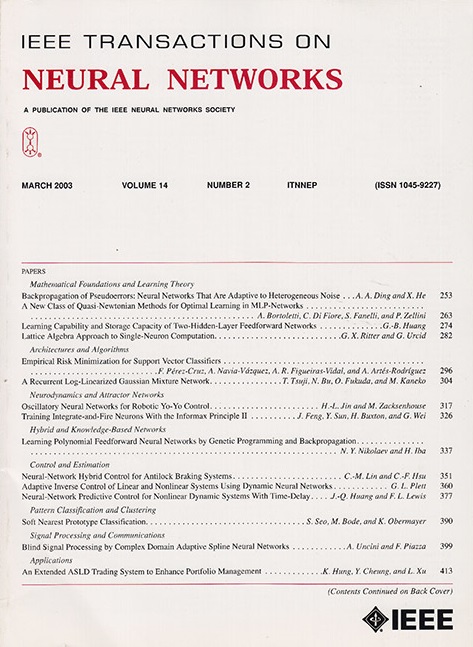
期刊介绍:
The focus of IEEE Transactions on Neural Networks and Learning Systems is to present scholarly articles discussing the theory, design, and applications of neural networks as well as other learning systems. The journal primarily highlights technical and scientific research in this domain.




 京公网安备 11010802042870号
京ICP备2023020795号-1
京公网安备 11010802042870号
京ICP备2023020795号-1

 分享
分享
 求助内容:
求助内容: 应助结果提醒方式:
 扫码关注我们
