John M. Migliore, Maruti Hegde, Amar S. Kumbhar, Qishun Tang, Theo J. Dingemans
{"title":"用一价盐增加棒状聚电解质溶液的粘度","authors":"John M. Migliore, Maruti Hegde, Amar S. Kumbhar, Qishun Tang, Theo J. Dingemans","doi":"10.1021/acs.macromol.4c03053","DOIUrl":null,"url":null,"abstract":"The behavior of a synthetic self-assembled rodlike polyelectrolyte is investigated both in salt-free solutions and in the presence of monovalent salt. The inherent rigidity and rodlike nature of poly(2,2′-disulfonyl-4,4′-benzidine terephthalamide) (PBDT) in salt-free aqueous solutions results in a nematic liquid-crystalline transition at a 1.0 wt % concentration. Specific viscosity η<sub>sp</sub> of PBDT scales with concentration (<i>c</i>) as η<sub>sp</sub> ∼ <i>c</i><sup>1.2</sup> in semidilute salt-free solutions, which deviates from the behavior of most semidilute polyelectrolyte solutions that follow Fuoss law (η<sub>sp</sub> ∼ <i>c</i><sup>0.5</sup>). Additionally, PBDT solutions containing 30 mM NaCl reveal a crossover concentration (<i>c</i> > <i>c</i><sub><i>x</i></sub>) and show up to a greater than 20-fold increase in η<sub><i>sp</i></sub> compared with salt-free PBDT solutions at the same concentration. Oscillatory rheology experiments display a rise in modulus at all frequencies for PBDT solutions containing 10 mM NaCl and above, suggesting an increase in rod–rod association strength. X-ray scattering studies in salt-free semidilute PBDT solutions reveal polyelectrolyte correlation length (ξ) scaling as ε ∼ <i>c</i><sup>–0.43±0.03</sup>, which is a weaker dependence than typical scaling (ξ ∼ <i>c</i><sup>–1/2</sup>) due to the balance of electrostatic and associative intermolecular interactions. We propose that PBDT can serve as a synthetic model system for studying the solution behavior of associative rodlike polyelectrolytes.","PeriodicalId":51,"journal":{"name":"Macromolecules","volume":"17 1","pages":""},"PeriodicalIF":5.2000,"publicationDate":"2025-01-29","publicationTypes":"Journal Article","fieldsOfStudy":null,"isOpenAccess":false,"openAccessPdf":"","citationCount":"0","resultStr":"{\"title\":\"Increasing Viscosity of a Rodlike Polyelectrolyte Solution with a Monovalent Salt\",\"authors\":\"John M. Migliore, Maruti Hegde, Amar S. Kumbhar, Qishun Tang, Theo J. Dingemans\",\"doi\":\"10.1021/acs.macromol.4c03053\",\"DOIUrl\":null,\"url\":null,\"abstract\":\"The behavior of a synthetic self-assembled rodlike polyelectrolyte is investigated both in salt-free solutions and in the presence of monovalent salt. The inherent rigidity and rodlike nature of poly(2,2′-disulfonyl-4,4′-benzidine terephthalamide) (PBDT) in salt-free aqueous solutions results in a nematic liquid-crystalline transition at a 1.0 wt % concentration. Specific viscosity η<sub>sp</sub> of PBDT scales with concentration (<i>c</i>) as η<sub>sp</sub> ∼ <i>c</i><sup>1.2</sup> in semidilute salt-free solutions, which deviates from the behavior of most semidilute polyelectrolyte solutions that follow Fuoss law (η<sub>sp</sub> ∼ <i>c</i><sup>0.5</sup>). Additionally, PBDT solutions containing 30 mM NaCl reveal a crossover concentration (<i>c</i> > <i>c</i><sub><i>x</i></sub>) and show up to a greater than 20-fold increase in η<sub><i>sp</i></sub> compared with salt-free PBDT solutions at the same concentration. Oscillatory rheology experiments display a rise in modulus at all frequencies for PBDT solutions containing 10 mM NaCl and above, suggesting an increase in rod–rod association strength. X-ray scattering studies in salt-free semidilute PBDT solutions reveal polyelectrolyte correlation length (ξ) scaling as ε ∼ <i>c</i><sup>–0.43±0.03</sup>, which is a weaker dependence than typical scaling (ξ ∼ <i>c</i><sup>–1/2</sup>) due to the balance of electrostatic and associative intermolecular interactions. We propose that PBDT can serve as a synthetic model system for studying the solution behavior of associative rodlike polyelectrolytes.\",\"PeriodicalId\":51,\"journal\":{\"name\":\"Macromolecules\",\"volume\":\"17 1\",\"pages\":\"\"},\"PeriodicalIF\":5.2000,\"publicationDate\":\"2025-01-29\",\"publicationTypes\":\"Journal Article\",\"fieldsOfStudy\":null,\"isOpenAccess\":false,\"openAccessPdf\":\"\",\"citationCount\":\"0\",\"resultStr\":null,\"platform\":\"Semanticscholar\",\"paperid\":null,\"PeriodicalName\":\"Macromolecules\",\"FirstCategoryId\":\"92\",\"ListUrlMain\":\"https://doi.org/10.1021/acs.macromol.4c03053\",\"RegionNum\":1,\"RegionCategory\":\"化学\",\"ArticlePicture\":[],\"TitleCN\":null,\"AbstractTextCN\":null,\"PMCID\":null,\"EPubDate\":\"\",\"PubModel\":\"\",\"JCR\":\"Q1\",\"JCRName\":\"POLYMER SCIENCE\",\"Score\":null,\"Total\":0}","platform":"Semanticscholar","paperid":null,"PeriodicalName":"Macromolecules","FirstCategoryId":"92","ListUrlMain":"https://doi.org/10.1021/acs.macromol.4c03053","RegionNum":1,"RegionCategory":"化学","ArticlePicture":[],"TitleCN":null,"AbstractTextCN":null,"PMCID":null,"EPubDate":"","PubModel":"","JCR":"Q1","JCRName":"POLYMER SCIENCE","Score":null,"Total":0}
引用次数: 0
摘要
研究了一种合成的自组装棒状聚电解质在无盐溶液和单价盐存在下的行为。聚(2,2 ' -二磺酰基-4,4 ' -联苯胺对苯二甲酸)(PBDT)在无盐水溶液中固有的刚性和棒状性质导致在1.0 wt %浓度下向列相液晶转变。在半稀无盐溶液中,PBDT的比粘度ηsp随浓度(c)为ηsp ~ c1.2而变化,这与大多数半稀聚电解质溶液遵循Fuoss定律(ηsp ~ c0.5)的行为不同。此外,含有30 mM NaCl的PBDT溶液显示交叉浓度(c >;在相同浓度下,与无盐PBDT溶液相比,ηsp增加了20倍以上。振荡流变学实验显示,含10 mM NaCl及以上的PBDT溶液在所有频率下的模量都有所增加,这表明棒-棒结合强度增加。在无盐半稀PBDT溶液中的x射线散射研究表明,聚电解质相关长度(ξ)结垢为ε ~ c-0.43±0.03,由于静电和缔合分子间相互作用的平衡,其依赖性比典型结垢(ξ ~ c-1/2)弱。我们提出PBDT可以作为研究结合棒状聚电解质溶液行为的综合模型体系。
Increasing Viscosity of a Rodlike Polyelectrolyte Solution with a Monovalent Salt
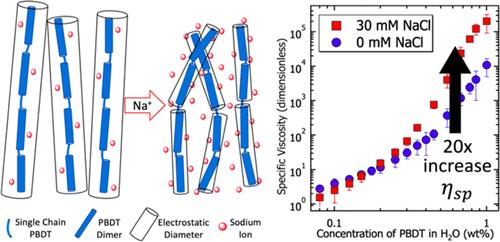
The behavior of a synthetic self-assembled rodlike polyelectrolyte is investigated both in salt-free solutions and in the presence of monovalent salt. The inherent rigidity and rodlike nature of poly(2,2′-disulfonyl-4,4′-benzidine terephthalamide) (PBDT) in salt-free aqueous solutions results in a nematic liquid-crystalline transition at a 1.0 wt % concentration. Specific viscosity ηsp of PBDT scales with concentration (c) as ηsp ∼ c1.2 in semidilute salt-free solutions, which deviates from the behavior of most semidilute polyelectrolyte solutions that follow Fuoss law (ηsp ∼ c0.5). Additionally, PBDT solutions containing 30 mM NaCl reveal a crossover concentration (c > cx) and show up to a greater than 20-fold increase in ηsp compared with salt-free PBDT solutions at the same concentration. Oscillatory rheology experiments display a rise in modulus at all frequencies for PBDT solutions containing 10 mM NaCl and above, suggesting an increase in rod–rod association strength. X-ray scattering studies in salt-free semidilute PBDT solutions reveal polyelectrolyte correlation length (ξ) scaling as ε ∼ c–0.43±0.03, which is a weaker dependence than typical scaling (ξ ∼ c–1/2) due to the balance of electrostatic and associative intermolecular interactions. We propose that PBDT can serve as a synthetic model system for studying the solution behavior of associative rodlike polyelectrolytes.
期刊介绍:
Macromolecules publishes original, fundamental, and impactful research on all aspects of polymer science. Topics of interest include synthesis (e.g., controlled polymerizations, polymerization catalysis, post polymerization modification, new monomer structures and polymer architectures, and polymerization mechanisms/kinetics analysis); phase behavior, thermodynamics, dynamic, and ordering/disordering phenomena (e.g., self-assembly, gelation, crystallization, solution/melt/solid-state characteristics); structure and properties (e.g., mechanical and rheological properties, surface/interfacial characteristics, electronic and transport properties); new state of the art characterization (e.g., spectroscopy, scattering, microscopy, rheology), simulation (e.g., Monte Carlo, molecular dynamics, multi-scale/coarse-grained modeling), and theoretical methods. Renewable/sustainable polymers, polymer networks, responsive polymers, electro-, magneto- and opto-active macromolecules, inorganic polymers, charge-transporting polymers (ion-containing, semiconducting, and conducting), nanostructured polymers, and polymer composites are also of interest. Typical papers published in Macromolecules showcase important and innovative concepts, experimental methods/observations, and theoretical/computational approaches that demonstrate a fundamental advance in the understanding of polymers.




 京公网安备 11010802042870号
京ICP备2023020795号-1
京公网安备 11010802042870号
京ICP备2023020795号-1

 分享
分享
 求助内容:
求助内容: 应助结果提醒方式:
 扫码关注我们
