{"title":"一种独特的大孔介孔碳纳米约束驱动的高效高压CO2捕获和释放。","authors":"László Szabó, Mizuki Inoue, Yurina Sekine, Ryuhei Motokawa, Yusuke Matsumoto, Thi Thi Nge, Edhuan Ismail, Izumi Ichinose, Tatsuhiko Yamada","doi":"10.1002/cssc.202402034","DOIUrl":null,"url":null,"abstract":"<p>Although microporous carbons can perform well for CO<sub>2</sub> separations under high pressure conditions, their energy-demanding regeneration may render them a less attractive material option. Here, we developed a large-pore mesoporous carbon with pore sizes centered around 20–30 nm using a templated technical lignin. During the soft-templating process, unique cylindrical supramolecular assemblies form from the copolymer template. This peculiar nanostructuring takes place due to the presence of polyethylene glycol (PEG) segments on both the Pluronic® template and the PEG-grafted lignin derivative (glycol lignin). A large increase in CO<sub>2</sub> uptake occurs on the resulting large-pore mesoporous carbon at 270 K close to the saturation pressure (3.2 MPa), owing to capillary condensation. This phenomenon enables a CO<sub>2</sub>/CH<sub>4</sub> selectivity (<i>S</i><sub>CO2/CH4</sub>, mol/mol) of 3.7 at 270 K and 3.1 MPa absolute pressure, and a swift pressure swing regeneration process with desorbed CO<sub>2</sub> per unit pressure far outperforming a benchmark activated carbon (<i>i.e</i>., notably rapid decrease in the amount of adsorbed CO<sub>2</sub> with decreasing pressure). We propose large-pore mesoporous carbons as a novel family of CO<sub>2</sub> capture adsorbents, based on the phase-transition behavior shift of CO<sub>2</sub> in the nanoconfined environment. This novel material concept may open new horizons for physisorptive CO<sub>2</sub> separations with energy-efficient regeneration options.</p>","PeriodicalId":149,"journal":{"name":"ChemSusChem","volume":"18 10","pages":""},"PeriodicalIF":6.6000,"publicationDate":"2025-01-28","publicationTypes":"Journal Article","fieldsOfStudy":null,"isOpenAccess":false,"openAccessPdf":"","citationCount":"0","resultStr":"{\"title\":\"Nanoconfinement-Driven Energy-Efficient CO2 Capture and Release at High Pressures on a Unique Large-Pore Mesoporous Carbon\",\"authors\":\"László Szabó, Mizuki Inoue, Yurina Sekine, Ryuhei Motokawa, Yusuke Matsumoto, Thi Thi Nge, Edhuan Ismail, Izumi Ichinose, Tatsuhiko Yamada\",\"doi\":\"10.1002/cssc.202402034\",\"DOIUrl\":null,\"url\":null,\"abstract\":\"<p>Although microporous carbons can perform well for CO<sub>2</sub> separations under high pressure conditions, their energy-demanding regeneration may render them a less attractive material option. Here, we developed a large-pore mesoporous carbon with pore sizes centered around 20–30 nm using a templated technical lignin. During the soft-templating process, unique cylindrical supramolecular assemblies form from the copolymer template. This peculiar nanostructuring takes place due to the presence of polyethylene glycol (PEG) segments on both the Pluronic® template and the PEG-grafted lignin derivative (glycol lignin). A large increase in CO<sub>2</sub> uptake occurs on the resulting large-pore mesoporous carbon at 270 K close to the saturation pressure (3.2 MPa), owing to capillary condensation. This phenomenon enables a CO<sub>2</sub>/CH<sub>4</sub> selectivity (<i>S</i><sub>CO2/CH4</sub>, mol/mol) of 3.7 at 270 K and 3.1 MPa absolute pressure, and a swift pressure swing regeneration process with desorbed CO<sub>2</sub> per unit pressure far outperforming a benchmark activated carbon (<i>i.e</i>., notably rapid decrease in the amount of adsorbed CO<sub>2</sub> with decreasing pressure). We propose large-pore mesoporous carbons as a novel family of CO<sub>2</sub> capture adsorbents, based on the phase-transition behavior shift of CO<sub>2</sub> in the nanoconfined environment. This novel material concept may open new horizons for physisorptive CO<sub>2</sub> separations with energy-efficient regeneration options.</p>\",\"PeriodicalId\":149,\"journal\":{\"name\":\"ChemSusChem\",\"volume\":\"18 10\",\"pages\":\"\"},\"PeriodicalIF\":6.6000,\"publicationDate\":\"2025-01-28\",\"publicationTypes\":\"Journal Article\",\"fieldsOfStudy\":null,\"isOpenAccess\":false,\"openAccessPdf\":\"\",\"citationCount\":\"0\",\"resultStr\":null,\"platform\":\"Semanticscholar\",\"paperid\":null,\"PeriodicalName\":\"ChemSusChem\",\"FirstCategoryId\":\"92\",\"ListUrlMain\":\"https://chemistry-europe.onlinelibrary.wiley.com/doi/10.1002/cssc.202402034\",\"RegionNum\":2,\"RegionCategory\":\"化学\",\"ArticlePicture\":[],\"TitleCN\":null,\"AbstractTextCN\":null,\"PMCID\":null,\"EPubDate\":\"\",\"PubModel\":\"\",\"JCR\":\"Q1\",\"JCRName\":\"CHEMISTRY, MULTIDISCIPLINARY\",\"Score\":null,\"Total\":0}","platform":"Semanticscholar","paperid":null,"PeriodicalName":"ChemSusChem","FirstCategoryId":"92","ListUrlMain":"https://chemistry-europe.onlinelibrary.wiley.com/doi/10.1002/cssc.202402034","RegionNum":2,"RegionCategory":"化学","ArticlePicture":[],"TitleCN":null,"AbstractTextCN":null,"PMCID":null,"EPubDate":"","PubModel":"","JCR":"Q1","JCRName":"CHEMISTRY, MULTIDISCIPLINARY","Score":null,"Total":0}
Nanoconfinement-Driven Energy-Efficient CO2 Capture and Release at High Pressures on a Unique Large-Pore Mesoporous Carbon
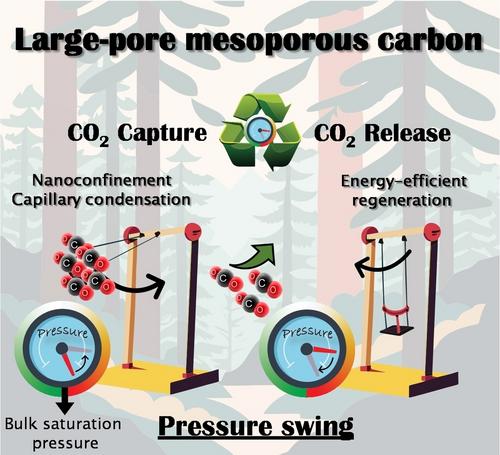
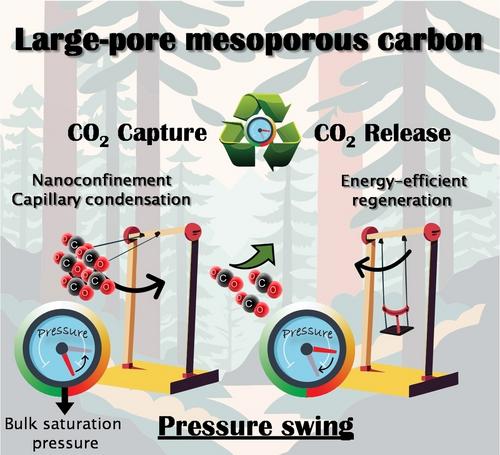
Although microporous carbons can perform well for CO2 separations under high pressure conditions, their energy-demanding regeneration may render them a less attractive material option. Here, we developed a large-pore mesoporous carbon with pore sizes centered around 20–30 nm using a templated technical lignin. During the soft-templating process, unique cylindrical supramolecular assemblies form from the copolymer template. This peculiar nanostructuring takes place due to the presence of polyethylene glycol (PEG) segments on both the Pluronic® template and the PEG-grafted lignin derivative (glycol lignin). A large increase in CO2 uptake occurs on the resulting large-pore mesoporous carbon at 270 K close to the saturation pressure (3.2 MPa), owing to capillary condensation. This phenomenon enables a CO2/CH4 selectivity (SCO2/CH4, mol/mol) of 3.7 at 270 K and 3.1 MPa absolute pressure, and a swift pressure swing regeneration process with desorbed CO2 per unit pressure far outperforming a benchmark activated carbon (i.e., notably rapid decrease in the amount of adsorbed CO2 with decreasing pressure). We propose large-pore mesoporous carbons as a novel family of CO2 capture adsorbents, based on the phase-transition behavior shift of CO2 in the nanoconfined environment. This novel material concept may open new horizons for physisorptive CO2 separations with energy-efficient regeneration options.
期刊介绍:
ChemSusChem
Impact Factor (2016): 7.226
Scope:
Interdisciplinary journal
Focuses on research at the interface of chemistry and sustainability
Features the best research on sustainability and energy
Areas Covered:
Chemistry
Materials Science
Chemical Engineering
Biotechnology






 京公网安备 11010802042870号
京ICP备2023020795号-1
京公网安备 11010802042870号
京ICP备2023020795号-1

 分享
分享
 求助内容:
求助内容: 应助结果提醒方式:
 扫码关注我们
