{"title":"两个nadph依赖的2-酮葡萄糖酸还原酶参与葡萄糖杆菌菌株CHM43的2-酮葡萄糖酸同化。","authors":"Sakura Nakashima, Minenosuke Matsutani, Naoya Kataoka, Osao Adachi, Riku Yamashita, Kazunobu Matsushita, Uraiwan Tippayasak, Gunjana Theeragool, Toshiharu Yakushi","doi":"10.1128/aem.02501-24","DOIUrl":null,"url":null,"abstract":"<p><p>Incomplete oxidation of glucose by <i>Gluconobacter</i> sp. strain CHM43 produces gluconic acid and then 2- or 5-ketogluconic acid. Although 2-keto-D-gluconate (2KG) is a valuable compound, it is sometimes consumed by <i>Gluconobacter</i> itself via an unknown metabolic pathway. We anticipated that 2KG reductase (2KGR) would be a key enzyme in 2KG metabolism. <i>GLF_0478</i> and <i>GLF_1777</i> were identified in the genome of strain CHM43, which encode proteins with 70% and 48% amino acid sequence identity, respectively, to the 2KGR of <i>Gluconobacter oxydans</i> strain 621H. Constructed mutant derivatives of strain CHM43 lacking <i>GLF_0478</i>, <i>GLF_1777</i>, or both were examined for their 2KG consumption ability. Strains ∆<i>GLF_0478</i> and ∆<i>GLF_1777</i> consumed 2KG like the parental strain. However, the double-deletion (∆∆) strain did not consume 2KG at all, although it produced 2KG like the parental strain. Strains ∆<i>GLF_0478</i> and ∆<i>GLF_1777</i> each showed decreased 2KGR activity compared with the parental strain, and strain ΔΔ lost 2KGR activity. These results suggest that reduction of 2KG catalyzed by GLF_0478 and GLF_1777 is the committed step in 2KG metabolism in <i>Gluconobacter</i> sp. strain CHM43. The two 2KGRs showed high activity at neutral pH and lower <i>K</i><sub>M</sub> values for NADPH than NADH. Results of induction experiments suggest that GLF_0478 is constitutively expressed at a low level but induced by 2KG, and GLF_1777 is also inducible by 2KG but repressed in the absence of an inducer. Our study that characterizes the key genes for 2KG consumption in <i>Gluconobacter</i> gives insights for improvement of biological 2KG production systems.</p><p><strong>Importance: </strong>2-Keto-D-gluconate (2KG), a product of incomplete oxidation of glucose by acetic acid bacteria including <i>Gluconobacter</i> spp., is used for various purposes, including in the food industry. <i>Gluconobacter</i> also consumes 2KG via an unclear metabolic pathway. It is reported that <i>Pseudomonas</i> spp. and <i>Cupriavidus necator</i> phosphorylate 2KG in the first step of 2KG metabolism, but some enteric bacteria including <i>Escherichia coli</i> reduce 2KG. This study evaluated the 2KG consumption ability of a mutant derivative of a strain of <i>Gluconobacter</i> that lacks two putative 2KGR-encoding genes. The mutant strain did not consume 2KG at all; the two 2KGRs were each found to catalyze 2KG reduction. It is concluded that reduction of 2KG is the committed step in 2KG metabolism in <i>Gluconobacter</i>. The results presented here give insights that might facilitate improvement of 2KG production systems that use <i>Gluconobacter</i>.</p>","PeriodicalId":8002,"journal":{"name":"Applied and Environmental Microbiology","volume":" ","pages":"e0250124"},"PeriodicalIF":3.7000,"publicationDate":"2025-02-19","publicationTypes":"Journal Article","fieldsOfStudy":null,"isOpenAccess":false,"openAccessPdf":"https://www.ncbi.nlm.nih.gov/pmc/articles/PMC11837542/pdf/","citationCount":"0","resultStr":"{\"title\":\"Two NADPH-dependent 2-ketogluconate reductases involved in 2-ketogluconate assimilation in <i>Gluconobacter</i> sp. strain CHM43.\",\"authors\":\"Sakura Nakashima, Minenosuke Matsutani, Naoya Kataoka, Osao Adachi, Riku Yamashita, Kazunobu Matsushita, Uraiwan Tippayasak, Gunjana Theeragool, Toshiharu Yakushi\",\"doi\":\"10.1128/aem.02501-24\",\"DOIUrl\":null,\"url\":null,\"abstract\":\"<p><p>Incomplete oxidation of glucose by <i>Gluconobacter</i> sp. strain CHM43 produces gluconic acid and then 2- or 5-ketogluconic acid. Although 2-keto-D-gluconate (2KG) is a valuable compound, it is sometimes consumed by <i>Gluconobacter</i> itself via an unknown metabolic pathway. We anticipated that 2KG reductase (2KGR) would be a key enzyme in 2KG metabolism. <i>GLF_0478</i> and <i>GLF_1777</i> were identified in the genome of strain CHM43, which encode proteins with 70% and 48% amino acid sequence identity, respectively, to the 2KGR of <i>Gluconobacter oxydans</i> strain 621H. Constructed mutant derivatives of strain CHM43 lacking <i>GLF_0478</i>, <i>GLF_1777</i>, or both were examined for their 2KG consumption ability. Strains ∆<i>GLF_0478</i> and ∆<i>GLF_1777</i> consumed 2KG like the parental strain. However, the double-deletion (∆∆) strain did not consume 2KG at all, although it produced 2KG like the parental strain. Strains ∆<i>GLF_0478</i> and ∆<i>GLF_1777</i> each showed decreased 2KGR activity compared with the parental strain, and strain ΔΔ lost 2KGR activity. These results suggest that reduction of 2KG catalyzed by GLF_0478 and GLF_1777 is the committed step in 2KG metabolism in <i>Gluconobacter</i> sp. strain CHM43. The two 2KGRs showed high activity at neutral pH and lower <i>K</i><sub>M</sub> values for NADPH than NADH. Results of induction experiments suggest that GLF_0478 is constitutively expressed at a low level but induced by 2KG, and GLF_1777 is also inducible by 2KG but repressed in the absence of an inducer. Our study that characterizes the key genes for 2KG consumption in <i>Gluconobacter</i> gives insights for improvement of biological 2KG production systems.</p><p><strong>Importance: </strong>2-Keto-D-gluconate (2KG), a product of incomplete oxidation of glucose by acetic acid bacteria including <i>Gluconobacter</i> spp., is used for various purposes, including in the food industry. <i>Gluconobacter</i> also consumes 2KG via an unclear metabolic pathway. It is reported that <i>Pseudomonas</i> spp. and <i>Cupriavidus necator</i> phosphorylate 2KG in the first step of 2KG metabolism, but some enteric bacteria including <i>Escherichia coli</i> reduce 2KG. This study evaluated the 2KG consumption ability of a mutant derivative of a strain of <i>Gluconobacter</i> that lacks two putative 2KGR-encoding genes. The mutant strain did not consume 2KG at all; the two 2KGRs were each found to catalyze 2KG reduction. It is concluded that reduction of 2KG is the committed step in 2KG metabolism in <i>Gluconobacter</i>. The results presented here give insights that might facilitate improvement of 2KG production systems that use <i>Gluconobacter</i>.</p>\",\"PeriodicalId\":8002,\"journal\":{\"name\":\"Applied and Environmental Microbiology\",\"volume\":\" \",\"pages\":\"e0250124\"},\"PeriodicalIF\":3.7000,\"publicationDate\":\"2025-02-19\",\"publicationTypes\":\"Journal Article\",\"fieldsOfStudy\":null,\"isOpenAccess\":false,\"openAccessPdf\":\"https://www.ncbi.nlm.nih.gov/pmc/articles/PMC11837542/pdf/\",\"citationCount\":\"0\",\"resultStr\":null,\"platform\":\"Semanticscholar\",\"paperid\":null,\"PeriodicalName\":\"Applied and Environmental Microbiology\",\"FirstCategoryId\":\"99\",\"ListUrlMain\":\"https://doi.org/10.1128/aem.02501-24\",\"RegionNum\":2,\"RegionCategory\":\"生物学\",\"ArticlePicture\":[],\"TitleCN\":null,\"AbstractTextCN\":null,\"PMCID\":null,\"EPubDate\":\"2025/1/29 0:00:00\",\"PubModel\":\"Epub\",\"JCR\":\"Q2\",\"JCRName\":\"BIOTECHNOLOGY & APPLIED MICROBIOLOGY\",\"Score\":null,\"Total\":0}","platform":"Semanticscholar","paperid":null,"PeriodicalName":"Applied and Environmental Microbiology","FirstCategoryId":"99","ListUrlMain":"https://doi.org/10.1128/aem.02501-24","RegionNum":2,"RegionCategory":"生物学","ArticlePicture":[],"TitleCN":null,"AbstractTextCN":null,"PMCID":null,"EPubDate":"2025/1/29 0:00:00","PubModel":"Epub","JCR":"Q2","JCRName":"BIOTECHNOLOGY & APPLIED MICROBIOLOGY","Score":null,"Total":0}
引用次数: 0
摘要
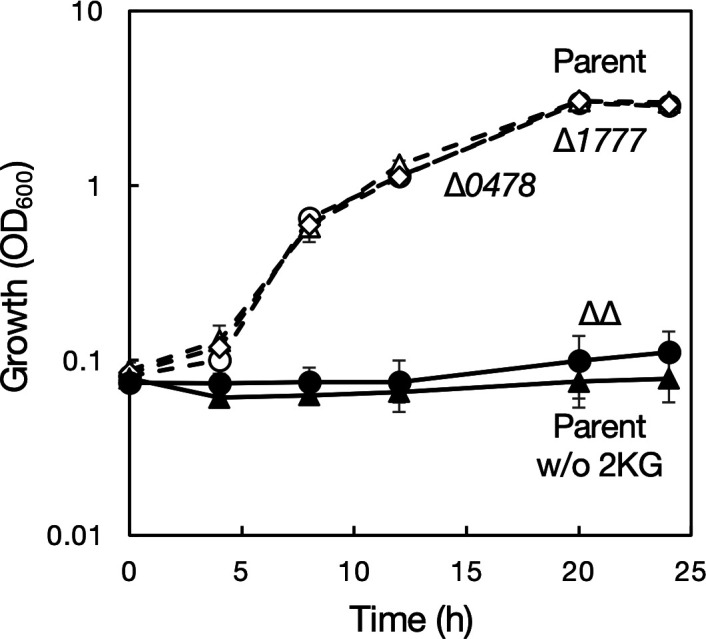
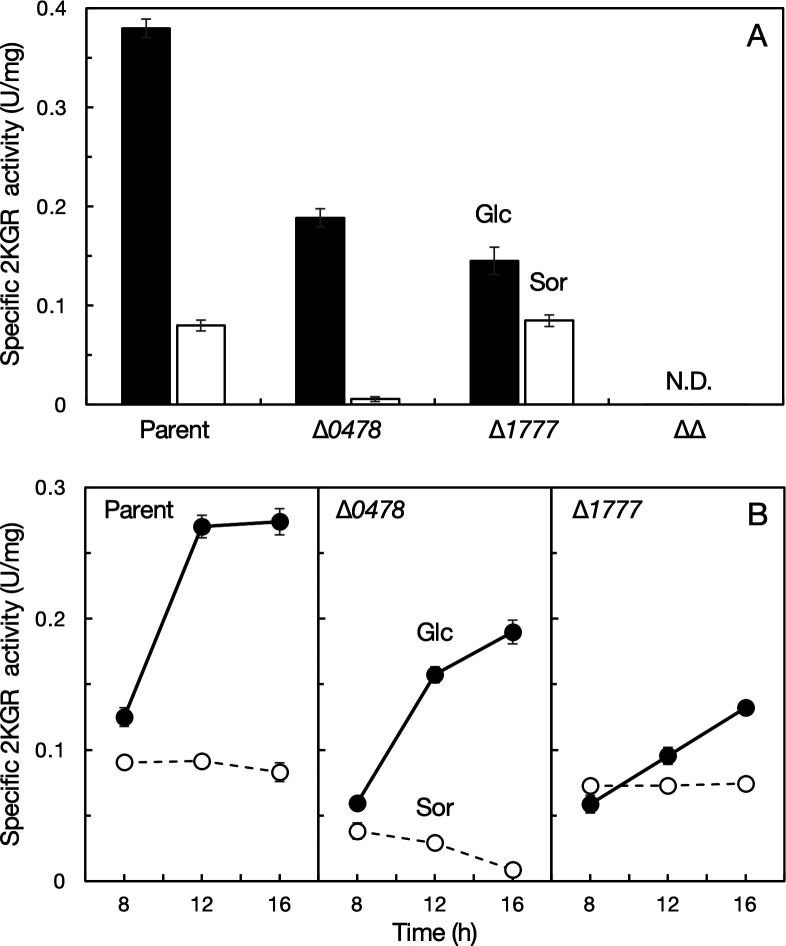
葡萄糖不完全氧化由葡萄糖杆菌sp.菌株CHM43产生葡萄糖酸,然后产生2-或5-酮葡萄糖酸。虽然2-酮- d -葡萄糖酸盐(2KG)是一种有价值的化合物,但它有时会通过一种未知的代谢途径被葡萄糖杆菌自身消耗。我们预计2KG还原酶(2KGR)将是2KG代谢的关键酶。在菌株CHM43基因组中鉴定出GLF_0478和GLF_1777,其编码的蛋白与氧化葡萄糖杆菌菌株621H的2KGR氨基酸序列分别具有70%和48%的同源性。构建的CHM43突变体衍生物缺乏GLF_0478、GLF_1777或两者兼有,对其2KG的消耗能力进行了检测。菌株∆GLF_0478和∆GLF_1777与亲本菌株一样消耗2KG。然而,双缺失(∆∆)菌株完全没有消耗2KG,尽管它产生了2KG,与亲本菌株一样。与亲本菌株相比,∆GLF_0478和∆GLF_1777的2KGR活性均下降,菌株ΔΔ的2KGR活性下降。这些结果表明,GLF_0478和GLF_1777催化的2KG还原是葡萄糖杆菌菌株CHM43代谢2KG的重要步骤。这两个2kgr在中性pH下表现出较高的活性,对NADPH的KM值低于NADH。诱导实验结果表明,GLF_0478在2KG诱导下低水平组成表达,GLF_1777在2KG诱导下也能诱导,但在没有诱导剂的情况下被抑制。我们的研究表征了葡萄糖杆菌2KG消耗的关键基因,为改进生物2KG生产系统提供了见解。重要性:2-酮- d -葡萄糖酸盐(2KG)是葡萄糖被包括葡萄球菌在内的乙酸细菌不完全氧化的产物,用于各种用途,包括食品工业。葡萄糖杆菌也通过不明确的代谢途径消耗2KG。据报道,在2KG代谢的第一步,假单胞菌(Pseudomonas spp.)和necator铜杆菌(Cupriavidus necator)磷酸化2KG,但包括大肠杆菌(Escherichia coli)在内的一些肠道细菌会降低2KG。本研究评估了一株葡萄糖杆菌的突变衍生物的2KG消耗能力,该菌株缺乏两个假定的2kgr编码基因。突变株完全不消耗2KG;发现这两个2kgr各自催化2KG还原。结论:2KG的减少是葡萄糖杆菌2KG代谢的重要步骤。本文提出的结果可能有助于改进使用葡萄杆菌的2KG生产系统。
Two NADPH-dependent 2-ketogluconate reductases involved in 2-ketogluconate assimilation in Gluconobacter sp. strain CHM43.
Incomplete oxidation of glucose by Gluconobacter sp. strain CHM43 produces gluconic acid and then 2- or 5-ketogluconic acid. Although 2-keto-D-gluconate (2KG) is a valuable compound, it is sometimes consumed by Gluconobacter itself via an unknown metabolic pathway. We anticipated that 2KG reductase (2KGR) would be a key enzyme in 2KG metabolism. GLF_0478 and GLF_1777 were identified in the genome of strain CHM43, which encode proteins with 70% and 48% amino acid sequence identity, respectively, to the 2KGR of Gluconobacter oxydans strain 621H. Constructed mutant derivatives of strain CHM43 lacking GLF_0478, GLF_1777, or both were examined for their 2KG consumption ability. Strains ∆GLF_0478 and ∆GLF_1777 consumed 2KG like the parental strain. However, the double-deletion (∆∆) strain did not consume 2KG at all, although it produced 2KG like the parental strain. Strains ∆GLF_0478 and ∆GLF_1777 each showed decreased 2KGR activity compared with the parental strain, and strain ΔΔ lost 2KGR activity. These results suggest that reduction of 2KG catalyzed by GLF_0478 and GLF_1777 is the committed step in 2KG metabolism in Gluconobacter sp. strain CHM43. The two 2KGRs showed high activity at neutral pH and lower KM values for NADPH than NADH. Results of induction experiments suggest that GLF_0478 is constitutively expressed at a low level but induced by 2KG, and GLF_1777 is also inducible by 2KG but repressed in the absence of an inducer. Our study that characterizes the key genes for 2KG consumption in Gluconobacter gives insights for improvement of biological 2KG production systems.
Importance: 2-Keto-D-gluconate (2KG), a product of incomplete oxidation of glucose by acetic acid bacteria including Gluconobacter spp., is used for various purposes, including in the food industry. Gluconobacter also consumes 2KG via an unclear metabolic pathway. It is reported that Pseudomonas spp. and Cupriavidus necator phosphorylate 2KG in the first step of 2KG metabolism, but some enteric bacteria including Escherichia coli reduce 2KG. This study evaluated the 2KG consumption ability of a mutant derivative of a strain of Gluconobacter that lacks two putative 2KGR-encoding genes. The mutant strain did not consume 2KG at all; the two 2KGRs were each found to catalyze 2KG reduction. It is concluded that reduction of 2KG is the committed step in 2KG metabolism in Gluconobacter. The results presented here give insights that might facilitate improvement of 2KG production systems that use Gluconobacter.
期刊介绍:
Applied and Environmental Microbiology (AEM) publishes papers that make significant contributions to (a) applied microbiology, including biotechnology, protein engineering, bioremediation, and food microbiology, (b) microbial ecology, including environmental, organismic, and genomic microbiology, and (c) interdisciplinary microbiology, including invertebrate microbiology, plant microbiology, aquatic microbiology, and geomicrobiology.





 京公网安备 11010802042870号
京ICP备2023020795号-1
京公网安备 11010802042870号
京ICP备2023020795号-1

 分享
分享
 求助内容:
求助内容: 应助结果提醒方式:
 扫码关注我们
