Ya Wen , Mattia Cannistra , Valeria Sacca , Linting Ma , Liang Feng , Zhongcong Xie , Jian Kong
{"title":"血浆Tau-PT217升高与膝关节骨关节炎患者海马功能连通性下降有关","authors":"Ya Wen , Mattia Cannistra , Valeria Sacca , Linting Ma , Liang Feng , Zhongcong Xie , Jian Kong","doi":"10.1016/j.brainres.2025.149478","DOIUrl":null,"url":null,"abstract":"<div><h3>Background</h3><div>Osteoarthritis is associated with a higher risk of developing dementia, though the underlying biological mechanisms have remained unclear. Recent studies suggest that blood phosphorylated tau proteins, particularly Tau-PT217, are sensitive biomarkers capable of detecting cognitive decline in its early stages, making it useful for early diagnosis of Alzheimer’s disease and other forms of cognitive impairment.</div></div><div><h3>Methods</h3><div>In this study, we investigated the plasma phosphorylated tau protein levels (Tau-PT217 and Tau-PT181), hippocampus functional connectivity, and cognitive function in people with knee osteoarthritis compared to age and gender matched pain-free controls.</div></div><div><h3>Results</h3><div>We found that knee osteoarthritis was associated with increased plasma levels of Tau-PT217 (but not Tau-PT181), and that the Tau-PT217 is also correlated with reduced hippocampal functional connectivity with middle cingulate cortex. Our findings suggest a potential biological correlation between knee osteoarthritis and an elevated risk of dementia, contributing valuable insights that may guide the formulation of early intervention and preventative strategies to mitigate dementia in individuals with knee osteoarthritis.</div></div>","PeriodicalId":9083,"journal":{"name":"Brain Research","volume":"1851 ","pages":"Article 149478"},"PeriodicalIF":2.6000,"publicationDate":"2025-03-15","publicationTypes":"Journal Article","fieldsOfStudy":null,"isOpenAccess":false,"openAccessPdf":"","citationCount":"0","resultStr":"{\"title\":\"Elevated plasma Tau-PT217 linked to decreased hippocampal functional connectivity in patients with knee osteoarthritis\",\"authors\":\"Ya Wen , Mattia Cannistra , Valeria Sacca , Linting Ma , Liang Feng , Zhongcong Xie , Jian Kong\",\"doi\":\"10.1016/j.brainres.2025.149478\",\"DOIUrl\":null,\"url\":null,\"abstract\":\"<div><h3>Background</h3><div>Osteoarthritis is associated with a higher risk of developing dementia, though the underlying biological mechanisms have remained unclear. Recent studies suggest that blood phosphorylated tau proteins, particularly Tau-PT217, are sensitive biomarkers capable of detecting cognitive decline in its early stages, making it useful for early diagnosis of Alzheimer’s disease and other forms of cognitive impairment.</div></div><div><h3>Methods</h3><div>In this study, we investigated the plasma phosphorylated tau protein levels (Tau-PT217 and Tau-PT181), hippocampus functional connectivity, and cognitive function in people with knee osteoarthritis compared to age and gender matched pain-free controls.</div></div><div><h3>Results</h3><div>We found that knee osteoarthritis was associated with increased plasma levels of Tau-PT217 (but not Tau-PT181), and that the Tau-PT217 is also correlated with reduced hippocampal functional connectivity with middle cingulate cortex. Our findings suggest a potential biological correlation between knee osteoarthritis and an elevated risk of dementia, contributing valuable insights that may guide the formulation of early intervention and preventative strategies to mitigate dementia in individuals with knee osteoarthritis.</div></div>\",\"PeriodicalId\":9083,\"journal\":{\"name\":\"Brain Research\",\"volume\":\"1851 \",\"pages\":\"Article 149478\"},\"PeriodicalIF\":2.6000,\"publicationDate\":\"2025-03-15\",\"publicationTypes\":\"Journal Article\",\"fieldsOfStudy\":null,\"isOpenAccess\":false,\"openAccessPdf\":\"\",\"citationCount\":\"0\",\"resultStr\":null,\"platform\":\"Semanticscholar\",\"paperid\":null,\"PeriodicalName\":\"Brain Research\",\"FirstCategoryId\":\"3\",\"ListUrlMain\":\"https://www.sciencedirect.com/science/article/pii/S0006899325000368\",\"RegionNum\":4,\"RegionCategory\":\"医学\",\"ArticlePicture\":[],\"TitleCN\":null,\"AbstractTextCN\":null,\"PMCID\":null,\"EPubDate\":\"2025/1/26 0:00:00\",\"PubModel\":\"Epub\",\"JCR\":\"Q3\",\"JCRName\":\"NEUROSCIENCES\",\"Score\":null,\"Total\":0}","platform":"Semanticscholar","paperid":null,"PeriodicalName":"Brain Research","FirstCategoryId":"3","ListUrlMain":"https://www.sciencedirect.com/science/article/pii/S0006899325000368","RegionNum":4,"RegionCategory":"医学","ArticlePicture":[],"TitleCN":null,"AbstractTextCN":null,"PMCID":null,"EPubDate":"2025/1/26 0:00:00","PubModel":"Epub","JCR":"Q3","JCRName":"NEUROSCIENCES","Score":null,"Total":0}
Elevated plasma Tau-PT217 linked to decreased hippocampal functional connectivity in patients with knee osteoarthritis
Background
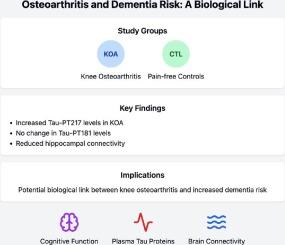
Osteoarthritis is associated with a higher risk of developing dementia, though the underlying biological mechanisms have remained unclear. Recent studies suggest that blood phosphorylated tau proteins, particularly Tau-PT217, are sensitive biomarkers capable of detecting cognitive decline in its early stages, making it useful for early diagnosis of Alzheimer’s disease and other forms of cognitive impairment.
Methods
In this study, we investigated the plasma phosphorylated tau protein levels (Tau-PT217 and Tau-PT181), hippocampus functional connectivity, and cognitive function in people with knee osteoarthritis compared to age and gender matched pain-free controls.
Results
We found that knee osteoarthritis was associated with increased plasma levels of Tau-PT217 (but not Tau-PT181), and that the Tau-PT217 is also correlated with reduced hippocampal functional connectivity with middle cingulate cortex. Our findings suggest a potential biological correlation between knee osteoarthritis and an elevated risk of dementia, contributing valuable insights that may guide the formulation of early intervention and preventative strategies to mitigate dementia in individuals with knee osteoarthritis.
期刊介绍:
An international multidisciplinary journal devoted to fundamental research in the brain sciences.
Brain Research publishes papers reporting interdisciplinary investigations of nervous system structure and function that are of general interest to the international community of neuroscientists. As is evident from the journals name, its scope is broad, ranging from cellular and molecular studies through systems neuroscience, cognition and disease. Invited reviews are also published; suggestions for and inquiries about potential reviews are welcomed.
With the appearance of the final issue of the 2011 subscription, Vol. 67/1-2 (24 June 2011), Brain Research Reviews has ceased publication as a distinct journal separate from Brain Research. Review articles accepted for Brain Research are now published in that journal.




 京公网安备 11010802042870号
京ICP备2023020795号-1
京公网安备 11010802042870号
京ICP备2023020795号-1

 分享
分享
 求助内容:
求助内容: 应助结果提醒方式:
 扫码关注我们
