{"title":"脊髓细胞移植可逆转脊髓损伤引起的脑炎症和认知能力下降。","authors":"Quentin Delarue , Amandine Robac , Fannie Semprez , Célia Duclos , Baptiste Pileyre , Pauline Neveu , Clémence Raimond , Gaëtan Riou , Inès Ziane , Nicolas Guérout","doi":"10.1016/j.bbi.2025.01.014","DOIUrl":null,"url":null,"abstract":"<div><div>Spinal cord injuries (SCIs) impact between 250,000 and 500,000 people worldwide annually, often resulting from road accidents or falls. These injuries frequently lead to lasting disabilities, with the severity depending on the injury’s extent and location. Emerging research also links SCIs to cognitive impairments due to brain inflammation. From a treatment perspective, various approaches, including cell therapy, have been investigated. One common mechanism across cellular transplant models is the modulation of inflammation at the injury site, though it remains uncertain if these effects extend to the brain. To explore this, we induced SCI in wild-type mice and treated them with either olfactory ensheathing cells or mesenchymal stem cells. Our findings reveal that both cell types can reverse SCI-induced cognitive deficits, reduce brain inflammation, and increase hippocampal neuronal density. This study is the first, to our knowledge, to demonstrate that cells transplanted into the spinal cord can influence brain inflammation and mitigate injury-induced effects on brain functions. These results highlight the intricate relationship between the spinal cord and brain in both health and disease.</div></div>","PeriodicalId":9199,"journal":{"name":"Brain, Behavior, and Immunity","volume":"125 ","pages":"Pages 388-397"},"PeriodicalIF":7.6000,"publicationDate":"2025-03-01","publicationTypes":"Journal Article","fieldsOfStudy":null,"isOpenAccess":false,"openAccessPdf":"","citationCount":"0","resultStr":"{\"title\":\"Brain inflammation and cognitive decline induced by spinal cord injury can be reversed by spinal cord cell transplants\",\"authors\":\"Quentin Delarue , Amandine Robac , Fannie Semprez , Célia Duclos , Baptiste Pileyre , Pauline Neveu , Clémence Raimond , Gaëtan Riou , Inès Ziane , Nicolas Guérout\",\"doi\":\"10.1016/j.bbi.2025.01.014\",\"DOIUrl\":null,\"url\":null,\"abstract\":\"<div><div>Spinal cord injuries (SCIs) impact between 250,000 and 500,000 people worldwide annually, often resulting from road accidents or falls. These injuries frequently lead to lasting disabilities, with the severity depending on the injury’s extent and location. Emerging research also links SCIs to cognitive impairments due to brain inflammation. From a treatment perspective, various approaches, including cell therapy, have been investigated. One common mechanism across cellular transplant models is the modulation of inflammation at the injury site, though it remains uncertain if these effects extend to the brain. To explore this, we induced SCI in wild-type mice and treated them with either olfactory ensheathing cells or mesenchymal stem cells. Our findings reveal that both cell types can reverse SCI-induced cognitive deficits, reduce brain inflammation, and increase hippocampal neuronal density. This study is the first, to our knowledge, to demonstrate that cells transplanted into the spinal cord can influence brain inflammation and mitigate injury-induced effects on brain functions. These results highlight the intricate relationship between the spinal cord and brain in both health and disease.</div></div>\",\"PeriodicalId\":9199,\"journal\":{\"name\":\"Brain, Behavior, and Immunity\",\"volume\":\"125 \",\"pages\":\"Pages 388-397\"},\"PeriodicalIF\":7.6000,\"publicationDate\":\"2025-03-01\",\"publicationTypes\":\"Journal Article\",\"fieldsOfStudy\":null,\"isOpenAccess\":false,\"openAccessPdf\":\"\",\"citationCount\":\"0\",\"resultStr\":null,\"platform\":\"Semanticscholar\",\"paperid\":null,\"PeriodicalName\":\"Brain, Behavior, and Immunity\",\"FirstCategoryId\":\"3\",\"ListUrlMain\":\"https://www.sciencedirect.com/science/article/pii/S0889159125000273\",\"RegionNum\":2,\"RegionCategory\":\"医学\",\"ArticlePicture\":[],\"TitleCN\":null,\"AbstractTextCN\":null,\"PMCID\":null,\"EPubDate\":\"2025/1/26 0:00:00\",\"PubModel\":\"Epub\",\"JCR\":\"Q1\",\"JCRName\":\"IMMUNOLOGY\",\"Score\":null,\"Total\":0}","platform":"Semanticscholar","paperid":null,"PeriodicalName":"Brain, Behavior, and Immunity","FirstCategoryId":"3","ListUrlMain":"https://www.sciencedirect.com/science/article/pii/S0889159125000273","RegionNum":2,"RegionCategory":"医学","ArticlePicture":[],"TitleCN":null,"AbstractTextCN":null,"PMCID":null,"EPubDate":"2025/1/26 0:00:00","PubModel":"Epub","JCR":"Q1","JCRName":"IMMUNOLOGY","Score":null,"Total":0}
Brain inflammation and cognitive decline induced by spinal cord injury can be reversed by spinal cord cell transplants
Spinal cord injuries (SCIs) impact between 250,000 and 500,000 people worldwide annually, often resulting from road accidents or falls. These injuries frequently lead to lasting disabilities, with the severity depending on the injury’s extent and location. Emerging research also links SCIs to cognitive impairments due to brain inflammation. From a treatment perspective, various approaches, including cell therapy, have been investigated. One common mechanism across cellular transplant models is the modulation of inflammation at the injury site, though it remains uncertain if these effects extend to the brain. To explore this, we induced SCI in wild-type mice and treated them with either olfactory ensheathing cells or mesenchymal stem cells. Our findings reveal that both cell types can reverse SCI-induced cognitive deficits, reduce brain inflammation, and increase hippocampal neuronal density. This study is the first, to our knowledge, to demonstrate that cells transplanted into the spinal cord can influence brain inflammation and mitigate injury-induced effects on brain functions. These results highlight the intricate relationship between the spinal cord and brain in both health and disease.
期刊介绍:
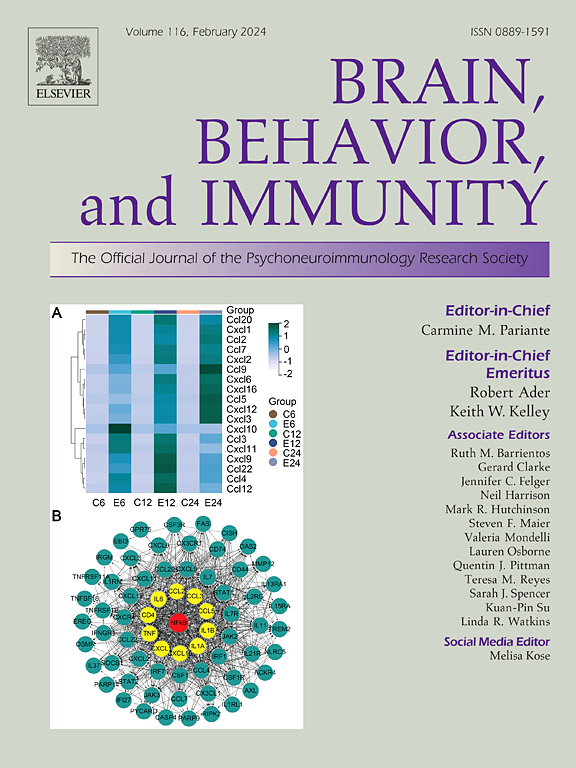
Established in 1987, Brain, Behavior, and Immunity proudly serves as the official journal of the Psychoneuroimmunology Research Society (PNIRS). This pioneering journal is dedicated to publishing peer-reviewed basic, experimental, and clinical studies that explore the intricate interactions among behavioral, neural, endocrine, and immune systems in both humans and animals.
As an international and interdisciplinary platform, Brain, Behavior, and Immunity focuses on original research spanning neuroscience, immunology, integrative physiology, behavioral biology, psychiatry, psychology, and clinical medicine. The journal is inclusive of research conducted at various levels, including molecular, cellular, social, and whole organism perspectives. With a commitment to efficiency, the journal facilitates online submission and review, ensuring timely publication of experimental results. Manuscripts typically undergo peer review and are returned to authors within 30 days of submission. It's worth noting that Brain, Behavior, and Immunity, published eight times a year, does not impose submission fees or page charges, fostering an open and accessible platform for scientific discourse.




 京公网安备 11010802042870号
京ICP备2023020795号-1
京公网安备 11010802042870号
京ICP备2023020795号-1

 分享
分享
 求助内容:
求助内容: 应助结果提醒方式:
 扫码关注我们
