Xavier Phina-Ziebin, Emmanuel Bachy, François-Xavier Gros, Roberta Di Blasi, Charles Herbaux, Jacques Olivier Bay, Sylvain Carras, Pierre Bories, Olivier Casasnovas, Fabrice Jardin, Franck Morschhauser, Blandine Guffroy, Mohamad Mohty, Elodie Gat, Julien Calvani, Marie-Cécile Parrens, Elsa Poullot, Alexandra Traverse-Glehen, Louise Roulin
{"title":"CAR-T抢救后高级别b细胞淋巴瘤与其他大b细胞淋巴瘤的预后比较。一项DESCAR-T LYSA研究。","authors":"Xavier Phina-Ziebin, Emmanuel Bachy, François-Xavier Gros, Roberta Di Blasi, Charles Herbaux, Jacques Olivier Bay, Sylvain Carras, Pierre Bories, Olivier Casasnovas, Fabrice Jardin, Franck Morschhauser, Blandine Guffroy, Mohamad Mohty, Elodie Gat, Julien Calvani, Marie-Cécile Parrens, Elsa Poullot, Alexandra Traverse-Glehen, Louise Roulin","doi":"10.1182/bloodadvances.2024014732","DOIUrl":null,"url":null,"abstract":"<p><strong>Abstract: </strong>High-grade B-cell lymphoma (HGBL) with MYC and BCL2 and/or BCL6 rearrangements (double hit [HGBL-DH] or triple hit [HGBL-TH]) or not otherwise specified (HGBL-NOS) are considered to be more aggressive diseases among large B-cell lymphomas (LBCLs). CD19-targeting chimeric antigen receptor (CAR) T cells have changed the prognosis of chemoresistant LBCL. Clinical and pathological data of patients treated for relapsed/refractory LBCL or HGBL in third line or more, all characterized by fluorescence in situ hybridization, were collected from the French DESCAR-T registry. Between January 2018 and November 2022, a total of 228 patients were included across 14 centers, 73 with HGBL (28 HGBL-DH MYC-BCL2, 14 HGBL-TH, 8 HGBL-DH MYC-BCL6, and 23 HGBL-NOS) and 155 with non-HGBL. The median follow-up was 18.5 months (95% confidence interval [CI], 14.3-23.4) from the date of infusion. Progression-free survival and overall survival (OS) were not significantly different between HGBL and non-HGBL, at 3.2 months (95% CI, 2.8-6.0) vs 4.5 months (95% CI, 3.1-8.7; P = .103) and 15.4 months (95% CI, 5.6-32.4) vs 18.3 months (95% CI, 8.5 to not reached), respectively. From the date of eligibility, the median OS was inferior for patients with HGBL-TH/DH MYC-BCL2 at 6.6 months vs 18.5 months for HGBL-NOS vs 13.6 months for HGBL-DH MYC-BCL6 vs 11.8 months for LBCL (P = .037). However, patients who received infusion presented the same outcome. CAR T-cell therapy used in third line or more seems to overcome the poor prognosis of HGBL subtypes, especially in HGBL-TH/DH MYC-BCL2. This observation supports considering the potential benefit of using CAR T cells earlier in disease course.</p>","PeriodicalId":9228,"journal":{"name":"Blood advances","volume":" ","pages":"2500-2510"},"PeriodicalIF":7.1000,"publicationDate":"2025-05-27","publicationTypes":"Journal Article","fieldsOfStudy":null,"isOpenAccess":false,"openAccessPdf":"https://www.ncbi.nlm.nih.gov/pmc/articles/PMC12148394/pdf/","citationCount":"0","resultStr":"{\"title\":\"Outcome of high-grade B-cell lymphoma compared with other large B-cell lymphoma after CAR-T rescue: a DESCAR-T LYSA study.\",\"authors\":\"Xavier Phina-Ziebin, Emmanuel Bachy, François-Xavier Gros, Roberta Di Blasi, Charles Herbaux, Jacques Olivier Bay, Sylvain Carras, Pierre Bories, Olivier Casasnovas, Fabrice Jardin, Franck Morschhauser, Blandine Guffroy, Mohamad Mohty, Elodie Gat, Julien Calvani, Marie-Cécile Parrens, Elsa Poullot, Alexandra Traverse-Glehen, Louise Roulin\",\"doi\":\"10.1182/bloodadvances.2024014732\",\"DOIUrl\":null,\"url\":null,\"abstract\":\"<p><strong>Abstract: </strong>High-grade B-cell lymphoma (HGBL) with MYC and BCL2 and/or BCL6 rearrangements (double hit [HGBL-DH] or triple hit [HGBL-TH]) or not otherwise specified (HGBL-NOS) are considered to be more aggressive diseases among large B-cell lymphomas (LBCLs). CD19-targeting chimeric antigen receptor (CAR) T cells have changed the prognosis of chemoresistant LBCL. Clinical and pathological data of patients treated for relapsed/refractory LBCL or HGBL in third line or more, all characterized by fluorescence in situ hybridization, were collected from the French DESCAR-T registry. Between January 2018 and November 2022, a total of 228 patients were included across 14 centers, 73 with HGBL (28 HGBL-DH MYC-BCL2, 14 HGBL-TH, 8 HGBL-DH MYC-BCL6, and 23 HGBL-NOS) and 155 with non-HGBL. The median follow-up was 18.5 months (95% confidence interval [CI], 14.3-23.4) from the date of infusion. Progression-free survival and overall survival (OS) were not significantly different between HGBL and non-HGBL, at 3.2 months (95% CI, 2.8-6.0) vs 4.5 months (95% CI, 3.1-8.7; P = .103) and 15.4 months (95% CI, 5.6-32.4) vs 18.3 months (95% CI, 8.5 to not reached), respectively. From the date of eligibility, the median OS was inferior for patients with HGBL-TH/DH MYC-BCL2 at 6.6 months vs 18.5 months for HGBL-NOS vs 13.6 months for HGBL-DH MYC-BCL6 vs 11.8 months for LBCL (P = .037). However, patients who received infusion presented the same outcome. CAR T-cell therapy used in third line or more seems to overcome the poor prognosis of HGBL subtypes, especially in HGBL-TH/DH MYC-BCL2. This observation supports considering the potential benefit of using CAR T cells earlier in disease course.</p>\",\"PeriodicalId\":9228,\"journal\":{\"name\":\"Blood advances\",\"volume\":\" \",\"pages\":\"2500-2510\"},\"PeriodicalIF\":7.1000,\"publicationDate\":\"2025-05-27\",\"publicationTypes\":\"Journal Article\",\"fieldsOfStudy\":null,\"isOpenAccess\":false,\"openAccessPdf\":\"https://www.ncbi.nlm.nih.gov/pmc/articles/PMC12148394/pdf/\",\"citationCount\":\"0\",\"resultStr\":null,\"platform\":\"Semanticscholar\",\"paperid\":null,\"PeriodicalName\":\"Blood advances\",\"FirstCategoryId\":\"3\",\"ListUrlMain\":\"https://doi.org/10.1182/bloodadvances.2024014732\",\"RegionNum\":1,\"RegionCategory\":\"医学\",\"ArticlePicture\":[],\"TitleCN\":null,\"AbstractTextCN\":null,\"PMCID\":null,\"EPubDate\":\"\",\"PubModel\":\"\",\"JCR\":\"Q1\",\"JCRName\":\"HEMATOLOGY\",\"Score\":null,\"Total\":0}","platform":"Semanticscholar","paperid":null,"PeriodicalName":"Blood advances","FirstCategoryId":"3","ListUrlMain":"https://doi.org/10.1182/bloodadvances.2024014732","RegionNum":1,"RegionCategory":"医学","ArticlePicture":[],"TitleCN":null,"AbstractTextCN":null,"PMCID":null,"EPubDate":"","PubModel":"","JCR":"Q1","JCRName":"HEMATOLOGY","Score":null,"Total":0}
Outcome of high-grade B-cell lymphoma compared with other large B-cell lymphoma after CAR-T rescue: a DESCAR-T LYSA study.
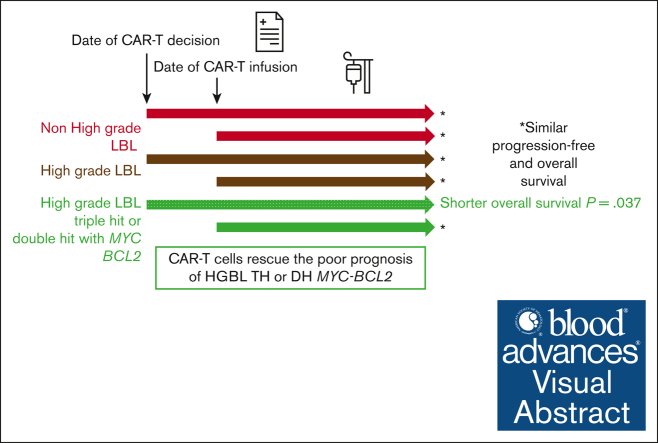
Abstract: High-grade B-cell lymphoma (HGBL) with MYC and BCL2 and/or BCL6 rearrangements (double hit [HGBL-DH] or triple hit [HGBL-TH]) or not otherwise specified (HGBL-NOS) are considered to be more aggressive diseases among large B-cell lymphomas (LBCLs). CD19-targeting chimeric antigen receptor (CAR) T cells have changed the prognosis of chemoresistant LBCL. Clinical and pathological data of patients treated for relapsed/refractory LBCL or HGBL in third line or more, all characterized by fluorescence in situ hybridization, were collected from the French DESCAR-T registry. Between January 2018 and November 2022, a total of 228 patients were included across 14 centers, 73 with HGBL (28 HGBL-DH MYC-BCL2, 14 HGBL-TH, 8 HGBL-DH MYC-BCL6, and 23 HGBL-NOS) and 155 with non-HGBL. The median follow-up was 18.5 months (95% confidence interval [CI], 14.3-23.4) from the date of infusion. Progression-free survival and overall survival (OS) were not significantly different between HGBL and non-HGBL, at 3.2 months (95% CI, 2.8-6.0) vs 4.5 months (95% CI, 3.1-8.7; P = .103) and 15.4 months (95% CI, 5.6-32.4) vs 18.3 months (95% CI, 8.5 to not reached), respectively. From the date of eligibility, the median OS was inferior for patients with HGBL-TH/DH MYC-BCL2 at 6.6 months vs 18.5 months for HGBL-NOS vs 13.6 months for HGBL-DH MYC-BCL6 vs 11.8 months for LBCL (P = .037). However, patients who received infusion presented the same outcome. CAR T-cell therapy used in third line or more seems to overcome the poor prognosis of HGBL subtypes, especially in HGBL-TH/DH MYC-BCL2. This observation supports considering the potential benefit of using CAR T cells earlier in disease course.
期刊介绍:
Blood Advances, a semimonthly medical journal published by the American Society of Hematology, marks the first addition to the Blood family in 70 years. This peer-reviewed, online-only, open-access journal was launched under the leadership of founding editor-in-chief Robert Negrin, MD, from Stanford University Medical Center in Stanford, CA, with its inaugural issue released on November 29, 2016.
Blood Advances serves as an international platform for original articles detailing basic laboratory, translational, and clinical investigations in hematology. The journal comprehensively covers all aspects of hematology, including disorders of leukocytes (both benign and malignant), erythrocytes, platelets, hemostatic mechanisms, vascular biology, immunology, and hematologic oncology. Each article undergoes a rigorous peer-review process, with selection based on the originality of the findings, the high quality of the work presented, and the clarity of the presentation.






 京公网安备 11010802042870号
京ICP备2023020795号-1
京公网安备 11010802042870号
京ICP备2023020795号-1

 分享
分享
 求助内容:
求助内容: 应助结果提醒方式:
 扫码关注我们
