Yuichi Kitagawa, Toranosuke Tomikawa, Kota Aikawa, Shiori Miyazaki, Tomoko Akama, Masato Kobayashi, Mengfei Wang, Sunao Shoji, Koji Fushimi, Kiyoshi Miyata, Yuichi Hirai, Takayuki Nakanishi, Ken Onda, Tetsuya Taketsugu, Yasuchika Hasegawa
{"title":"三价铕配合物中π和4f轨道间的电荷转移发射。","authors":"Yuichi Kitagawa, Toranosuke Tomikawa, Kota Aikawa, Shiori Miyazaki, Tomoko Akama, Masato Kobayashi, Mengfei Wang, Sunao Shoji, Koji Fushimi, Kiyoshi Miyata, Yuichi Hirai, Takayuki Nakanishi, Ken Onda, Tetsuya Taketsugu, Yasuchika Hasegawa","doi":"10.1038/s42004-025-01420-6","DOIUrl":null,"url":null,"abstract":"<p><p>Photoinduced metal-to-ligand (or ligand-to-metal) charge-transfer (CT) states in metal complexes have been extensively studied toward the development of luminescent materials. However, previous studies have mainly focused on CT transitions between d- and π-orbitals. Herein, we report the demonstration of CT emission from 4f- to π-orbitals using a trivalent europium (Eu(III)) complex, supported by both experimental and theoretical analyses. The Eu(III) complex exhibits an eight-coordination structure, comprising three anionic nitrates and two neutral electron-donating ligands containing a carbazole unit. The diffuse reflectance spectrum of the complex displays an absorption band at 440 nm and time-resolved emission analyses reveal a characteristic emission band at 550 nm. Comparative studies employing a trivalent gadolinium (Gd(III)) complex, alongside quantum chemical analyses, confirm that the observed absorption and emission bands are associated with CT transitions between π- and 4f-orbitals. The observation of CT emission based on the 4f-orbital offers novel insights into the field of molecular luminescence science and technology.</p>","PeriodicalId":10529,"journal":{"name":"Communications Chemistry","volume":"8 1","pages":"24"},"PeriodicalIF":6.2000,"publicationDate":"2025-01-28","publicationTypes":"Journal Article","fieldsOfStudy":null,"isOpenAccess":false,"openAccessPdf":"https://www.ncbi.nlm.nih.gov/pmc/articles/PMC11775200/pdf/","citationCount":"0","resultStr":"{\"title\":\"Charge transfer emission between π- and 4f-orbitals in a trivalent europium complex.\",\"authors\":\"Yuichi Kitagawa, Toranosuke Tomikawa, Kota Aikawa, Shiori Miyazaki, Tomoko Akama, Masato Kobayashi, Mengfei Wang, Sunao Shoji, Koji Fushimi, Kiyoshi Miyata, Yuichi Hirai, Takayuki Nakanishi, Ken Onda, Tetsuya Taketsugu, Yasuchika Hasegawa\",\"doi\":\"10.1038/s42004-025-01420-6\",\"DOIUrl\":null,\"url\":null,\"abstract\":\"<p><p>Photoinduced metal-to-ligand (or ligand-to-metal) charge-transfer (CT) states in metal complexes have been extensively studied toward the development of luminescent materials. However, previous studies have mainly focused on CT transitions between d- and π-orbitals. Herein, we report the demonstration of CT emission from 4f- to π-orbitals using a trivalent europium (Eu(III)) complex, supported by both experimental and theoretical analyses. The Eu(III) complex exhibits an eight-coordination structure, comprising three anionic nitrates and two neutral electron-donating ligands containing a carbazole unit. The diffuse reflectance spectrum of the complex displays an absorption band at 440 nm and time-resolved emission analyses reveal a characteristic emission band at 550 nm. Comparative studies employing a trivalent gadolinium (Gd(III)) complex, alongside quantum chemical analyses, confirm that the observed absorption and emission bands are associated with CT transitions between π- and 4f-orbitals. The observation of CT emission based on the 4f-orbital offers novel insights into the field of molecular luminescence science and technology.</p>\",\"PeriodicalId\":10529,\"journal\":{\"name\":\"Communications Chemistry\",\"volume\":\"8 1\",\"pages\":\"24\"},\"PeriodicalIF\":6.2000,\"publicationDate\":\"2025-01-28\",\"publicationTypes\":\"Journal Article\",\"fieldsOfStudy\":null,\"isOpenAccess\":false,\"openAccessPdf\":\"https://www.ncbi.nlm.nih.gov/pmc/articles/PMC11775200/pdf/\",\"citationCount\":\"0\",\"resultStr\":null,\"platform\":\"Semanticscholar\",\"paperid\":null,\"PeriodicalName\":\"Communications Chemistry\",\"FirstCategoryId\":\"92\",\"ListUrlMain\":\"https://doi.org/10.1038/s42004-025-01420-6\",\"RegionNum\":2,\"RegionCategory\":\"化学\",\"ArticlePicture\":[],\"TitleCN\":null,\"AbstractTextCN\":null,\"PMCID\":null,\"EPubDate\":\"\",\"PubModel\":\"\",\"JCR\":\"Q1\",\"JCRName\":\"CHEMISTRY, MULTIDISCIPLINARY\",\"Score\":null,\"Total\":0}","platform":"Semanticscholar","paperid":null,"PeriodicalName":"Communications Chemistry","FirstCategoryId":"92","ListUrlMain":"https://doi.org/10.1038/s42004-025-01420-6","RegionNum":2,"RegionCategory":"化学","ArticlePicture":[],"TitleCN":null,"AbstractTextCN":null,"PMCID":null,"EPubDate":"","PubModel":"","JCR":"Q1","JCRName":"CHEMISTRY, MULTIDISCIPLINARY","Score":null,"Total":0}
Charge transfer emission between π- and 4f-orbitals in a trivalent europium complex.
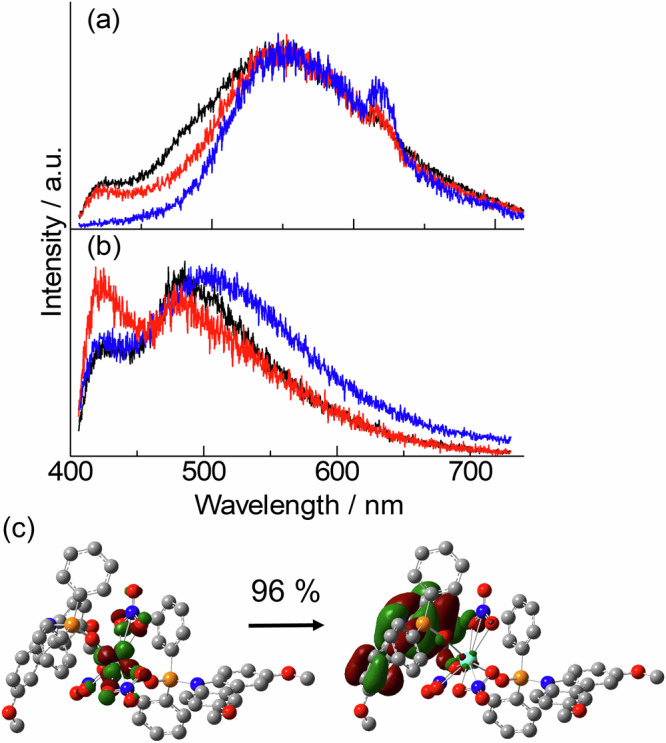
Photoinduced metal-to-ligand (or ligand-to-metal) charge-transfer (CT) states in metal complexes have been extensively studied toward the development of luminescent materials. However, previous studies have mainly focused on CT transitions between d- and π-orbitals. Herein, we report the demonstration of CT emission from 4f- to π-orbitals using a trivalent europium (Eu(III)) complex, supported by both experimental and theoretical analyses. The Eu(III) complex exhibits an eight-coordination structure, comprising three anionic nitrates and two neutral electron-donating ligands containing a carbazole unit. The diffuse reflectance spectrum of the complex displays an absorption band at 440 nm and time-resolved emission analyses reveal a characteristic emission band at 550 nm. Comparative studies employing a trivalent gadolinium (Gd(III)) complex, alongside quantum chemical analyses, confirm that the observed absorption and emission bands are associated with CT transitions between π- and 4f-orbitals. The observation of CT emission based on the 4f-orbital offers novel insights into the field of molecular luminescence science and technology.
期刊介绍:
Communications Chemistry is an open access journal from Nature Research publishing high-quality research, reviews and commentary in all areas of the chemical sciences. Research papers published by the journal represent significant advances bringing new chemical insight to a specialized area of research. We also aim to provide a community forum for issues of importance to all chemists, regardless of sub-discipline.






 京公网安备 11010802042870号
京ICP备2023020795号-1
京公网安备 11010802042870号
京ICP备2023020795号-1

 分享
分享
 求助内容:
求助内容: 应助结果提醒方式:
 扫码关注我们
