Lara Chayab, Natasha B Leighl, Mina Tadrous, Christine M Warren, William W L Wong
{"title":"间变性淋巴瘤激酶(ALK)重排非小细胞肺癌(NSCLC)患者接受一种或多种ALK酪氨酸激酶抑制剂(TKIs)的现实世界临床结果趋势:加拿大安大略省的一项队列研究。","authors":"Lara Chayab, Natasha B Leighl, Mina Tadrous, Christine M Warren, William W L Wong","doi":"10.3390/curroncol32010013","DOIUrl":null,"url":null,"abstract":"<p><p>The treatment landscape for patients with advanced ALK-positive NSCLC has rapidly evolved following the approval of several ALK TKIs in Canada. However, public funding of ALK TKIs is mostly limited to the first line treatment setting. Using linked provincial health administrative databases, we examined real-world outcomes of patients with advanced ALK-positive NSCLC receiving ALK TKIs in Ontario between 1 January 2012 and 31 December 2021. Demographic, clinical characteristics and treatment patterns were summarized using descriptive statistics. Kaplan-Meier analysis was performed to evaluate progression-free survival (PFS) and overall survival (OS) among the treatment groups. A total of 413 patients were identified. Patients were administered alectinib (n = 154), crizotinib (n = 80), or palliative-intent chemotherapy (n = 55) in the first-line treatment. There was a significant difference in first-line PFS between the treatment groups. The median PFS (mPFS) was not reached for alectinib (95% CI, 568 days-not reached), compared to 8.2 months (95% CI, 171-294 days) for crizotinib (HR = 0.34, <i>p</i> < 0.0001) and 2.4 months (95% CI, 65-100 days) for chemotherapy (HR = 0.14, <i>p</i> < 0.0001). There was no significant difference in first-line OS between the treatment groups. In patients who received more than one line of treatment, there was a significant difference in mOS between patients who received two or more lines of ALK TKIs compared to those who received one line of ALK TKI (mOS = 55 months (95% CI, 400-987 days) and 26 months (95% CI, 1448-2644 days), respectively, HR = 4.64, <i>p</i> < 0.0001). This study confirms the effectiveness of ALK TKIs in real-world practice and supports the potential benefit of multiple lines of ALK TKI on overall survival in patients with ALK-positive NSCLC.</p>","PeriodicalId":11012,"journal":{"name":"Current oncology","volume":"32 1","pages":""},"PeriodicalIF":3.4000,"publicationDate":"2024-12-27","publicationTypes":"Journal Article","fieldsOfStudy":null,"isOpenAccess":false,"openAccessPdf":"https://www.ncbi.nlm.nih.gov/pmc/articles/PMC11764221/pdf/","citationCount":"0","resultStr":"{\"title\":\"Trends in Real-World Clinical Outcomes of Patients with Anaplastic Lymphoma Kinase (ALK) Rearranged Non-Small Cell Lung Cancer (NSCLC) Receiving One or More ALK Tyrosine Kinase Inhibitors (TKIs): A Cohort Study in Ontario, Canada.\",\"authors\":\"Lara Chayab, Natasha B Leighl, Mina Tadrous, Christine M Warren, William W L Wong\",\"doi\":\"10.3390/curroncol32010013\",\"DOIUrl\":null,\"url\":null,\"abstract\":\"<p><p>The treatment landscape for patients with advanced ALK-positive NSCLC has rapidly evolved following the approval of several ALK TKIs in Canada. However, public funding of ALK TKIs is mostly limited to the first line treatment setting. Using linked provincial health administrative databases, we examined real-world outcomes of patients with advanced ALK-positive NSCLC receiving ALK TKIs in Ontario between 1 January 2012 and 31 December 2021. Demographic, clinical characteristics and treatment patterns were summarized using descriptive statistics. Kaplan-Meier analysis was performed to evaluate progression-free survival (PFS) and overall survival (OS) among the treatment groups. A total of 413 patients were identified. Patients were administered alectinib (n = 154), crizotinib (n = 80), or palliative-intent chemotherapy (n = 55) in the first-line treatment. There was a significant difference in first-line PFS between the treatment groups. The median PFS (mPFS) was not reached for alectinib (95% CI, 568 days-not reached), compared to 8.2 months (95% CI, 171-294 days) for crizotinib (HR = 0.34, <i>p</i> < 0.0001) and 2.4 months (95% CI, 65-100 days) for chemotherapy (HR = 0.14, <i>p</i> < 0.0001). There was no significant difference in first-line OS between the treatment groups. In patients who received more than one line of treatment, there was a significant difference in mOS between patients who received two or more lines of ALK TKIs compared to those who received one line of ALK TKI (mOS = 55 months (95% CI, 400-987 days) and 26 months (95% CI, 1448-2644 days), respectively, HR = 4.64, <i>p</i> < 0.0001). This study confirms the effectiveness of ALK TKIs in real-world practice and supports the potential benefit of multiple lines of ALK TKI on overall survival in patients with ALK-positive NSCLC.</p>\",\"PeriodicalId\":11012,\"journal\":{\"name\":\"Current oncology\",\"volume\":\"32 1\",\"pages\":\"\"},\"PeriodicalIF\":3.4000,\"publicationDate\":\"2024-12-27\",\"publicationTypes\":\"Journal Article\",\"fieldsOfStudy\":null,\"isOpenAccess\":false,\"openAccessPdf\":\"https://www.ncbi.nlm.nih.gov/pmc/articles/PMC11764221/pdf/\",\"citationCount\":\"0\",\"resultStr\":null,\"platform\":\"Semanticscholar\",\"paperid\":null,\"PeriodicalName\":\"Current oncology\",\"FirstCategoryId\":\"3\",\"ListUrlMain\":\"https://doi.org/10.3390/curroncol32010013\",\"RegionNum\":4,\"RegionCategory\":\"医学\",\"ArticlePicture\":[],\"TitleCN\":null,\"AbstractTextCN\":null,\"PMCID\":null,\"EPubDate\":\"\",\"PubModel\":\"\",\"JCR\":\"Q2\",\"JCRName\":\"ONCOLOGY\",\"Score\":null,\"Total\":0}","platform":"Semanticscholar","paperid":null,"PeriodicalName":"Current oncology","FirstCategoryId":"3","ListUrlMain":"https://doi.org/10.3390/curroncol32010013","RegionNum":4,"RegionCategory":"医学","ArticlePicture":[],"TitleCN":null,"AbstractTextCN":null,"PMCID":null,"EPubDate":"","PubModel":"","JCR":"Q2","JCRName":"ONCOLOGY","Score":null,"Total":0}
Trends in Real-World Clinical Outcomes of Patients with Anaplastic Lymphoma Kinase (ALK) Rearranged Non-Small Cell Lung Cancer (NSCLC) Receiving One or More ALK Tyrosine Kinase Inhibitors (TKIs): A Cohort Study in Ontario, Canada.
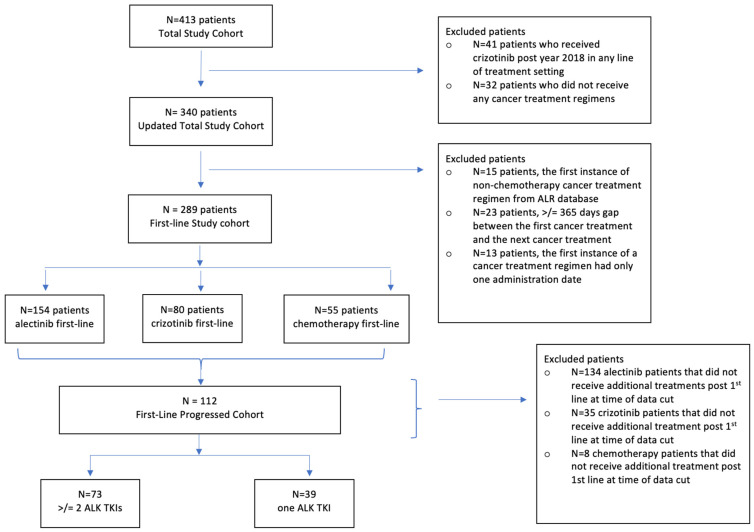
The treatment landscape for patients with advanced ALK-positive NSCLC has rapidly evolved following the approval of several ALK TKIs in Canada. However, public funding of ALK TKIs is mostly limited to the first line treatment setting. Using linked provincial health administrative databases, we examined real-world outcomes of patients with advanced ALK-positive NSCLC receiving ALK TKIs in Ontario between 1 January 2012 and 31 December 2021. Demographic, clinical characteristics and treatment patterns were summarized using descriptive statistics. Kaplan-Meier analysis was performed to evaluate progression-free survival (PFS) and overall survival (OS) among the treatment groups. A total of 413 patients were identified. Patients were administered alectinib (n = 154), crizotinib (n = 80), or palliative-intent chemotherapy (n = 55) in the first-line treatment. There was a significant difference in first-line PFS between the treatment groups. The median PFS (mPFS) was not reached for alectinib (95% CI, 568 days-not reached), compared to 8.2 months (95% CI, 171-294 days) for crizotinib (HR = 0.34, p < 0.0001) and 2.4 months (95% CI, 65-100 days) for chemotherapy (HR = 0.14, p < 0.0001). There was no significant difference in first-line OS between the treatment groups. In patients who received more than one line of treatment, there was a significant difference in mOS between patients who received two or more lines of ALK TKIs compared to those who received one line of ALK TKI (mOS = 55 months (95% CI, 400-987 days) and 26 months (95% CI, 1448-2644 days), respectively, HR = 4.64, p < 0.0001). This study confirms the effectiveness of ALK TKIs in real-world practice and supports the potential benefit of multiple lines of ALK TKI on overall survival in patients with ALK-positive NSCLC.
期刊介绍:
Current Oncology is a peer-reviewed, Canadian-based and internationally respected journal. Current Oncology represents a multidisciplinary medium encompassing health care workers in the field of cancer therapy in Canada to report upon and to review progress in the management of this disease.
We encourage submissions from all fields of cancer medicine, including radiation oncology, surgical oncology, medical oncology, pediatric oncology, pathology, and cancer rehabilitation and survivorship. Articles published in the journal typically contain information that is relevant directly to clinical oncology practice, and have clear potential for application to the current or future practice of cancer medicine.






 京公网安备 11010802042870号
京ICP备2023020795号-1
京公网安备 11010802042870号
京ICP备2023020795号-1

 分享
分享
 求助内容:
求助内容: 应助结果提醒方式:
 扫码关注我们
