{"title":"阿法替尼与奥西替尼治疗EGFR外显子19缺失非小细胞肺癌的再活检提高生存率:台湾的一项多中心研究。","authors":"Jerry Shu-Hung Kuo, Cheng-Yu Chang, Shih-Chieh Chang, Yu-Feng Wei, Chung-Yu Chen","doi":"10.3390/curroncol32010036","DOIUrl":null,"url":null,"abstract":"<p><strong>Background: </strong>Afatinib and Osimertinib are first-line treatments for EGFR-mutated advanced non-small cell lung cancer (NSCLC), but their comparative efficacies and the patient groups that benefit the most remain unclear. This multicenter retrospective study evaluated the efficacy of first-line Afatinib and Osimertinib in NSCLC patients with EGFR 19del and no brain metastases at diagnosis.</p><p><strong>Methods: </strong>The primary endpoints were time on treatment (ToT) and overall survival (OS). Survival analyses were performed for three groups: Afatinib followed by Osimertinib, Afatinib followed by other therapies, and Osimertinib (alone or followed by other therapies). Rebiopsy practices, including T790M mutation detection, were also analyzed in patients with disease progression on Afatinib.</p><p><strong>Results: </strong>Among 97 Afatinib-treated and 60 Osimertinib-treated patients, Osimertinib showed a significantly longer ToT (23.3 vs. 16.5 months; <i>p</i> = 0.007). Median OS was numerically higher for Afatinib with sequential Osimertinib (40.5 vs. 34.6 months for Osimertinib; <i>p</i> = 0.473). Osimertinib demonstrated advantages, with fewer brain metastases upon progression and fewer adverse effects. In the Afatinib group, 64% of patients with disease progression underwent rebiopsy, with 39% testing positive for T790M mutation and subsequently receiving Osimertinib. Rebiopsy was most frequently performed on the lung parenchyma using non-surgical methods.</p><p><strong>Conclusions: </strong>In this real-world study, Osimertinib achieved a significantly longer ToT compared to Afatinib in NSCLC patients with EGFR 19del and no brain metastases. The sequential use of Afatinib followed by Osimertinib showed a trend toward improved OS, highlighting the importance of rebiopsy for identifying T790M mutations to guide subsequent therapy.</p>","PeriodicalId":11012,"journal":{"name":"Current oncology","volume":"32 1","pages":""},"PeriodicalIF":3.4000,"publicationDate":"2025-01-10","publicationTypes":"Journal Article","fieldsOfStudy":null,"isOpenAccess":false,"openAccessPdf":"https://www.ncbi.nlm.nih.gov/pmc/articles/PMC11763488/pdf/","citationCount":"0","resultStr":"{\"title\":\"Rebiopsy Enhances Survival with Afatinib vs. Osimertinib in EGFR Exon 19 Deletion Non-Small Cell Lung Cancer: A Multicenter Study in Taiwan.\",\"authors\":\"Jerry Shu-Hung Kuo, Cheng-Yu Chang, Shih-Chieh Chang, Yu-Feng Wei, Chung-Yu Chen\",\"doi\":\"10.3390/curroncol32010036\",\"DOIUrl\":null,\"url\":null,\"abstract\":\"<p><strong>Background: </strong>Afatinib and Osimertinib are first-line treatments for EGFR-mutated advanced non-small cell lung cancer (NSCLC), but their comparative efficacies and the patient groups that benefit the most remain unclear. This multicenter retrospective study evaluated the efficacy of first-line Afatinib and Osimertinib in NSCLC patients with EGFR 19del and no brain metastases at diagnosis.</p><p><strong>Methods: </strong>The primary endpoints were time on treatment (ToT) and overall survival (OS). Survival analyses were performed for three groups: Afatinib followed by Osimertinib, Afatinib followed by other therapies, and Osimertinib (alone or followed by other therapies). Rebiopsy practices, including T790M mutation detection, were also analyzed in patients with disease progression on Afatinib.</p><p><strong>Results: </strong>Among 97 Afatinib-treated and 60 Osimertinib-treated patients, Osimertinib showed a significantly longer ToT (23.3 vs. 16.5 months; <i>p</i> = 0.007). Median OS was numerically higher for Afatinib with sequential Osimertinib (40.5 vs. 34.6 months for Osimertinib; <i>p</i> = 0.473). Osimertinib demonstrated advantages, with fewer brain metastases upon progression and fewer adverse effects. In the Afatinib group, 64% of patients with disease progression underwent rebiopsy, with 39% testing positive for T790M mutation and subsequently receiving Osimertinib. Rebiopsy was most frequently performed on the lung parenchyma using non-surgical methods.</p><p><strong>Conclusions: </strong>In this real-world study, Osimertinib achieved a significantly longer ToT compared to Afatinib in NSCLC patients with EGFR 19del and no brain metastases. The sequential use of Afatinib followed by Osimertinib showed a trend toward improved OS, highlighting the importance of rebiopsy for identifying T790M mutations to guide subsequent therapy.</p>\",\"PeriodicalId\":11012,\"journal\":{\"name\":\"Current oncology\",\"volume\":\"32 1\",\"pages\":\"\"},\"PeriodicalIF\":3.4000,\"publicationDate\":\"2025-01-10\",\"publicationTypes\":\"Journal Article\",\"fieldsOfStudy\":null,\"isOpenAccess\":false,\"openAccessPdf\":\"https://www.ncbi.nlm.nih.gov/pmc/articles/PMC11763488/pdf/\",\"citationCount\":\"0\",\"resultStr\":null,\"platform\":\"Semanticscholar\",\"paperid\":null,\"PeriodicalName\":\"Current oncology\",\"FirstCategoryId\":\"3\",\"ListUrlMain\":\"https://doi.org/10.3390/curroncol32010036\",\"RegionNum\":4,\"RegionCategory\":\"医学\",\"ArticlePicture\":[],\"TitleCN\":null,\"AbstractTextCN\":null,\"PMCID\":null,\"EPubDate\":\"\",\"PubModel\":\"\",\"JCR\":\"Q2\",\"JCRName\":\"ONCOLOGY\",\"Score\":null,\"Total\":0}","platform":"Semanticscholar","paperid":null,"PeriodicalName":"Current oncology","FirstCategoryId":"3","ListUrlMain":"https://doi.org/10.3390/curroncol32010036","RegionNum":4,"RegionCategory":"医学","ArticlePicture":[],"TitleCN":null,"AbstractTextCN":null,"PMCID":null,"EPubDate":"","PubModel":"","JCR":"Q2","JCRName":"ONCOLOGY","Score":null,"Total":0}
Rebiopsy Enhances Survival with Afatinib vs. Osimertinib in EGFR Exon 19 Deletion Non-Small Cell Lung Cancer: A Multicenter Study in Taiwan.
Background: Afatinib and Osimertinib are first-line treatments for EGFR-mutated advanced non-small cell lung cancer (NSCLC), but their comparative efficacies and the patient groups that benefit the most remain unclear. This multicenter retrospective study evaluated the efficacy of first-line Afatinib and Osimertinib in NSCLC patients with EGFR 19del and no brain metastases at diagnosis.
Methods: The primary endpoints were time on treatment (ToT) and overall survival (OS). Survival analyses were performed for three groups: Afatinib followed by Osimertinib, Afatinib followed by other therapies, and Osimertinib (alone or followed by other therapies). Rebiopsy practices, including T790M mutation detection, were also analyzed in patients with disease progression on Afatinib.
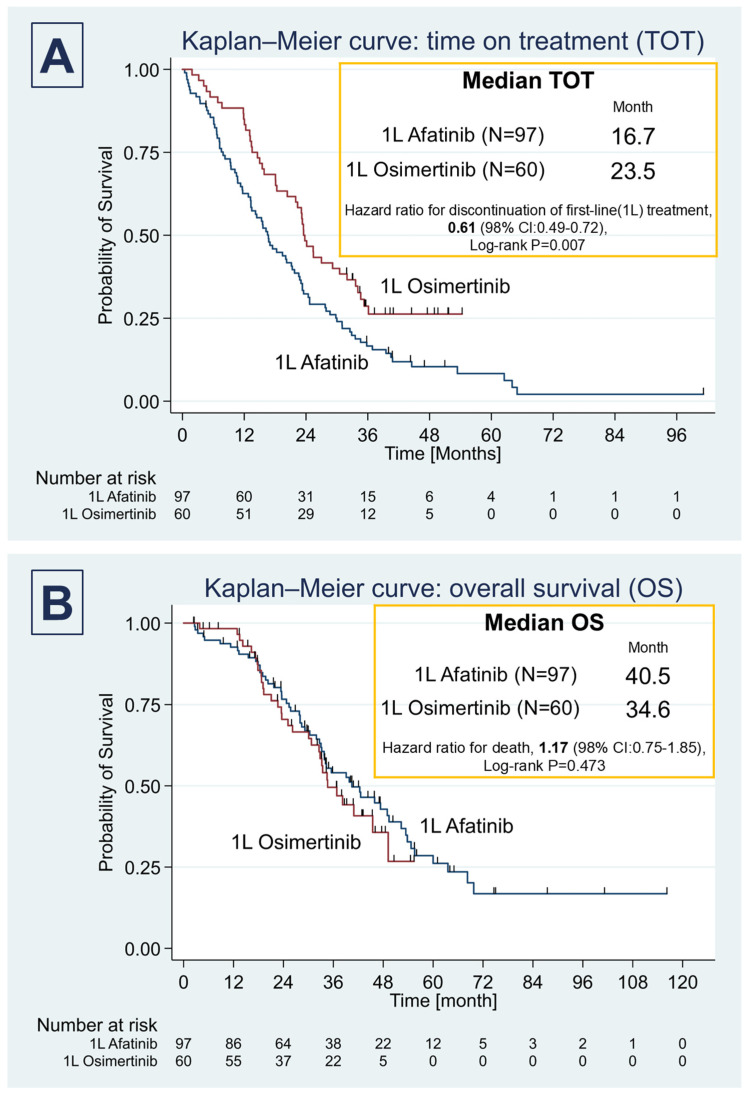
Results: Among 97 Afatinib-treated and 60 Osimertinib-treated patients, Osimertinib showed a significantly longer ToT (23.3 vs. 16.5 months; p = 0.007). Median OS was numerically higher for Afatinib with sequential Osimertinib (40.5 vs. 34.6 months for Osimertinib; p = 0.473). Osimertinib demonstrated advantages, with fewer brain metastases upon progression and fewer adverse effects. In the Afatinib group, 64% of patients with disease progression underwent rebiopsy, with 39% testing positive for T790M mutation and subsequently receiving Osimertinib. Rebiopsy was most frequently performed on the lung parenchyma using non-surgical methods.
Conclusions: In this real-world study, Osimertinib achieved a significantly longer ToT compared to Afatinib in NSCLC patients with EGFR 19del and no brain metastases. The sequential use of Afatinib followed by Osimertinib showed a trend toward improved OS, highlighting the importance of rebiopsy for identifying T790M mutations to guide subsequent therapy.
期刊介绍:
Current Oncology is a peer-reviewed, Canadian-based and internationally respected journal. Current Oncology represents a multidisciplinary medium encompassing health care workers in the field of cancer therapy in Canada to report upon and to review progress in the management of this disease.
We encourage submissions from all fields of cancer medicine, including radiation oncology, surgical oncology, medical oncology, pediatric oncology, pathology, and cancer rehabilitation and survivorship. Articles published in the journal typically contain information that is relevant directly to clinical oncology practice, and have clear potential for application to the current or future practice of cancer medicine.






 京公网安备 11010802042870号
京ICP备2023020795号-1
京公网安备 11010802042870号
京ICP备2023020795号-1

 分享
分享
 求助内容:
求助内容: 应助结果提醒方式:
 扫码关注我们
