Michele Tomaselli, Paolo Springhetti, Giovanni Benfari, Marco Penso, Alexandra Clement, Matteo Pilan, Denis Leonardi, Luca Ciceri, Alexandra Buta, Roberto Scarsini, Andreea Calin, Claudia Nitu, Noela Radu, Denisa Muraru, Bogdan A Popescu, Flavio Ribichini, Luigi P Badano
{"title":"基于多腔心肌变形的主动脉瓣狭窄心脏损伤分期新方法","authors":"Michele Tomaselli, Paolo Springhetti, Giovanni Benfari, Marco Penso, Alexandra Clement, Matteo Pilan, Denis Leonardi, Luca Ciceri, Alexandra Buta, Roberto Scarsini, Andreea Calin, Claudia Nitu, Noela Radu, Denisa Muraru, Bogdan A Popescu, Flavio Ribichini, Luigi P Badano","doi":"10.1093/ehjci/jeaf035","DOIUrl":null,"url":null,"abstract":"<p><strong>Aims: </strong>This study evaluates whether multi-chamber myocardial deformation analysis using speckle tracking echocardiography (STE) can enhance validated current staging systems and improve risk stratification for patients with moderate-to-severe aortic stenosis (AS).</p><p><strong>Methods and results: </strong>We reanalysed 2D, Doppler, and STE data obtained from two cohorts: derivation (654 patients, median age: 82 years; 51% men) and validation (237 patients, median age: 77 years; 55% men) with at least moderate AS (aortic valve area < 1.5 cm2). The receiver operator characteristic curve analysis identified optimal cut-off values linked to outcomes: 15% for left ventricular global longitudinal strain (LVGLS), 13% for peak atrial longitudinal strain (PALS), and 19% for right ventricular free-wall strain (RVFWS). Patients have been divided into five stages: Stage 0, no left-side damage (LVGLS ≥ 15% and PALS ≥ 13%); Stage 1, partial left-side damage (LVGLS < 15% or PALS < 13%); Stage 2, definite left-side damage (LVGLS < 15% and PALS < 13%); Stage 3, no right-side damage (RVFWS ≥ 19%); and Stage 4, right-side damage (RVFWS < 19%). In a multivariable Cox regression analysis, the new staging scheme remained independently associated with an increased risk of all-cause death [adjusted-hazard ratio: 1.28; 95% confidence interval (CI): 1.10-1.48; P = 0.001]. This new staging classification exhibited higher predictive power [area under the curve (AUC) 0.67; 95% CI 0.62-0.73] than those proposed by Généreux et al. (Staging classification of aortic stenosis based on the extent of cardiac damage. Eur Heart J 2017;38:3351-8.) (AUC 0.62; 95% CI 0.56-0.67; P = 0.002) and Tastet et al. (Staging cardiac damage in patients with asymptomatic aortic valve stenosis. J Am Coll Cardiol 2019;74:550-63.) (AUC 0.64; 95% CI 0.58-0.70; P = 0.041) for 2-year all-cause death, with similar findings in the validation cohort.</p><p><strong>Conclusion: </strong>Our staging system for detecting cardiac damage, incorporating multi-chamber myocardial deformation, exhibits a stronger association with outcomes than previously validated systems.</p>","PeriodicalId":12026,"journal":{"name":"European Heart Journal - Cardiovascular Imaging","volume":" ","pages":"908-917"},"PeriodicalIF":6.6000,"publicationDate":"2025-04-30","publicationTypes":"Journal Article","fieldsOfStudy":null,"isOpenAccess":false,"openAccessPdf":"https://www.ncbi.nlm.nih.gov/pmc/articles/PMC12042747/pdf/","citationCount":"0","resultStr":"{\"title\":\"A novel staging system of cardiac damage in aortic stenosis based on multi-chamber myocardial deformation.\",\"authors\":\"Michele Tomaselli, Paolo Springhetti, Giovanni Benfari, Marco Penso, Alexandra Clement, Matteo Pilan, Denis Leonardi, Luca Ciceri, Alexandra Buta, Roberto Scarsini, Andreea Calin, Claudia Nitu, Noela Radu, Denisa Muraru, Bogdan A Popescu, Flavio Ribichini, Luigi P Badano\",\"doi\":\"10.1093/ehjci/jeaf035\",\"DOIUrl\":null,\"url\":null,\"abstract\":\"<p><strong>Aims: </strong>This study evaluates whether multi-chamber myocardial deformation analysis using speckle tracking echocardiography (STE) can enhance validated current staging systems and improve risk stratification for patients with moderate-to-severe aortic stenosis (AS).</p><p><strong>Methods and results: </strong>We reanalysed 2D, Doppler, and STE data obtained from two cohorts: derivation (654 patients, median age: 82 years; 51% men) and validation (237 patients, median age: 77 years; 55% men) with at least moderate AS (aortic valve area < 1.5 cm2). The receiver operator characteristic curve analysis identified optimal cut-off values linked to outcomes: 15% for left ventricular global longitudinal strain (LVGLS), 13% for peak atrial longitudinal strain (PALS), and 19% for right ventricular free-wall strain (RVFWS). Patients have been divided into five stages: Stage 0, no left-side damage (LVGLS ≥ 15% and PALS ≥ 13%); Stage 1, partial left-side damage (LVGLS < 15% or PALS < 13%); Stage 2, definite left-side damage (LVGLS < 15% and PALS < 13%); Stage 3, no right-side damage (RVFWS ≥ 19%); and Stage 4, right-side damage (RVFWS < 19%). In a multivariable Cox regression analysis, the new staging scheme remained independently associated with an increased risk of all-cause death [adjusted-hazard ratio: 1.28; 95% confidence interval (CI): 1.10-1.48; P = 0.001]. This new staging classification exhibited higher predictive power [area under the curve (AUC) 0.67; 95% CI 0.62-0.73] than those proposed by Généreux et al. (Staging classification of aortic stenosis based on the extent of cardiac damage. Eur Heart J 2017;38:3351-8.) (AUC 0.62; 95% CI 0.56-0.67; P = 0.002) and Tastet et al. (Staging cardiac damage in patients with asymptomatic aortic valve stenosis. J Am Coll Cardiol 2019;74:550-63.) (AUC 0.64; 95% CI 0.58-0.70; P = 0.041) for 2-year all-cause death, with similar findings in the validation cohort.</p><p><strong>Conclusion: </strong>Our staging system for detecting cardiac damage, incorporating multi-chamber myocardial deformation, exhibits a stronger association with outcomes than previously validated systems.</p>\",\"PeriodicalId\":12026,\"journal\":{\"name\":\"European Heart Journal - Cardiovascular Imaging\",\"volume\":\" \",\"pages\":\"908-917\"},\"PeriodicalIF\":6.6000,\"publicationDate\":\"2025-04-30\",\"publicationTypes\":\"Journal Article\",\"fieldsOfStudy\":null,\"isOpenAccess\":false,\"openAccessPdf\":\"https://www.ncbi.nlm.nih.gov/pmc/articles/PMC12042747/pdf/\",\"citationCount\":\"0\",\"resultStr\":null,\"platform\":\"Semanticscholar\",\"paperid\":null,\"PeriodicalName\":\"European Heart Journal - Cardiovascular Imaging\",\"FirstCategoryId\":\"3\",\"ListUrlMain\":\"https://doi.org/10.1093/ehjci/jeaf035\",\"RegionNum\":1,\"RegionCategory\":\"医学\",\"ArticlePicture\":[],\"TitleCN\":null,\"AbstractTextCN\":null,\"PMCID\":null,\"EPubDate\":\"\",\"PubModel\":\"\",\"JCR\":\"Q1\",\"JCRName\":\"CARDIAC & CARDIOVASCULAR SYSTEMS\",\"Score\":null,\"Total\":0}","platform":"Semanticscholar","paperid":null,"PeriodicalName":"European Heart Journal - Cardiovascular Imaging","FirstCategoryId":"3","ListUrlMain":"https://doi.org/10.1093/ehjci/jeaf035","RegionNum":1,"RegionCategory":"医学","ArticlePicture":[],"TitleCN":null,"AbstractTextCN":null,"PMCID":null,"EPubDate":"","PubModel":"","JCR":"Q1","JCRName":"CARDIAC & CARDIOVASCULAR SYSTEMS","Score":null,"Total":0}
A novel staging system of cardiac damage in aortic stenosis based on multi-chamber myocardial deformation.
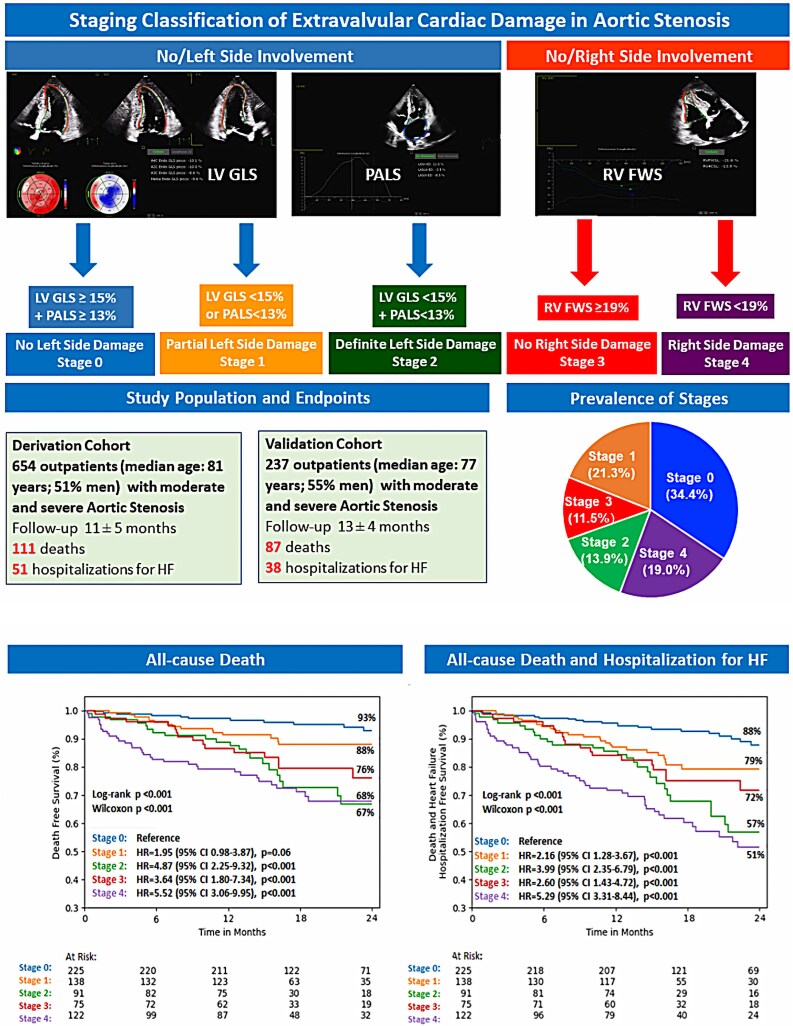
Aims: This study evaluates whether multi-chamber myocardial deformation analysis using speckle tracking echocardiography (STE) can enhance validated current staging systems and improve risk stratification for patients with moderate-to-severe aortic stenosis (AS).
Methods and results: We reanalysed 2D, Doppler, and STE data obtained from two cohorts: derivation (654 patients, median age: 82 years; 51% men) and validation (237 patients, median age: 77 years; 55% men) with at least moderate AS (aortic valve area < 1.5 cm2). The receiver operator characteristic curve analysis identified optimal cut-off values linked to outcomes: 15% for left ventricular global longitudinal strain (LVGLS), 13% for peak atrial longitudinal strain (PALS), and 19% for right ventricular free-wall strain (RVFWS). Patients have been divided into five stages: Stage 0, no left-side damage (LVGLS ≥ 15% and PALS ≥ 13%); Stage 1, partial left-side damage (LVGLS < 15% or PALS < 13%); Stage 2, definite left-side damage (LVGLS < 15% and PALS < 13%); Stage 3, no right-side damage (RVFWS ≥ 19%); and Stage 4, right-side damage (RVFWS < 19%). In a multivariable Cox regression analysis, the new staging scheme remained independently associated with an increased risk of all-cause death [adjusted-hazard ratio: 1.28; 95% confidence interval (CI): 1.10-1.48; P = 0.001]. This new staging classification exhibited higher predictive power [area under the curve (AUC) 0.67; 95% CI 0.62-0.73] than those proposed by Généreux et al. (Staging classification of aortic stenosis based on the extent of cardiac damage. Eur Heart J 2017;38:3351-8.) (AUC 0.62; 95% CI 0.56-0.67; P = 0.002) and Tastet et al. (Staging cardiac damage in patients with asymptomatic aortic valve stenosis. J Am Coll Cardiol 2019;74:550-63.) (AUC 0.64; 95% CI 0.58-0.70; P = 0.041) for 2-year all-cause death, with similar findings in the validation cohort.
Conclusion: Our staging system for detecting cardiac damage, incorporating multi-chamber myocardial deformation, exhibits a stronger association with outcomes than previously validated systems.
期刊介绍:
European Heart Journal – Cardiovascular Imaging is a monthly international peer reviewed journal dealing with Cardiovascular Imaging. It is an official publication of the European Association of Cardiovascular Imaging, a branch of the European Society of Cardiology.
The journal aims to publish the highest quality material, both scientific and clinical from all areas of cardiovascular imaging including echocardiography, magnetic resonance, computed tomography, nuclear and invasive imaging. A range of article types will be considered, including original research, reviews, editorials, image focus, letters and recommendation papers from relevant groups of the European Society of Cardiology. In addition it provides a forum for the exchange of information on all aspects of cardiovascular imaging.






 京公网安备 11010802042870号
京ICP备2023020795号-1
京公网安备 11010802042870号
京ICP备2023020795号-1

 分享
分享
 求助内容:
求助内容: 应助结果提醒方式:
 扫码关注我们
