Po-Han Huang, Mary Patricia Nowalk, Richard K Zimmerman, Samantha M Olson, H Keipp Talbot, Yuwei Zhu, Manjusha Gaglani, Kempapura Murthy, Arnold S Monto, Emily T Martin, Fernanda P Silveira, G K Balasubramani
{"title":"2015-2020年美国住院成人流感疫苗有效性网络(HAIVEN):肝脏疾病成人流感相关住院的疫苗有效性","authors":"Po-Han Huang, Mary Patricia Nowalk, Richard K Zimmerman, Samantha M Olson, H Keipp Talbot, Yuwei Zhu, Manjusha Gaglani, Kempapura Murthy, Arnold S Monto, Emily T Martin, Fernanda P Silveira, G K Balasubramani","doi":"10.1080/21645515.2025.2457205","DOIUrl":null,"url":null,"abstract":"<p><p>Influenza causes 100,000-710,000 hospitalizations annually in the U.S. Patients with liver disease are at higher risk of severe outcomes following influenza infection. This study evaluated influenza vaccine effectiveness (VE) against influenza-associated hospitalization among adults with liver disease. Data from the U.S. Hospitalized Adult Influenza Vaccine Effectiveness Network (HAIVEN), a test-negative case-control study, from 2015 to 2020 were used to estimate VE among adults ≥18 years admitted for acute respiratory illness. VE was calculated as (1-adjusted odds ratio)*100%, comparing the odds of vaccine receipt between laboratory-confirmed influenza cases and test-negative controls using multiple logistic regression with inverse probability of treatment weighting (IPTW). In total, 1,622 (12.8%) of 12,704 adults had ≥1 liver disease(s). Compared with those without liver disease, adults with liver disease were more likely to be admitted to the intensive care unit (15.7% vs 12.8%, <i>p</i> = .001) or to die in hospital (3.0% vs 1.4%, <i>p</i> < .001). The IPTW-adjusted VE against influenza-associated hospitalization was 27% (95% confidence interval [CI], 22-32%) among patients without liver disease, but the VE of 11% (95% CI, -8-26%) was not significant among those with liver disease. Significant effect modification of VE by the presence of liver disease was found (<i>p</i> < .05 for interaction term). While influenza vaccination significantly reduced the risk of influenza-associated hospitalization among adults without liver disease, the protective effect was not significant among those with liver disease. Further studies are warranted to evaluate influenza VE in patients with different types of liver disease and with specific vaccine formulations.</p>","PeriodicalId":49067,"journal":{"name":"Human Vaccines & Immunotherapeutics","volume":"21 1","pages":"2457205"},"PeriodicalIF":4.2000,"publicationDate":"2025-12-01","publicationTypes":"Journal Article","fieldsOfStudy":null,"isOpenAccess":false,"openAccessPdf":"https://www.ncbi.nlm.nih.gov/pmc/articles/PMC11776484/pdf/","citationCount":"0","resultStr":"{\"title\":\"Vaccine effectiveness against influenza-associated hospitalizations in adults with liver disease, 2015-2020: US Hospitalized Adult Influenza Vaccine Effectiveness Network (HAIVEN).\",\"authors\":\"Po-Han Huang, Mary Patricia Nowalk, Richard K Zimmerman, Samantha M Olson, H Keipp Talbot, Yuwei Zhu, Manjusha Gaglani, Kempapura Murthy, Arnold S Monto, Emily T Martin, Fernanda P Silveira, G K Balasubramani\",\"doi\":\"10.1080/21645515.2025.2457205\",\"DOIUrl\":null,\"url\":null,\"abstract\":\"<p><p>Influenza causes 100,000-710,000 hospitalizations annually in the U.S. Patients with liver disease are at higher risk of severe outcomes following influenza infection. This study evaluated influenza vaccine effectiveness (VE) against influenza-associated hospitalization among adults with liver disease. Data from the U.S. Hospitalized Adult Influenza Vaccine Effectiveness Network (HAIVEN), a test-negative case-control study, from 2015 to 2020 were used to estimate VE among adults ≥18 years admitted for acute respiratory illness. VE was calculated as (1-adjusted odds ratio)*100%, comparing the odds of vaccine receipt between laboratory-confirmed influenza cases and test-negative controls using multiple logistic regression with inverse probability of treatment weighting (IPTW). In total, 1,622 (12.8%) of 12,704 adults had ≥1 liver disease(s). Compared with those without liver disease, adults with liver disease were more likely to be admitted to the intensive care unit (15.7% vs 12.8%, <i>p</i> = .001) or to die in hospital (3.0% vs 1.4%, <i>p</i> < .001). The IPTW-adjusted VE against influenza-associated hospitalization was 27% (95% confidence interval [CI], 22-32%) among patients without liver disease, but the VE of 11% (95% CI, -8-26%) was not significant among those with liver disease. Significant effect modification of VE by the presence of liver disease was found (<i>p</i> < .05 for interaction term). While influenza vaccination significantly reduced the risk of influenza-associated hospitalization among adults without liver disease, the protective effect was not significant among those with liver disease. Further studies are warranted to evaluate influenza VE in patients with different types of liver disease and with specific vaccine formulations.</p>\",\"PeriodicalId\":49067,\"journal\":{\"name\":\"Human Vaccines & Immunotherapeutics\",\"volume\":\"21 1\",\"pages\":\"2457205\"},\"PeriodicalIF\":4.2000,\"publicationDate\":\"2025-12-01\",\"publicationTypes\":\"Journal Article\",\"fieldsOfStudy\":null,\"isOpenAccess\":false,\"openAccessPdf\":\"https://www.ncbi.nlm.nih.gov/pmc/articles/PMC11776484/pdf/\",\"citationCount\":\"0\",\"resultStr\":null,\"platform\":\"Semanticscholar\",\"paperid\":null,\"PeriodicalName\":\"Human Vaccines & Immunotherapeutics\",\"FirstCategoryId\":\"3\",\"ListUrlMain\":\"https://doi.org/10.1080/21645515.2025.2457205\",\"RegionNum\":4,\"RegionCategory\":\"医学\",\"ArticlePicture\":[],\"TitleCN\":null,\"AbstractTextCN\":null,\"PMCID\":null,\"EPubDate\":\"2025/1/28 0:00:00\",\"PubModel\":\"Epub\",\"JCR\":\"Q2\",\"JCRName\":\"BIOTECHNOLOGY & APPLIED MICROBIOLOGY\",\"Score\":null,\"Total\":0}","platform":"Semanticscholar","paperid":null,"PeriodicalName":"Human Vaccines & Immunotherapeutics","FirstCategoryId":"3","ListUrlMain":"https://doi.org/10.1080/21645515.2025.2457205","RegionNum":4,"RegionCategory":"医学","ArticlePicture":[],"TitleCN":null,"AbstractTextCN":null,"PMCID":null,"EPubDate":"2025/1/28 0:00:00","PubModel":"Epub","JCR":"Q2","JCRName":"BIOTECHNOLOGY & APPLIED MICROBIOLOGY","Score":null,"Total":0}
引用次数: 0
摘要
在美国,每年有10万至71万人因流感住院。患有肝脏疾病的患者在流感感染后出现严重后果的风险更高。本研究评估流感疫苗(VE)对成人肝病患者流感相关住院治疗的有效性。2015年至2020年,美国住院成人流感疫苗有效性网络(HAIVEN)(一项检测阴性的病例对照研究)的数据用于估计因急性呼吸道疾病住院的≥18岁成人的VE。VE计算为(1校正优势比)*100%,使用治疗加权逆概率(IPTW)的多重逻辑回归比较实验室确诊流感病例和检测阴性对照接种疫苗的几率。在12,704名成年人中,总共有1,622名(12.8%)患有≥1种肝脏疾病。与没有肝脏疾病的人相比,患有肝脏疾病的成年人更有可能住进重症监护病房(15.7% vs 12.8%, p = 0.001)或在医院死亡(3.0% vs 1.4%, p = 0.001)
Vaccine effectiveness against influenza-associated hospitalizations in adults with liver disease, 2015-2020: US Hospitalized Adult Influenza Vaccine Effectiveness Network (HAIVEN).
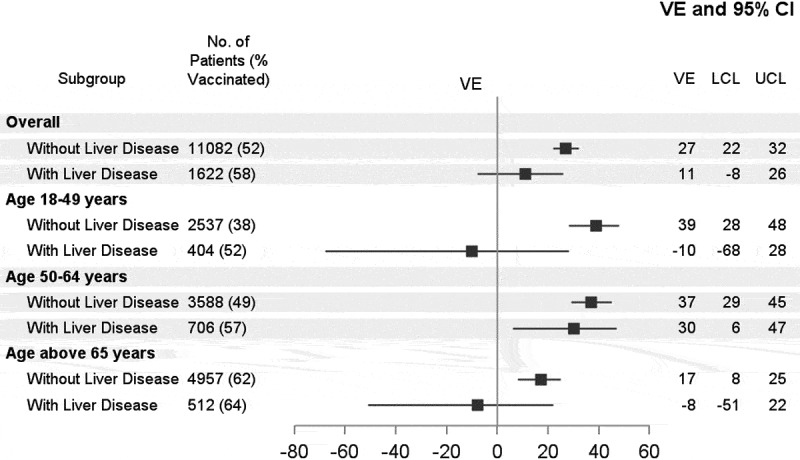
Influenza causes 100,000-710,000 hospitalizations annually in the U.S. Patients with liver disease are at higher risk of severe outcomes following influenza infection. This study evaluated influenza vaccine effectiveness (VE) against influenza-associated hospitalization among adults with liver disease. Data from the U.S. Hospitalized Adult Influenza Vaccine Effectiveness Network (HAIVEN), a test-negative case-control study, from 2015 to 2020 were used to estimate VE among adults ≥18 years admitted for acute respiratory illness. VE was calculated as (1-adjusted odds ratio)*100%, comparing the odds of vaccine receipt between laboratory-confirmed influenza cases and test-negative controls using multiple logistic regression with inverse probability of treatment weighting (IPTW). In total, 1,622 (12.8%) of 12,704 adults had ≥1 liver disease(s). Compared with those without liver disease, adults with liver disease were more likely to be admitted to the intensive care unit (15.7% vs 12.8%, p = .001) or to die in hospital (3.0% vs 1.4%, p < .001). The IPTW-adjusted VE against influenza-associated hospitalization was 27% (95% confidence interval [CI], 22-32%) among patients without liver disease, but the VE of 11% (95% CI, -8-26%) was not significant among those with liver disease. Significant effect modification of VE by the presence of liver disease was found (p < .05 for interaction term). While influenza vaccination significantly reduced the risk of influenza-associated hospitalization among adults without liver disease, the protective effect was not significant among those with liver disease. Further studies are warranted to evaluate influenza VE in patients with different types of liver disease and with specific vaccine formulations.
期刊介绍:
(formerly Human Vaccines; issn 1554-8619)
Vaccine research and development is extending its reach beyond the prevention of bacterial or viral diseases. There are experimental vaccines for immunotherapeutic purposes and for applications outside of infectious diseases, in diverse fields such as cancer, autoimmunity, allergy, Alzheimer’s and addiction. Many of these vaccines and immunotherapeutics should become available in the next two decades, with consequent benefit for human health. Continued advancement in this field will benefit from a forum that can (A) help to promote interest by keeping investigators updated, and (B) enable an exchange of ideas regarding the latest progress in the many topics pertaining to vaccines and immunotherapeutics.
Human Vaccines & Immunotherapeutics provides such a forum. It is published monthly in a format that is accessible to a wide international audience in the academic, industrial and public sectors.







 京公网安备 11010802042870号
京ICP备2023020795号-1
京公网安备 11010802042870号
京ICP备2023020795号-1

 分享
分享
 求助内容:
求助内容: 应助结果提醒方式:
 扫码关注我们
