Marta Righetto, Cristian Brandi, Riccardo Reale and Federica Caselli
{"title":"将阻抗细胞仪与其他微流控工具集成到多功能单细胞分析平台。","authors":"Marta Righetto, Cristian Brandi, Riccardo Reale and Federica Caselli","doi":"10.1039/D4LC00957F","DOIUrl":null,"url":null,"abstract":"<p >Microfluidic impedance cytometry (MIC) is a label-free technique that characterizes individual flowing particles/cells based on their interaction with a multifrequency electric field. The technique has been successfully applied in different scenarios including life-science research, diagnostics, and environmental monitoring. The aim of this review is to illustrate the fascinating opportunities enabled by the integration of MIC with other microfluidic tools. Specifically, we identify five categories according to their synergistic advantage: (i) improving the multiparametric characterization capability, (ii) enabling on-chip sample preparation steps, (iii) stimulating the sample, (iv) sample carrying/confinement, and (v) impedance-activated sample sorting. We discuss examples from each category, highlighting integration challenges and promising perspectives for next-generation multifunctional systems.</p>","PeriodicalId":85,"journal":{"name":"Lab on a Chip","volume":" 5","pages":" 1316-1341"},"PeriodicalIF":5.4000,"publicationDate":"2025-01-22","publicationTypes":"Journal Article","fieldsOfStudy":null,"isOpenAccess":false,"openAccessPdf":"","citationCount":"0","resultStr":"{\"title\":\"Integrating impedance cytometry with other microfluidic tools towards multifunctional single-cell analysis platforms\",\"authors\":\"Marta Righetto, Cristian Brandi, Riccardo Reale and Federica Caselli\",\"doi\":\"10.1039/D4LC00957F\",\"DOIUrl\":null,\"url\":null,\"abstract\":\"<p >Microfluidic impedance cytometry (MIC) is a label-free technique that characterizes individual flowing particles/cells based on their interaction with a multifrequency electric field. The technique has been successfully applied in different scenarios including life-science research, diagnostics, and environmental monitoring. The aim of this review is to illustrate the fascinating opportunities enabled by the integration of MIC with other microfluidic tools. Specifically, we identify five categories according to their synergistic advantage: (i) improving the multiparametric characterization capability, (ii) enabling on-chip sample preparation steps, (iii) stimulating the sample, (iv) sample carrying/confinement, and (v) impedance-activated sample sorting. We discuss examples from each category, highlighting integration challenges and promising perspectives for next-generation multifunctional systems.</p>\",\"PeriodicalId\":85,\"journal\":{\"name\":\"Lab on a Chip\",\"volume\":\" 5\",\"pages\":\" 1316-1341\"},\"PeriodicalIF\":5.4000,\"publicationDate\":\"2025-01-22\",\"publicationTypes\":\"Journal Article\",\"fieldsOfStudy\":null,\"isOpenAccess\":false,\"openAccessPdf\":\"\",\"citationCount\":\"0\",\"resultStr\":null,\"platform\":\"Semanticscholar\",\"paperid\":null,\"PeriodicalName\":\"Lab on a Chip\",\"FirstCategoryId\":\"5\",\"ListUrlMain\":\"https://pubs.rsc.org/en/content/articlelanding/2025/lc/d4lc00957f\",\"RegionNum\":2,\"RegionCategory\":\"工程技术\",\"ArticlePicture\":[],\"TitleCN\":null,\"AbstractTextCN\":null,\"PMCID\":null,\"EPubDate\":\"\",\"PubModel\":\"\",\"JCR\":\"Q1\",\"JCRName\":\"BIOCHEMICAL RESEARCH METHODS\",\"Score\":null,\"Total\":0}","platform":"Semanticscholar","paperid":null,"PeriodicalName":"Lab on a Chip","FirstCategoryId":"5","ListUrlMain":"https://pubs.rsc.org/en/content/articlelanding/2025/lc/d4lc00957f","RegionNum":2,"RegionCategory":"工程技术","ArticlePicture":[],"TitleCN":null,"AbstractTextCN":null,"PMCID":null,"EPubDate":"","PubModel":"","JCR":"Q1","JCRName":"BIOCHEMICAL RESEARCH METHODS","Score":null,"Total":0}
Integrating impedance cytometry with other microfluidic tools towards multifunctional single-cell analysis platforms
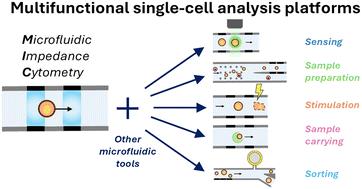
Microfluidic impedance cytometry (MIC) is a label-free technique that characterizes individual flowing particles/cells based on their interaction with a multifrequency electric field. The technique has been successfully applied in different scenarios including life-science research, diagnostics, and environmental monitoring. The aim of this review is to illustrate the fascinating opportunities enabled by the integration of MIC with other microfluidic tools. Specifically, we identify five categories according to their synergistic advantage: (i) improving the multiparametric characterization capability, (ii) enabling on-chip sample preparation steps, (iii) stimulating the sample, (iv) sample carrying/confinement, and (v) impedance-activated sample sorting. We discuss examples from each category, highlighting integration challenges and promising perspectives for next-generation multifunctional systems.
期刊介绍:
Lab on a Chip is the premiere journal that publishes cutting-edge research in the field of miniaturization. By their very nature, microfluidic/nanofluidic/miniaturized systems are at the intersection of disciplines, spanning fundamental research to high-end application, which is reflected by the broad readership of the journal. Lab on a Chip publishes two types of papers on original research: full-length research papers and communications. Papers should demonstrate innovations, which can come from technical advancements or applications addressing pressing needs in globally important areas. The journal also publishes Comments, Reviews, and Perspectives.




 京公网安备 11010802042870号
京ICP备2023020795号-1
京公网安备 11010802042870号
京ICP备2023020795号-1

 分享
分享
 求助内容:
求助内容: 应助结果提醒方式:
 扫码关注我们
