Xuan Yang, Yuxin Pan, Yang Zhang, Yang Meng, Tang Tong, Mingyi Zhao
{"title":"系统性免疫炎症指数(SII)与牛皮癣风险的关联:2011-2014年全国健康与营养调查的横断面分析","authors":"Xuan Yang, Yuxin Pan, Yang Zhang, Yang Meng, Tang Tong, Mingyi Zhao","doi":"10.1186/s40001-025-02304-0","DOIUrl":null,"url":null,"abstract":"<p><strong>Background: </strong>The systemic immune-inflammation index (SII) is an emerging marker of inflammation, and the onset of psoriasis is associated with inflammation. The aim of our study was to investigate the potential impact of SII on the incidence rate of adult psoriasis.</p><p><strong>Methods: </strong>We conducted a cross-sectional study based on the National Health and Nutrition Examination Survey (NHANES) 2011-2014 data sets. Multiple logistic regression analyses with appropriate covariates adjustment were the major methods in this study. Subgroup analyses were conducted by age, gender, race, smoking status, alcohol consumption, history of heart attack, stroke, coronary heart disease and diabetes. Interactions among these variables were also detected. We further utilized smooth curve fitting to explore potential nonlinear associations between SII and psoriasis across different subgroups. The receiver operating characteristic curve analysis was used to assess the diagnostic value of SII for psoriasis in the general population and diabetic individuals. Multiple imputation was adopted as sensitivity analysis to address potential bias due to missing data.</p><p><strong>Results: </strong>9314 participants (≥ 20 years) were included. A significant positive association was observed between SII and psoriasis (OR = 1.56; P = 0.0069). Subgroup analysis revealed significant positive association in males (OR = 1.52; P = 0.0288), females (OR = 1.61; P = 0.0322), Non-Hispanic Whites (OR = 1.55; P = 0.0190), people aged 40-59 years (OR = 1.98; P = 0.0386), diabetics (OR = 3.40; P = 0.0088), and overweight participants (OR = 1.80; P = 0.0034). SII had a higher predictive value for psoriasis in diabetic patients (AUC = 0.62; 95% CI [0.55, 0.70]). In stroke patients, SII was negatively correlated with the occurrence of psoriasis, and interaction test suggested the effect of SII on psoriasis was significantly modified by stroke (P = 0.0003). Nonlinear relationships between SII and psoriasis were observed in participants aged 20 to 39, former smokers, current drinkers, individuals with or without heart attack, those without coronary heart disease, and overweight participants.</p><p><strong>Conclusions: </strong>SII was positively associated with psoriasis. Testing for SII levels may help to identify the onset of psoriasis early.</p>","PeriodicalId":11949,"journal":{"name":"European Journal of Medical Research","volume":"30 1","pages":"58"},"PeriodicalIF":4.8000,"publicationDate":"2025-01-29","publicationTypes":"Journal Article","fieldsOfStudy":null,"isOpenAccess":false,"openAccessPdf":"https://www.ncbi.nlm.nih.gov/pmc/articles/PMC11776211/pdf/","citationCount":"0","resultStr":"{\"title\":\"Association of systemic immune-inflammation index (SII) with risk of psoriasis: a cross-sectional analysis of National Health and Nutrition Examination Survey 2011-2014.\",\"authors\":\"Xuan Yang, Yuxin Pan, Yang Zhang, Yang Meng, Tang Tong, Mingyi Zhao\",\"doi\":\"10.1186/s40001-025-02304-0\",\"DOIUrl\":null,\"url\":null,\"abstract\":\"<p><strong>Background: </strong>The systemic immune-inflammation index (SII) is an emerging marker of inflammation, and the onset of psoriasis is associated with inflammation. The aim of our study was to investigate the potential impact of SII on the incidence rate of adult psoriasis.</p><p><strong>Methods: </strong>We conducted a cross-sectional study based on the National Health and Nutrition Examination Survey (NHANES) 2011-2014 data sets. Multiple logistic regression analyses with appropriate covariates adjustment were the major methods in this study. Subgroup analyses were conducted by age, gender, race, smoking status, alcohol consumption, history of heart attack, stroke, coronary heart disease and diabetes. Interactions among these variables were also detected. We further utilized smooth curve fitting to explore potential nonlinear associations between SII and psoriasis across different subgroups. The receiver operating characteristic curve analysis was used to assess the diagnostic value of SII for psoriasis in the general population and diabetic individuals. Multiple imputation was adopted as sensitivity analysis to address potential bias due to missing data.</p><p><strong>Results: </strong>9314 participants (≥ 20 years) were included. A significant positive association was observed between SII and psoriasis (OR = 1.56; P = 0.0069). Subgroup analysis revealed significant positive association in males (OR = 1.52; P = 0.0288), females (OR = 1.61; P = 0.0322), Non-Hispanic Whites (OR = 1.55; P = 0.0190), people aged 40-59 years (OR = 1.98; P = 0.0386), diabetics (OR = 3.40; P = 0.0088), and overweight participants (OR = 1.80; P = 0.0034). SII had a higher predictive value for psoriasis in diabetic patients (AUC = 0.62; 95% CI [0.55, 0.70]). In stroke patients, SII was negatively correlated with the occurrence of psoriasis, and interaction test suggested the effect of SII on psoriasis was significantly modified by stroke (P = 0.0003). Nonlinear relationships between SII and psoriasis were observed in participants aged 20 to 39, former smokers, current drinkers, individuals with or without heart attack, those without coronary heart disease, and overweight participants.</p><p><strong>Conclusions: </strong>SII was positively associated with psoriasis. Testing for SII levels may help to identify the onset of psoriasis early.</p>\",\"PeriodicalId\":11949,\"journal\":{\"name\":\"European Journal of Medical Research\",\"volume\":\"30 1\",\"pages\":\"58\"},\"PeriodicalIF\":4.8000,\"publicationDate\":\"2025-01-29\",\"publicationTypes\":\"Journal Article\",\"fieldsOfStudy\":null,\"isOpenAccess\":false,\"openAccessPdf\":\"https://www.ncbi.nlm.nih.gov/pmc/articles/PMC11776211/pdf/\",\"citationCount\":\"0\",\"resultStr\":null,\"platform\":\"Semanticscholar\",\"paperid\":null,\"PeriodicalName\":\"European Journal of Medical Research\",\"FirstCategoryId\":\"3\",\"ListUrlMain\":\"https://doi.org/10.1186/s40001-025-02304-0\",\"RegionNum\":3,\"RegionCategory\":\"医学\",\"ArticlePicture\":[],\"TitleCN\":null,\"AbstractTextCN\":null,\"PMCID\":null,\"EPubDate\":\"\",\"PubModel\":\"\",\"JCR\":\"Q2\",\"JCRName\":\"MEDICINE, RESEARCH & EXPERIMENTAL\",\"Score\":null,\"Total\":0}","platform":"Semanticscholar","paperid":null,"PeriodicalName":"European Journal of Medical Research","FirstCategoryId":"3","ListUrlMain":"https://doi.org/10.1186/s40001-025-02304-0","RegionNum":3,"RegionCategory":"医学","ArticlePicture":[],"TitleCN":null,"AbstractTextCN":null,"PMCID":null,"EPubDate":"","PubModel":"","JCR":"Q2","JCRName":"MEDICINE, RESEARCH & EXPERIMENTAL","Score":null,"Total":0}
Association of systemic immune-inflammation index (SII) with risk of psoriasis: a cross-sectional analysis of National Health and Nutrition Examination Survey 2011-2014.
Background: The systemic immune-inflammation index (SII) is an emerging marker of inflammation, and the onset of psoriasis is associated with inflammation. The aim of our study was to investigate the potential impact of SII on the incidence rate of adult psoriasis.
Methods: We conducted a cross-sectional study based on the National Health and Nutrition Examination Survey (NHANES) 2011-2014 data sets. Multiple logistic regression analyses with appropriate covariates adjustment were the major methods in this study. Subgroup analyses were conducted by age, gender, race, smoking status, alcohol consumption, history of heart attack, stroke, coronary heart disease and diabetes. Interactions among these variables were also detected. We further utilized smooth curve fitting to explore potential nonlinear associations between SII and psoriasis across different subgroups. The receiver operating characteristic curve analysis was used to assess the diagnostic value of SII for psoriasis in the general population and diabetic individuals. Multiple imputation was adopted as sensitivity analysis to address potential bias due to missing data.
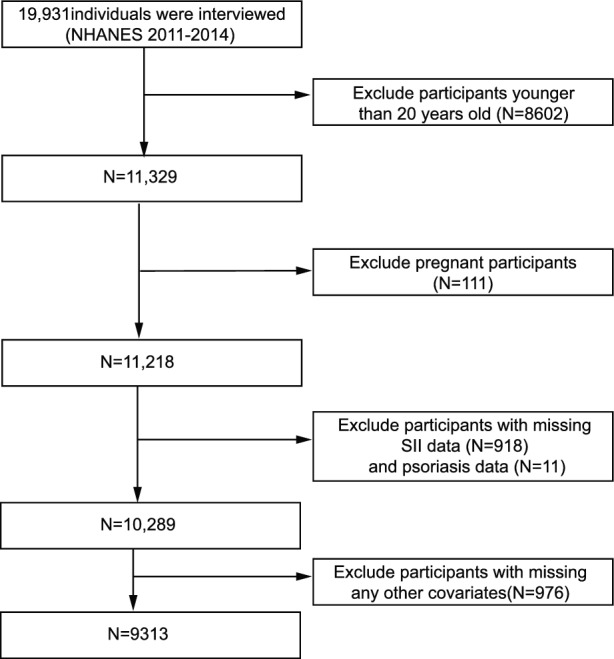
Results: 9314 participants (≥ 20 years) were included. A significant positive association was observed between SII and psoriasis (OR = 1.56; P = 0.0069). Subgroup analysis revealed significant positive association in males (OR = 1.52; P = 0.0288), females (OR = 1.61; P = 0.0322), Non-Hispanic Whites (OR = 1.55; P = 0.0190), people aged 40-59 years (OR = 1.98; P = 0.0386), diabetics (OR = 3.40; P = 0.0088), and overweight participants (OR = 1.80; P = 0.0034). SII had a higher predictive value for psoriasis in diabetic patients (AUC = 0.62; 95% CI [0.55, 0.70]). In stroke patients, SII was negatively correlated with the occurrence of psoriasis, and interaction test suggested the effect of SII on psoriasis was significantly modified by stroke (P = 0.0003). Nonlinear relationships between SII and psoriasis were observed in participants aged 20 to 39, former smokers, current drinkers, individuals with or without heart attack, those without coronary heart disease, and overweight participants.
Conclusions: SII was positively associated with psoriasis. Testing for SII levels may help to identify the onset of psoriasis early.
期刊介绍:
European Journal of Medical Research publishes translational and clinical research of international interest across all medical disciplines, enabling clinicians and other researchers to learn about developments and innovations within these disciplines and across the boundaries between disciplines. The journal publishes high quality research and reviews and aims to ensure that the results of all well-conducted research are published, regardless of their outcome.




 京公网安备 11010802042870号
京ICP备2023020795号-1
京公网安备 11010802042870号
京ICP备2023020795号-1

 分享
分享
 求助内容:
求助内容: 应助结果提醒方式:
 扫码关注我们
