Shivani Soni, Sunita Teli, Pankaj Teli and Shikha Agarwal
{"title":"革命性的绿色催化:一种新的amla种子衍生的生物炭修饰的g-C3N4·SO3H催化剂,用于可持续和通用的双吲哚合成。","authors":"Shivani Soni, Sunita Teli, Pankaj Teli and Shikha Agarwal","doi":"10.1039/D4NA00891J","DOIUrl":null,"url":null,"abstract":"<p >Catalysis plays a vital role in green chemistry by improving process efficiency, reducing waste, and minimizing environmental impact. A biochar-modified g-C<small><sub>3</sub></small>N<small><sub>4</sub></small>·SO<small><sub>3</sub></small>H (BCNSA) catalyst was developed using biochar derived from amla seed powder and CNSA. CNSA was synthesized <em>via</em> the reaction of g-C<small><sub>3</sub></small>N<small><sub>4</sub></small> with chlorosulfonic acid. Both components were combined, pyrolyzed, purified, and comprehensively characterized using FTIR, XRD, FE-SEM, EDX, elemental mapping, TGA, and DTA studies to confirm the successful synthesis and structural integrity. The catalyst demonstrated exceptional efficiency in synthesizing bis-indole derivatives through reactions between substituted indoles (indole, 1-methyl indole, and 6-chloro indole) and carbonyl-containing compounds, including isatins (isatin, 7-(trifluoromethyl)isatin, 5-bromo isatin, and 5-fluoro isatin), aldehydes, cyclo-ketones, dimedone, and acetophenones. These reactions were carried out under simplified conditions using water as a green solvent, promoting sustainability and versatility. A total of 21 bis-indole products were synthesized within 5–45 minutes, achieving yields of 80–98% showcasing the catalyst's outstanding performance. Furthermore, the method was scaled up to gram-level synthesis, and green chemistry metrics were evaluated for all the products, highlighting the environmental and economic benefits of this approach.</p>","PeriodicalId":18806,"journal":{"name":"Nanoscale Advances","volume":" 6","pages":" 1603-1616"},"PeriodicalIF":4.6000,"publicationDate":"2025-01-13","publicationTypes":"Journal Article","fieldsOfStudy":null,"isOpenAccess":false,"openAccessPdf":"https://www.ncbi.nlm.nih.gov/pmc/articles/PMC11774277/pdf/","citationCount":"0","resultStr":"{\"title\":\"Revolutionizing green catalysis: a novel amla seed derived biochar modified g-C3N4·SO3H catalyst for sustainable and versatile synthesis of bis-indoles†\",\"authors\":\"Shivani Soni, Sunita Teli, Pankaj Teli and Shikha Agarwal\",\"doi\":\"10.1039/D4NA00891J\",\"DOIUrl\":null,\"url\":null,\"abstract\":\"<p >Catalysis plays a vital role in green chemistry by improving process efficiency, reducing waste, and minimizing environmental impact. A biochar-modified g-C<small><sub>3</sub></small>N<small><sub>4</sub></small>·SO<small><sub>3</sub></small>H (BCNSA) catalyst was developed using biochar derived from amla seed powder and CNSA. CNSA was synthesized <em>via</em> the reaction of g-C<small><sub>3</sub></small>N<small><sub>4</sub></small> with chlorosulfonic acid. Both components were combined, pyrolyzed, purified, and comprehensively characterized using FTIR, XRD, FE-SEM, EDX, elemental mapping, TGA, and DTA studies to confirm the successful synthesis and structural integrity. The catalyst demonstrated exceptional efficiency in synthesizing bis-indole derivatives through reactions between substituted indoles (indole, 1-methyl indole, and 6-chloro indole) and carbonyl-containing compounds, including isatins (isatin, 7-(trifluoromethyl)isatin, 5-bromo isatin, and 5-fluoro isatin), aldehydes, cyclo-ketones, dimedone, and acetophenones. These reactions were carried out under simplified conditions using water as a green solvent, promoting sustainability and versatility. A total of 21 bis-indole products were synthesized within 5–45 minutes, achieving yields of 80–98% showcasing the catalyst's outstanding performance. Furthermore, the method was scaled up to gram-level synthesis, and green chemistry metrics were evaluated for all the products, highlighting the environmental and economic benefits of this approach.</p>\",\"PeriodicalId\":18806,\"journal\":{\"name\":\"Nanoscale Advances\",\"volume\":\" 6\",\"pages\":\" 1603-1616\"},\"PeriodicalIF\":4.6000,\"publicationDate\":\"2025-01-13\",\"publicationTypes\":\"Journal Article\",\"fieldsOfStudy\":null,\"isOpenAccess\":false,\"openAccessPdf\":\"https://www.ncbi.nlm.nih.gov/pmc/articles/PMC11774277/pdf/\",\"citationCount\":\"0\",\"resultStr\":null,\"platform\":\"Semanticscholar\",\"paperid\":null,\"PeriodicalName\":\"Nanoscale Advances\",\"FirstCategoryId\":\"88\",\"ListUrlMain\":\"https://pubs.rsc.org/en/content/articlelanding/2025/na/d4na00891j\",\"RegionNum\":3,\"RegionCategory\":\"材料科学\",\"ArticlePicture\":[],\"TitleCN\":null,\"AbstractTextCN\":null,\"PMCID\":null,\"EPubDate\":\"\",\"PubModel\":\"\",\"JCR\":\"Q2\",\"JCRName\":\"CHEMISTRY, MULTIDISCIPLINARY\",\"Score\":null,\"Total\":0}","platform":"Semanticscholar","paperid":null,"PeriodicalName":"Nanoscale Advances","FirstCategoryId":"88","ListUrlMain":"https://pubs.rsc.org/en/content/articlelanding/2025/na/d4na00891j","RegionNum":3,"RegionCategory":"材料科学","ArticlePicture":[],"TitleCN":null,"AbstractTextCN":null,"PMCID":null,"EPubDate":"","PubModel":"","JCR":"Q2","JCRName":"CHEMISTRY, MULTIDISCIPLINARY","Score":null,"Total":0}
Revolutionizing green catalysis: a novel amla seed derived biochar modified g-C3N4·SO3H catalyst for sustainable and versatile synthesis of bis-indoles†
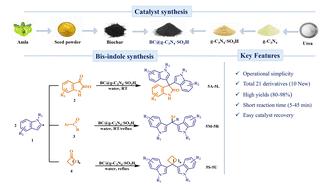
Catalysis plays a vital role in green chemistry by improving process efficiency, reducing waste, and minimizing environmental impact. A biochar-modified g-C3N4·SO3H (BCNSA) catalyst was developed using biochar derived from amla seed powder and CNSA. CNSA was synthesized via the reaction of g-C3N4 with chlorosulfonic acid. Both components were combined, pyrolyzed, purified, and comprehensively characterized using FTIR, XRD, FE-SEM, EDX, elemental mapping, TGA, and DTA studies to confirm the successful synthesis and structural integrity. The catalyst demonstrated exceptional efficiency in synthesizing bis-indole derivatives through reactions between substituted indoles (indole, 1-methyl indole, and 6-chloro indole) and carbonyl-containing compounds, including isatins (isatin, 7-(trifluoromethyl)isatin, 5-bromo isatin, and 5-fluoro isatin), aldehydes, cyclo-ketones, dimedone, and acetophenones. These reactions were carried out under simplified conditions using water as a green solvent, promoting sustainability and versatility. A total of 21 bis-indole products were synthesized within 5–45 minutes, achieving yields of 80–98% showcasing the catalyst's outstanding performance. Furthermore, the method was scaled up to gram-level synthesis, and green chemistry metrics were evaluated for all the products, highlighting the environmental and economic benefits of this approach.




 京公网安备 11010802042870号
京ICP备2023020795号-1
京公网安备 11010802042870号
京ICP备2023020795号-1

 分享
分享
 求助内容:
求助内容: 应助结果提醒方式:
 扫码关注我们
