{"title":"基于面部照片的颅内生殖细胞肿瘤识别:应用深度学习进行软件开发的探索性研究。","authors":"Yanong Li, Yixuan He, Yawei Liu, Bingchen Wang, Bo Li, Xiaoguang Qiu","doi":"10.2196/58760","DOIUrl":null,"url":null,"abstract":"<p><strong>Background: </strong>Primary intracranial germ cell tumors (iGCTs) are highly malignant brain tumors that predominantly occur in children and adolescents, with an incidence rate ranking third among primary brain tumors in East Asia (8%-15%). Due to their insidious onset and impact on critical functional areas of the brain, these tumors often result in irreversible abnormalities in growth and development, as well as cognitive and motor impairments in affected children. Therefore, early diagnosis through advanced screening techniques is vital for improving patient outcomes and quality of life.</p><p><strong>Objective: </strong>This study aimed to investigate the application of facial recognition technology in the early detection of iGCTs in children and adolescents. Early diagnosis through advanced screening techniques is vital for improving patient outcomes and quality of life.</p><p><strong>Methods: </strong>A multicenter, phased approach was adopted for the development and validation of a deep learning model, GVisageNet, dedicated to the screening of midline brain tumors from normal controls (NCs) and iGCTs from other midline brain tumors. The study comprised the collection and division of datasets into training (n=847, iGCTs=358, NCs=300, other midline brain tumors=189) and testing (n=212, iGCTs=79, NCs=70, other midline brain tumors=63), with an additional independent validation dataset (n=336, iGCTs=130, NCs=100, other midline brain tumors=106) sourced from 4 medical institutions. A regression model using clinically relevant, statistically significant data was developed and combined with GVisageNet outputs to create a hybrid model. This integration sought to assess the incremental value of clinical data. The model's predictive mechanisms were explored through correlation analyses with endocrine indicators and stratified evaluations based on the degree of hypothalamic-pituitary-target axis damage. Performance metrics included area under the curve (AUC), accuracy, sensitivity, and specificity.</p><p><strong>Results: </strong>On the independent validation dataset, GVisageNet achieved an AUC of 0.938 (P<.01) in distinguishing midline brain tumors from NCs. Further, GVisageNet demonstrated significant diagnostic capability in distinguishing iGCTs from the other midline brain tumors, achieving an AUC of 0.739, which is superior to the regression model alone (AUC=0.632, P<.001) but less than the hybrid model (AUC=0.789, P=.04). Significant correlations were found between the GVisageNet's outputs and 7 endocrine indicators. Performance varied with hypothalamic-pituitary-target axis damage, indicating a further understanding of the working mechanism of GVisageNet.</p><p><strong>Conclusions: </strong>GVisageNet, capable of high accuracy both independently and with clinical data, shows substantial potential for early iGCTs detection, highlighting the importance of combining deep learning with clinical insights for personalized health care.</p>","PeriodicalId":16337,"journal":{"name":"Journal of Medical Internet Research","volume":"27 ","pages":"e58760"},"PeriodicalIF":8.2000,"publicationDate":"2025-01-30","publicationTypes":"Journal Article","fieldsOfStudy":null,"isOpenAccess":false,"openAccessPdf":"https://www.ncbi.nlm.nih.gov/pmc/articles/PMC11826948/pdf/","citationCount":"0","resultStr":"{\"title\":\"Identification of Intracranial Germ Cell Tumors Based on Facial Photos: Exploratory Study on the Use of Deep Learning for Software Development.\",\"authors\":\"Yanong Li, Yixuan He, Yawei Liu, Bingchen Wang, Bo Li, Xiaoguang Qiu\",\"doi\":\"10.2196/58760\",\"DOIUrl\":null,\"url\":null,\"abstract\":\"<p><strong>Background: </strong>Primary intracranial germ cell tumors (iGCTs) are highly malignant brain tumors that predominantly occur in children and adolescents, with an incidence rate ranking third among primary brain tumors in East Asia (8%-15%). Due to their insidious onset and impact on critical functional areas of the brain, these tumors often result in irreversible abnormalities in growth and development, as well as cognitive and motor impairments in affected children. Therefore, early diagnosis through advanced screening techniques is vital for improving patient outcomes and quality of life.</p><p><strong>Objective: </strong>This study aimed to investigate the application of facial recognition technology in the early detection of iGCTs in children and adolescents. Early diagnosis through advanced screening techniques is vital for improving patient outcomes and quality of life.</p><p><strong>Methods: </strong>A multicenter, phased approach was adopted for the development and validation of a deep learning model, GVisageNet, dedicated to the screening of midline brain tumors from normal controls (NCs) and iGCTs from other midline brain tumors. The study comprised the collection and division of datasets into training (n=847, iGCTs=358, NCs=300, other midline brain tumors=189) and testing (n=212, iGCTs=79, NCs=70, other midline brain tumors=63), with an additional independent validation dataset (n=336, iGCTs=130, NCs=100, other midline brain tumors=106) sourced from 4 medical institutions. A regression model using clinically relevant, statistically significant data was developed and combined with GVisageNet outputs to create a hybrid model. This integration sought to assess the incremental value of clinical data. The model's predictive mechanisms were explored through correlation analyses with endocrine indicators and stratified evaluations based on the degree of hypothalamic-pituitary-target axis damage. Performance metrics included area under the curve (AUC), accuracy, sensitivity, and specificity.</p><p><strong>Results: </strong>On the independent validation dataset, GVisageNet achieved an AUC of 0.938 (P<.01) in distinguishing midline brain tumors from NCs. Further, GVisageNet demonstrated significant diagnostic capability in distinguishing iGCTs from the other midline brain tumors, achieving an AUC of 0.739, which is superior to the regression model alone (AUC=0.632, P<.001) but less than the hybrid model (AUC=0.789, P=.04). Significant correlations were found between the GVisageNet's outputs and 7 endocrine indicators. Performance varied with hypothalamic-pituitary-target axis damage, indicating a further understanding of the working mechanism of GVisageNet.</p><p><strong>Conclusions: </strong>GVisageNet, capable of high accuracy both independently and with clinical data, shows substantial potential for early iGCTs detection, highlighting the importance of combining deep learning with clinical insights for personalized health care.</p>\",\"PeriodicalId\":16337,\"journal\":{\"name\":\"Journal of Medical Internet Research\",\"volume\":\"27 \",\"pages\":\"e58760\"},\"PeriodicalIF\":8.2000,\"publicationDate\":\"2025-01-30\",\"publicationTypes\":\"Journal Article\",\"fieldsOfStudy\":null,\"isOpenAccess\":false,\"openAccessPdf\":\"https://www.ncbi.nlm.nih.gov/pmc/articles/PMC11826948/pdf/\",\"citationCount\":\"0\",\"resultStr\":null,\"platform\":\"Semanticscholar\",\"paperid\":null,\"PeriodicalName\":\"Journal of Medical Internet Research\",\"FirstCategoryId\":\"3\",\"ListUrlMain\":\"https://doi.org/10.2196/58760\",\"RegionNum\":2,\"RegionCategory\":\"医学\",\"ArticlePicture\":[],\"TitleCN\":null,\"AbstractTextCN\":null,\"PMCID\":null,\"EPubDate\":\"\",\"PubModel\":\"\",\"JCR\":\"Q1\",\"JCRName\":\"HEALTH CARE SCIENCES & SERVICES\",\"Score\":null,\"Total\":0}","platform":"Semanticscholar","paperid":null,"PeriodicalName":"Journal of Medical Internet Research","FirstCategoryId":"3","ListUrlMain":"https://doi.org/10.2196/58760","RegionNum":2,"RegionCategory":"医学","ArticlePicture":[],"TitleCN":null,"AbstractTextCN":null,"PMCID":null,"EPubDate":"","PubModel":"","JCR":"Q1","JCRName":"HEALTH CARE SCIENCES & SERVICES","Score":null,"Total":0}
Identification of Intracranial Germ Cell Tumors Based on Facial Photos: Exploratory Study on the Use of Deep Learning for Software Development.
Background: Primary intracranial germ cell tumors (iGCTs) are highly malignant brain tumors that predominantly occur in children and adolescents, with an incidence rate ranking third among primary brain tumors in East Asia (8%-15%). Due to their insidious onset and impact on critical functional areas of the brain, these tumors often result in irreversible abnormalities in growth and development, as well as cognitive and motor impairments in affected children. Therefore, early diagnosis through advanced screening techniques is vital for improving patient outcomes and quality of life.
Objective: This study aimed to investigate the application of facial recognition technology in the early detection of iGCTs in children and adolescents. Early diagnosis through advanced screening techniques is vital for improving patient outcomes and quality of life.
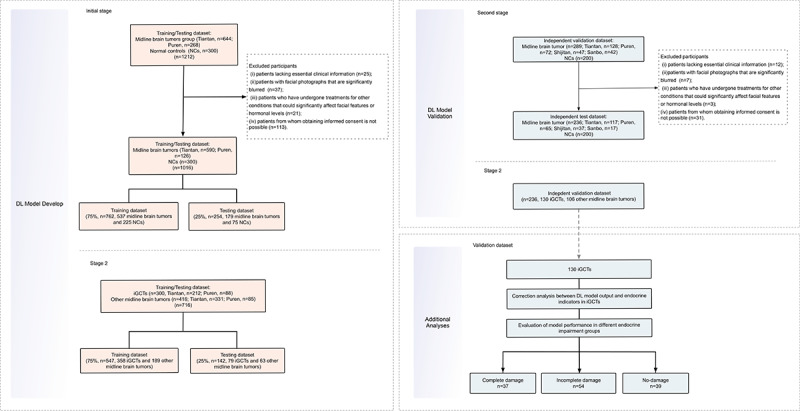
Methods: A multicenter, phased approach was adopted for the development and validation of a deep learning model, GVisageNet, dedicated to the screening of midline brain tumors from normal controls (NCs) and iGCTs from other midline brain tumors. The study comprised the collection and division of datasets into training (n=847, iGCTs=358, NCs=300, other midline brain tumors=189) and testing (n=212, iGCTs=79, NCs=70, other midline brain tumors=63), with an additional independent validation dataset (n=336, iGCTs=130, NCs=100, other midline brain tumors=106) sourced from 4 medical institutions. A regression model using clinically relevant, statistically significant data was developed and combined with GVisageNet outputs to create a hybrid model. This integration sought to assess the incremental value of clinical data. The model's predictive mechanisms were explored through correlation analyses with endocrine indicators and stratified evaluations based on the degree of hypothalamic-pituitary-target axis damage. Performance metrics included area under the curve (AUC), accuracy, sensitivity, and specificity.
Results: On the independent validation dataset, GVisageNet achieved an AUC of 0.938 (P<.01) in distinguishing midline brain tumors from NCs. Further, GVisageNet demonstrated significant diagnostic capability in distinguishing iGCTs from the other midline brain tumors, achieving an AUC of 0.739, which is superior to the regression model alone (AUC=0.632, P<.001) but less than the hybrid model (AUC=0.789, P=.04). Significant correlations were found between the GVisageNet's outputs and 7 endocrine indicators. Performance varied with hypothalamic-pituitary-target axis damage, indicating a further understanding of the working mechanism of GVisageNet.
Conclusions: GVisageNet, capable of high accuracy both independently and with clinical data, shows substantial potential for early iGCTs detection, highlighting the importance of combining deep learning with clinical insights for personalized health care.
期刊介绍:
The Journal of Medical Internet Research (JMIR) is a highly respected publication in the field of health informatics and health services. With a founding date in 1999, JMIR has been a pioneer in the field for over two decades.
As a leader in the industry, the journal focuses on digital health, data science, health informatics, and emerging technologies for health, medicine, and biomedical research. It is recognized as a top publication in these disciplines, ranking in the first quartile (Q1) by Impact Factor.
Notably, JMIR holds the prestigious position of being ranked #1 on Google Scholar within the "Medical Informatics" discipline.






 京公网安备 11010802042870号
京ICP备2023020795号-1
京公网安备 11010802042870号
京ICP备2023020795号-1

 分享
分享

 求助内容:
求助内容: 应助结果提醒方式:
 扫码关注我们
