Kyung-Je Park, Hoo-Chang Park, Yu-Ran Lee, Gordon Mitchell, Young Pyo Choi, Hyun-Joo Sohn
{"title":"大韩民国农场土壤中慢性消耗性疾病朊病毒的检测。","authors":"Kyung-Je Park, Hoo-Chang Park, Yu-Ran Lee, Gordon Mitchell, Young Pyo Choi, Hyun-Joo Sohn","doi":"10.1128/msphere.00866-24","DOIUrl":null,"url":null,"abstract":"<p><p>Chronic wasting disease (CWD) is a highly contagious prion disease occurring in free-ranging and farmed cervids. CWD continues to spread uncontrolled across North America, and cases continue to be detected almost every year in the Republic of Korea. CWD-infected animals contaminate the soil by releasing infectious prions through their excreta, and shed prions accumulate and remain infectious in the soil for years. Given that the upper soil levels can become contaminated with prions and serve as infectivity reservoirs facilitating horizontal transmission of CWD, the ability to detect prions in the soil is needed for monitoring and managing CWD spread. Using the protein misfolding cyclic amplification (PMCA) technique, we investigated whether prions could be amplified and detected in farm soil experimentally exposed to CWD-infected brain homogenate as well as in the soil of CWD-affected farms. From each soil sample, we performed 10 serial extractions and used these 10 extracts as PMCA templates. Here, we show that prion seeding activity was detected in extracts from farm soil following 4 years of incubation with CWD-infected brain homogenate. More importantly, 13 of 38 soil samples collected from six CWD-affected farms displayed prion seeding activity, with at least one soil sample in each farm being PMCA positive. Mouse bioassays confirmed the presence of prion infectivity in the soil extracts in which PMCA seeding activity was detected. This is the first report describing the successful detection of prions in soil collected from CWD-affected farms, suggesting that PMCA conducted on serial soil extracts is a sensitive means for prion detection in CWD-contaminated soil.IMPORTANCEChronic wasting disease (CWD) is a highly contagious prion disease affecting free-ranging and farmed cervids. CWD continues to spread uncontrollably across North America, and multiple cases are detected annually in the Republic of Korea. Prions shed from CWD-infected animals remain infectious in the soil for years, serving as infectivity reservoirs that facilitate horizontal transmission of the disease. Therefore, the ability to detect CWD prions in soil is crucial for monitoring and managing the spread of the disease. In this study, we have demonstrated for the first time that prions in the soil of CWD-affected farms can be reliably detected using a combination of serial soil extraction and a prion amplification technique. Our data, in which at least one soil sample tested positive for CWD in each of the six CWD-affected farms analyzed, suggest that the approach employed in this study is a sensitive method for prion detection in CWD-contaminated soil.</p>","PeriodicalId":19052,"journal":{"name":"mSphere","volume":" ","pages":"e0086624"},"PeriodicalIF":3.1000,"publicationDate":"2025-02-25","publicationTypes":"Journal Article","fieldsOfStudy":null,"isOpenAccess":false,"openAccessPdf":"https://www.ncbi.nlm.nih.gov/pmc/articles/PMC11852723/pdf/","citationCount":"0","resultStr":"{\"title\":\"Detection of chronic wasting disease prions in the farm soil of the Republic of Korea.\",\"authors\":\"Kyung-Je Park, Hoo-Chang Park, Yu-Ran Lee, Gordon Mitchell, Young Pyo Choi, Hyun-Joo Sohn\",\"doi\":\"10.1128/msphere.00866-24\",\"DOIUrl\":null,\"url\":null,\"abstract\":\"<p><p>Chronic wasting disease (CWD) is a highly contagious prion disease occurring in free-ranging and farmed cervids. CWD continues to spread uncontrolled across North America, and cases continue to be detected almost every year in the Republic of Korea. CWD-infected animals contaminate the soil by releasing infectious prions through their excreta, and shed prions accumulate and remain infectious in the soil for years. Given that the upper soil levels can become contaminated with prions and serve as infectivity reservoirs facilitating horizontal transmission of CWD, the ability to detect prions in the soil is needed for monitoring and managing CWD spread. Using the protein misfolding cyclic amplification (PMCA) technique, we investigated whether prions could be amplified and detected in farm soil experimentally exposed to CWD-infected brain homogenate as well as in the soil of CWD-affected farms. From each soil sample, we performed 10 serial extractions and used these 10 extracts as PMCA templates. Here, we show that prion seeding activity was detected in extracts from farm soil following 4 years of incubation with CWD-infected brain homogenate. More importantly, 13 of 38 soil samples collected from six CWD-affected farms displayed prion seeding activity, with at least one soil sample in each farm being PMCA positive. Mouse bioassays confirmed the presence of prion infectivity in the soil extracts in which PMCA seeding activity was detected. This is the first report describing the successful detection of prions in soil collected from CWD-affected farms, suggesting that PMCA conducted on serial soil extracts is a sensitive means for prion detection in CWD-contaminated soil.IMPORTANCEChronic wasting disease (CWD) is a highly contagious prion disease affecting free-ranging and farmed cervids. CWD continues to spread uncontrollably across North America, and multiple cases are detected annually in the Republic of Korea. Prions shed from CWD-infected animals remain infectious in the soil for years, serving as infectivity reservoirs that facilitate horizontal transmission of the disease. Therefore, the ability to detect CWD prions in soil is crucial for monitoring and managing the spread of the disease. In this study, we have demonstrated for the first time that prions in the soil of CWD-affected farms can be reliably detected using a combination of serial soil extraction and a prion amplification technique. Our data, in which at least one soil sample tested positive for CWD in each of the six CWD-affected farms analyzed, suggest that the approach employed in this study is a sensitive method for prion detection in CWD-contaminated soil.</p>\",\"PeriodicalId\":19052,\"journal\":{\"name\":\"mSphere\",\"volume\":\" \",\"pages\":\"e0086624\"},\"PeriodicalIF\":3.1000,\"publicationDate\":\"2025-02-25\",\"publicationTypes\":\"Journal Article\",\"fieldsOfStudy\":null,\"isOpenAccess\":false,\"openAccessPdf\":\"https://www.ncbi.nlm.nih.gov/pmc/articles/PMC11852723/pdf/\",\"citationCount\":\"0\",\"resultStr\":null,\"platform\":\"Semanticscholar\",\"paperid\":null,\"PeriodicalName\":\"mSphere\",\"FirstCategoryId\":\"99\",\"ListUrlMain\":\"https://doi.org/10.1128/msphere.00866-24\",\"RegionNum\":2,\"RegionCategory\":\"生物学\",\"ArticlePicture\":[],\"TitleCN\":null,\"AbstractTextCN\":null,\"PMCID\":null,\"EPubDate\":\"2025/1/30 0:00:00\",\"PubModel\":\"Epub\",\"JCR\":\"Q2\",\"JCRName\":\"MICROBIOLOGY\",\"Score\":null,\"Total\":0}","platform":"Semanticscholar","paperid":null,"PeriodicalName":"mSphere","FirstCategoryId":"99","ListUrlMain":"https://doi.org/10.1128/msphere.00866-24","RegionNum":2,"RegionCategory":"生物学","ArticlePicture":[],"TitleCN":null,"AbstractTextCN":null,"PMCID":null,"EPubDate":"2025/1/30 0:00:00","PubModel":"Epub","JCR":"Q2","JCRName":"MICROBIOLOGY","Score":null,"Total":0}
Detection of chronic wasting disease prions in the farm soil of the Republic of Korea.
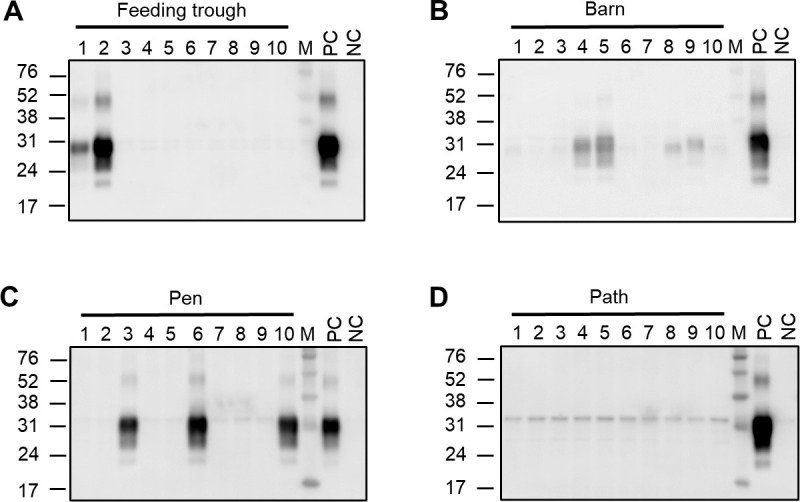
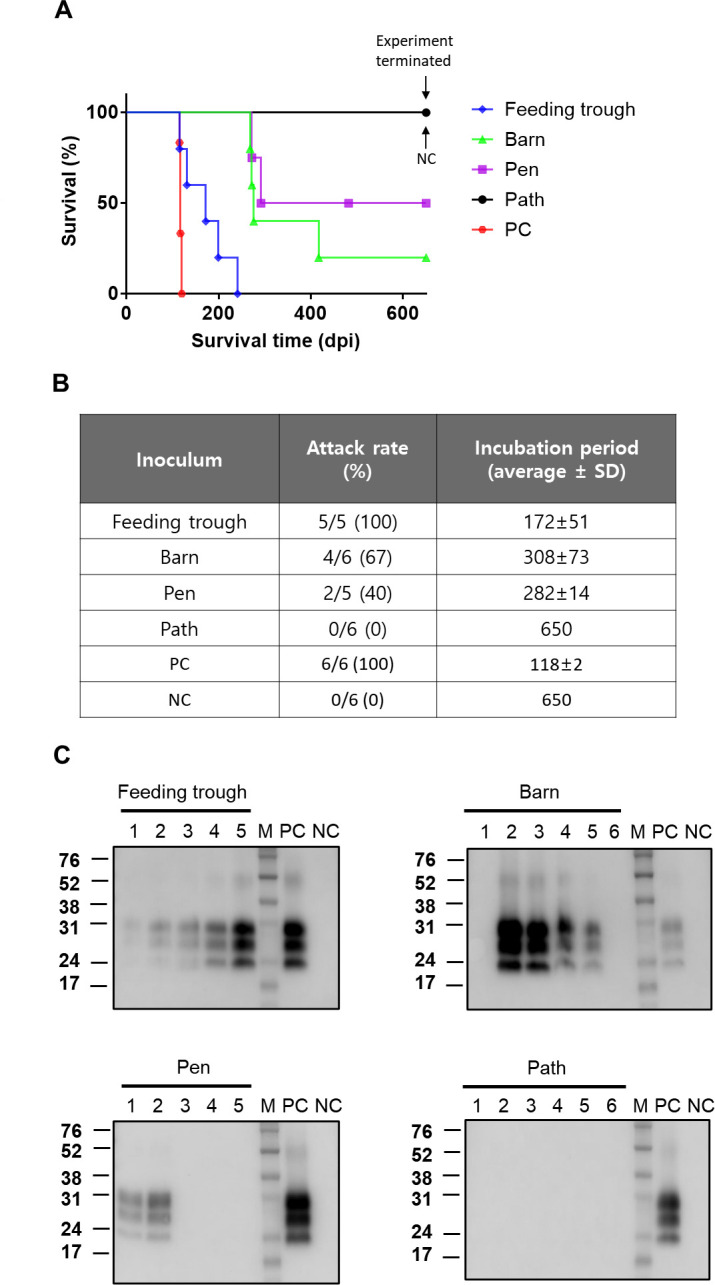
Chronic wasting disease (CWD) is a highly contagious prion disease occurring in free-ranging and farmed cervids. CWD continues to spread uncontrolled across North America, and cases continue to be detected almost every year in the Republic of Korea. CWD-infected animals contaminate the soil by releasing infectious prions through their excreta, and shed prions accumulate and remain infectious in the soil for years. Given that the upper soil levels can become contaminated with prions and serve as infectivity reservoirs facilitating horizontal transmission of CWD, the ability to detect prions in the soil is needed for monitoring and managing CWD spread. Using the protein misfolding cyclic amplification (PMCA) technique, we investigated whether prions could be amplified and detected in farm soil experimentally exposed to CWD-infected brain homogenate as well as in the soil of CWD-affected farms. From each soil sample, we performed 10 serial extractions and used these 10 extracts as PMCA templates. Here, we show that prion seeding activity was detected in extracts from farm soil following 4 years of incubation with CWD-infected brain homogenate. More importantly, 13 of 38 soil samples collected from six CWD-affected farms displayed prion seeding activity, with at least one soil sample in each farm being PMCA positive. Mouse bioassays confirmed the presence of prion infectivity in the soil extracts in which PMCA seeding activity was detected. This is the first report describing the successful detection of prions in soil collected from CWD-affected farms, suggesting that PMCA conducted on serial soil extracts is a sensitive means for prion detection in CWD-contaminated soil.IMPORTANCEChronic wasting disease (CWD) is a highly contagious prion disease affecting free-ranging and farmed cervids. CWD continues to spread uncontrollably across North America, and multiple cases are detected annually in the Republic of Korea. Prions shed from CWD-infected animals remain infectious in the soil for years, serving as infectivity reservoirs that facilitate horizontal transmission of the disease. Therefore, the ability to detect CWD prions in soil is crucial for monitoring and managing the spread of the disease. In this study, we have demonstrated for the first time that prions in the soil of CWD-affected farms can be reliably detected using a combination of serial soil extraction and a prion amplification technique. Our data, in which at least one soil sample tested positive for CWD in each of the six CWD-affected farms analyzed, suggest that the approach employed in this study is a sensitive method for prion detection in CWD-contaminated soil.
期刊介绍:
mSphere™ is a multi-disciplinary open-access journal that will focus on rapid publication of fundamental contributions to our understanding of microbiology. Its scope will reflect the immense range of fields within the microbial sciences, creating new opportunities for researchers to share findings that are transforming our understanding of human health and disease, ecosystems, neuroscience, agriculture, energy production, climate change, evolution, biogeochemical cycling, and food and drug production. Submissions will be encouraged of all high-quality work that makes fundamental contributions to our understanding of microbiology. mSphere™ will provide streamlined decisions, while carrying on ASM''s tradition for rigorous peer review.





 京公网安备 11010802042870号
京ICP备2023020795号-1
京公网安备 11010802042870号
京ICP备2023020795号-1

 分享
分享
 求助内容:
求助内容: 应助结果提醒方式:
 扫码关注我们
