Christen Grettenberger, David A Gold, C Titus Brown
{"title":"早期分支蓝藻的分布和产生最早的富氧光养生物的潜在栖息地。","authors":"Christen Grettenberger, David A Gold, C Titus Brown","doi":"10.1128/msphere.01013-24","DOIUrl":null,"url":null,"abstract":"<p><p>The evolution of oxygenic photosynthesis in the Cyanobacteria was one of the most transformative events in Earth history, eventually leading to the oxygenation of Earth's atmosphere. However, it is difficult to understand how the earliest Cyanobacteria functioned or evolved on early Earth in part because we do not understand their ecology, including the environments in which they lived. Here, we use a cutting-edge bioinformatics tool to survey nearly 500,000 metagenomes for relatives of the taxa that likely bookended the evolution of oxygenic photosynthesis to identify the modern environments in which these organisms live. Ancestral state reconstruction suggests that the common ancestors of these organisms lived in terrestrial (soil and/or freshwater) environments. This restricted distribution may have increased the lag between the evolution of oxygenic photosynthesis and the oxygenation of Earth's atmosphere.IMPORTANCECyanobacteria generate oxygen as part of their metabolism and are responsible for the rise of oxygen in Earth's atmosphere over two billion years ago. However, we do not know how long this process may have taken. To help constrain how long this process would have taken, it is necessary to understand where the earliest Cyanobacteria may have lived. Here, we use a cutting-edge bioinformatics tool called branch water to examine the environments where modern Cyanobacteria and their relatives live to constrain those inhabited by the earliest Cyanobacteria. We find that these species likely lived in non-marine environments. This indicates that the rise of oxygen may have taken longer than previously believed.</p>","PeriodicalId":19052,"journal":{"name":"mSphere","volume":" ","pages":"e0101324"},"PeriodicalIF":3.1000,"publicationDate":"2025-02-25","publicationTypes":"Journal Article","fieldsOfStudy":null,"isOpenAccess":false,"openAccessPdf":"https://www.ncbi.nlm.nih.gov/pmc/articles/PMC11853062/pdf/","citationCount":"0","resultStr":"{\"title\":\"Distribution of early-branching Cyanobacteriia and the potential habitats that gave rise to the earliest oxygenic phototrophs.\",\"authors\":\"Christen Grettenberger, David A Gold, C Titus Brown\",\"doi\":\"10.1128/msphere.01013-24\",\"DOIUrl\":null,\"url\":null,\"abstract\":\"<p><p>The evolution of oxygenic photosynthesis in the Cyanobacteria was one of the most transformative events in Earth history, eventually leading to the oxygenation of Earth's atmosphere. However, it is difficult to understand how the earliest Cyanobacteria functioned or evolved on early Earth in part because we do not understand their ecology, including the environments in which they lived. Here, we use a cutting-edge bioinformatics tool to survey nearly 500,000 metagenomes for relatives of the taxa that likely bookended the evolution of oxygenic photosynthesis to identify the modern environments in which these organisms live. Ancestral state reconstruction suggests that the common ancestors of these organisms lived in terrestrial (soil and/or freshwater) environments. This restricted distribution may have increased the lag between the evolution of oxygenic photosynthesis and the oxygenation of Earth's atmosphere.IMPORTANCECyanobacteria generate oxygen as part of their metabolism and are responsible for the rise of oxygen in Earth's atmosphere over two billion years ago. However, we do not know how long this process may have taken. To help constrain how long this process would have taken, it is necessary to understand where the earliest Cyanobacteria may have lived. Here, we use a cutting-edge bioinformatics tool called branch water to examine the environments where modern Cyanobacteria and their relatives live to constrain those inhabited by the earliest Cyanobacteria. We find that these species likely lived in non-marine environments. This indicates that the rise of oxygen may have taken longer than previously believed.</p>\",\"PeriodicalId\":19052,\"journal\":{\"name\":\"mSphere\",\"volume\":\" \",\"pages\":\"e0101324\"},\"PeriodicalIF\":3.1000,\"publicationDate\":\"2025-02-25\",\"publicationTypes\":\"Journal Article\",\"fieldsOfStudy\":null,\"isOpenAccess\":false,\"openAccessPdf\":\"https://www.ncbi.nlm.nih.gov/pmc/articles/PMC11853062/pdf/\",\"citationCount\":\"0\",\"resultStr\":null,\"platform\":\"Semanticscholar\",\"paperid\":null,\"PeriodicalName\":\"mSphere\",\"FirstCategoryId\":\"99\",\"ListUrlMain\":\"https://doi.org/10.1128/msphere.01013-24\",\"RegionNum\":2,\"RegionCategory\":\"生物学\",\"ArticlePicture\":[],\"TitleCN\":null,\"AbstractTextCN\":null,\"PMCID\":null,\"EPubDate\":\"2025/1/30 0:00:00\",\"PubModel\":\"Epub\",\"JCR\":\"Q2\",\"JCRName\":\"MICROBIOLOGY\",\"Score\":null,\"Total\":0}","platform":"Semanticscholar","paperid":null,"PeriodicalName":"mSphere","FirstCategoryId":"99","ListUrlMain":"https://doi.org/10.1128/msphere.01013-24","RegionNum":2,"RegionCategory":"生物学","ArticlePicture":[],"TitleCN":null,"AbstractTextCN":null,"PMCID":null,"EPubDate":"2025/1/30 0:00:00","PubModel":"Epub","JCR":"Q2","JCRName":"MICROBIOLOGY","Score":null,"Total":0}
Distribution of early-branching Cyanobacteriia and the potential habitats that gave rise to the earliest oxygenic phototrophs.
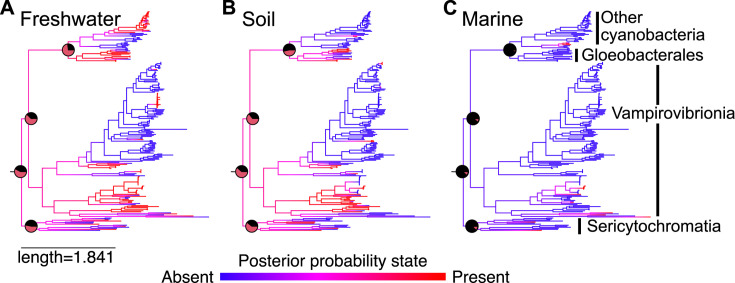
The evolution of oxygenic photosynthesis in the Cyanobacteria was one of the most transformative events in Earth history, eventually leading to the oxygenation of Earth's atmosphere. However, it is difficult to understand how the earliest Cyanobacteria functioned or evolved on early Earth in part because we do not understand their ecology, including the environments in which they lived. Here, we use a cutting-edge bioinformatics tool to survey nearly 500,000 metagenomes for relatives of the taxa that likely bookended the evolution of oxygenic photosynthesis to identify the modern environments in which these organisms live. Ancestral state reconstruction suggests that the common ancestors of these organisms lived in terrestrial (soil and/or freshwater) environments. This restricted distribution may have increased the lag between the evolution of oxygenic photosynthesis and the oxygenation of Earth's atmosphere.IMPORTANCECyanobacteria generate oxygen as part of their metabolism and are responsible for the rise of oxygen in Earth's atmosphere over two billion years ago. However, we do not know how long this process may have taken. To help constrain how long this process would have taken, it is necessary to understand where the earliest Cyanobacteria may have lived. Here, we use a cutting-edge bioinformatics tool called branch water to examine the environments where modern Cyanobacteria and their relatives live to constrain those inhabited by the earliest Cyanobacteria. We find that these species likely lived in non-marine environments. This indicates that the rise of oxygen may have taken longer than previously believed.
期刊介绍:
mSphere™ is a multi-disciplinary open-access journal that will focus on rapid publication of fundamental contributions to our understanding of microbiology. Its scope will reflect the immense range of fields within the microbial sciences, creating new opportunities for researchers to share findings that are transforming our understanding of human health and disease, ecosystems, neuroscience, agriculture, energy production, climate change, evolution, biogeochemical cycling, and food and drug production. Submissions will be encouraged of all high-quality work that makes fundamental contributions to our understanding of microbiology. mSphere™ will provide streamlined decisions, while carrying on ASM''s tradition for rigorous peer review.




 京公网安备 11010802042870号
京ICP备2023020795号-1
京公网安备 11010802042870号
京ICP备2023020795号-1

 分享
分享
 求助内容:
求助内容: 应助结果提醒方式:
 扫码关注我们
