Domenico Scrutinio , Federica Amitrano , Pietro Guida , Armando Coccia , Gaetano Pagano , Gianni D'addio , Andrea Passantino
{"title":"用机器学习预测心力衰竭的死亡率。与统计建模的比较。","authors":"Domenico Scrutinio , Federica Amitrano , Pietro Guida , Armando Coccia , Gaetano Pagano , Gianni D'addio , Andrea Passantino","doi":"10.1016/j.ejim.2025.01.020","DOIUrl":null,"url":null,"abstract":"<div><h3>Background</h3><div>Assessing the relative performance of machine learning (ML) methods and conventional statistical methods in predicting prognosis in heart failure (HF) still remains a challenging research field.</div></div><div><h3>Methods</h3><div>The primary outcome was three-year mortality. The following 5 machine learning approaches were used for modeling: Random Forest (RF), Gradient Boosting, Extreme Gradient Boosting (XGBoost), Support Vector Machine, and Multilayer perceptron. We compared the performance of the best performing ML models to the MAGGIC (Meta-analysis Global Group in Chronic Heart Failure) score and a novel logistic regression model (LRM) developed using the same set of variables used to develop the machine learning models. The performance was determined based on discrimination, calibration, and net benefit.</div></div><div><h3>Results</h3><div>The XGBoost and the RF were the best performing ML models. The XGBoost provided the highest discrimination (C-statistic: 0.793) and the lowest Brier score (0.178); the RF model had a C-statistic of 0.779 and provided the highest area under the precision‐recall curve (0.636). Both models were well calibrated. Both the XGboost and RF models outperformed MAGGIC score. The LRM had a C-statistic of 0.811 and a Brier score of 0.160 and was well calibrated. The XGBoost, RF, and LRM gave a higher net benefit than MAGGIC score; the XGBoost, RF, and logistic regression model gave similar net benefit.</div></div><div><h3>Conclusions</h3><div>RF and XGBoost models outperformed MAGGIC in predicting mortality. However, they did not offer any improvement over a logistic regression model built using the same set of covariates considered in the ML modeling.</div></div>","PeriodicalId":50485,"journal":{"name":"European Journal of Internal Medicine","volume":"133 ","pages":"Pages 106-112"},"PeriodicalIF":8.1000,"publicationDate":"2025-03-01","publicationTypes":"Journal Article","fieldsOfStudy":null,"isOpenAccess":false,"openAccessPdf":"","citationCount":"0","resultStr":"{\"title\":\"Prediction of mortality in heart failure by machine learning. Comparison with statistical modeling\",\"authors\":\"Domenico Scrutinio , Federica Amitrano , Pietro Guida , Armando Coccia , Gaetano Pagano , Gianni D'addio , Andrea Passantino\",\"doi\":\"10.1016/j.ejim.2025.01.020\",\"DOIUrl\":null,\"url\":null,\"abstract\":\"<div><h3>Background</h3><div>Assessing the relative performance of machine learning (ML) methods and conventional statistical methods in predicting prognosis in heart failure (HF) still remains a challenging research field.</div></div><div><h3>Methods</h3><div>The primary outcome was three-year mortality. The following 5 machine learning approaches were used for modeling: Random Forest (RF), Gradient Boosting, Extreme Gradient Boosting (XGBoost), Support Vector Machine, and Multilayer perceptron. We compared the performance of the best performing ML models to the MAGGIC (Meta-analysis Global Group in Chronic Heart Failure) score and a novel logistic regression model (LRM) developed using the same set of variables used to develop the machine learning models. The performance was determined based on discrimination, calibration, and net benefit.</div></div><div><h3>Results</h3><div>The XGBoost and the RF were the best performing ML models. The XGBoost provided the highest discrimination (C-statistic: 0.793) and the lowest Brier score (0.178); the RF model had a C-statistic of 0.779 and provided the highest area under the precision‐recall curve (0.636). Both models were well calibrated. Both the XGboost and RF models outperformed MAGGIC score. The LRM had a C-statistic of 0.811 and a Brier score of 0.160 and was well calibrated. The XGBoost, RF, and LRM gave a higher net benefit than MAGGIC score; the XGBoost, RF, and logistic regression model gave similar net benefit.</div></div><div><h3>Conclusions</h3><div>RF and XGBoost models outperformed MAGGIC in predicting mortality. However, they did not offer any improvement over a logistic regression model built using the same set of covariates considered in the ML modeling.</div></div>\",\"PeriodicalId\":50485,\"journal\":{\"name\":\"European Journal of Internal Medicine\",\"volume\":\"133 \",\"pages\":\"Pages 106-112\"},\"PeriodicalIF\":8.1000,\"publicationDate\":\"2025-03-01\",\"publicationTypes\":\"Journal Article\",\"fieldsOfStudy\":null,\"isOpenAccess\":false,\"openAccessPdf\":\"\",\"citationCount\":\"0\",\"resultStr\":null,\"platform\":\"Semanticscholar\",\"paperid\":null,\"PeriodicalName\":\"European Journal of Internal Medicine\",\"FirstCategoryId\":\"3\",\"ListUrlMain\":\"https://www.sciencedirect.com/science/article/pii/S0953620525000305\",\"RegionNum\":2,\"RegionCategory\":\"医学\",\"ArticlePicture\":[],\"TitleCN\":null,\"AbstractTextCN\":null,\"PMCID\":null,\"EPubDate\":\"2025/1/28 0:00:00\",\"PubModel\":\"Epub\",\"JCR\":\"Q1\",\"JCRName\":\"MEDICINE, GENERAL & INTERNAL\",\"Score\":null,\"Total\":0}","platform":"Semanticscholar","paperid":null,"PeriodicalName":"European Journal of Internal Medicine","FirstCategoryId":"3","ListUrlMain":"https://www.sciencedirect.com/science/article/pii/S0953620525000305","RegionNum":2,"RegionCategory":"医学","ArticlePicture":[],"TitleCN":null,"AbstractTextCN":null,"PMCID":null,"EPubDate":"2025/1/28 0:00:00","PubModel":"Epub","JCR":"Q1","JCRName":"MEDICINE, GENERAL & INTERNAL","Score":null,"Total":0}
Prediction of mortality in heart failure by machine learning. Comparison with statistical modeling
Background
Assessing the relative performance of machine learning (ML) methods and conventional statistical methods in predicting prognosis in heart failure (HF) still remains a challenging research field.
Methods
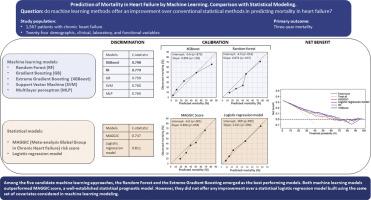
The primary outcome was three-year mortality. The following 5 machine learning approaches were used for modeling: Random Forest (RF), Gradient Boosting, Extreme Gradient Boosting (XGBoost), Support Vector Machine, and Multilayer perceptron. We compared the performance of the best performing ML models to the MAGGIC (Meta-analysis Global Group in Chronic Heart Failure) score and a novel logistic regression model (LRM) developed using the same set of variables used to develop the machine learning models. The performance was determined based on discrimination, calibration, and net benefit.
Results
The XGBoost and the RF were the best performing ML models. The XGBoost provided the highest discrimination (C-statistic: 0.793) and the lowest Brier score (0.178); the RF model had a C-statistic of 0.779 and provided the highest area under the precision‐recall curve (0.636). Both models were well calibrated. Both the XGboost and RF models outperformed MAGGIC score. The LRM had a C-statistic of 0.811 and a Brier score of 0.160 and was well calibrated. The XGBoost, RF, and LRM gave a higher net benefit than MAGGIC score; the XGBoost, RF, and logistic regression model gave similar net benefit.
Conclusions
RF and XGBoost models outperformed MAGGIC in predicting mortality. However, they did not offer any improvement over a logistic regression model built using the same set of covariates considered in the ML modeling.
期刊介绍:
The European Journal of Internal Medicine serves as the official journal of the European Federation of Internal Medicine and is the primary scientific reference for European academic and non-academic internists. It is dedicated to advancing science and practice in internal medicine across Europe. The journal publishes original articles, editorials, reviews, internal medicine flashcards, and other relevant information in the field. Both translational medicine and clinical studies are emphasized. EJIM aspires to be a leading platform for excellent clinical studies, with a focus on enhancing the quality of healthcare in European hospitals.




 京公网安备 11010802042870号
京ICP备2023020795号-1
京公网安备 11010802042870号
京ICP备2023020795号-1

 分享
分享
 求助内容:
求助内容: 应助结果提醒方式:
 扫码关注我们
