Guglielmo Di Molfetta, Ilaria Pola, Kubra Tan, Richard Isaacson, Kaj Blennow, Nicholas J Ashton, Andrea L Benedet, Henrik Zetterberg
{"title":"炎症生物标志物与阿尔茨海默病:一项使用NULISAseq的试点研究。","authors":"Guglielmo Di Molfetta, Ilaria Pola, Kubra Tan, Richard Isaacson, Kaj Blennow, Nicholas J Ashton, Andrea L Benedet, Henrik Zetterberg","doi":"10.1002/dad2.70079","DOIUrl":null,"url":null,"abstract":"<p><strong>Introduction: </strong>Increasing evidence links amyloid beta (Aβ) aggregation with inflammation. This pilot study investigated the use of an immunoassay panel to map biomarker changes in patients with Alzheimer's disease (AD). Furthermore, we evaluated the stability of protein quantification after multiple freeze-thaw cycles (FTCs).</p><p><strong>Methods: </strong>The nucleic acid-linked immuno-sandwich assay (NULISA) inflammation panel measured 203 proteins in serum samples of individuals with (<i>n</i> = 31) and without (<i>n</i> = 31) AD pathology. Linear models, adjusted for age and sex, contrasted protein expression across groups.</p><p><strong>Results: </strong>After multiple-testing adjustments, glial fibrillary acidic protein (<i>p</i> < 0.001) and S100A12 (<i>p</i> < 0.001) were significantly changed in the presence of AD pathology. Furthermore, they correlated with cerebrospinal fluid biomarkers (phosphorylated tau-181 [p-tau181], tau, and Aβ42). Additional markers were nominally changed between groups. Five FTCs caused minimal changes in measurements with the NULISA inflammation panel.</p><p><strong>Discussion: </strong>Monitoring of inflammation in AD, using the 200-plex NULISA panel, demonstrates changes in peripherally circulating inflammation-related proteins. Contrary to previous reports, FTCs had minimal impact on the quantification of inflammatory markers.</p><p><strong>Highlights: </strong>The novel nucleic acid-linked immuno-sandwich assay (NULISA) inflammation panel, which includes 200 protein biomarkers, was used.The panel was used for the first time in serum from patients with Alzheimer's disease (AD).The protein S100A12 was identified as a potential biomarker for AD.Inflammation markers were stable in up to five freeze-thaw cycles.</p>","PeriodicalId":53226,"journal":{"name":"Alzheimer''s and Dementia: Diagnosis, Assessment and Disease Monitoring","volume":"17 1","pages":"e70079"},"PeriodicalIF":4.4000,"publicationDate":"2025-01-30","publicationTypes":"Journal Article","fieldsOfStudy":null,"isOpenAccess":false,"openAccessPdf":"https://www.ncbi.nlm.nih.gov/pmc/articles/PMC11780250/pdf/","citationCount":"0","resultStr":"{\"title\":\"Inflammation biomarkers and Alzheimer's disease: A pilot study using NULISAseq.\",\"authors\":\"Guglielmo Di Molfetta, Ilaria Pola, Kubra Tan, Richard Isaacson, Kaj Blennow, Nicholas J Ashton, Andrea L Benedet, Henrik Zetterberg\",\"doi\":\"10.1002/dad2.70079\",\"DOIUrl\":null,\"url\":null,\"abstract\":\"<p><strong>Introduction: </strong>Increasing evidence links amyloid beta (Aβ) aggregation with inflammation. This pilot study investigated the use of an immunoassay panel to map biomarker changes in patients with Alzheimer's disease (AD). Furthermore, we evaluated the stability of protein quantification after multiple freeze-thaw cycles (FTCs).</p><p><strong>Methods: </strong>The nucleic acid-linked immuno-sandwich assay (NULISA) inflammation panel measured 203 proteins in serum samples of individuals with (<i>n</i> = 31) and without (<i>n</i> = 31) AD pathology. Linear models, adjusted for age and sex, contrasted protein expression across groups.</p><p><strong>Results: </strong>After multiple-testing adjustments, glial fibrillary acidic protein (<i>p</i> < 0.001) and S100A12 (<i>p</i> < 0.001) were significantly changed in the presence of AD pathology. Furthermore, they correlated with cerebrospinal fluid biomarkers (phosphorylated tau-181 [p-tau181], tau, and Aβ42). Additional markers were nominally changed between groups. Five FTCs caused minimal changes in measurements with the NULISA inflammation panel.</p><p><strong>Discussion: </strong>Monitoring of inflammation in AD, using the 200-plex NULISA panel, demonstrates changes in peripherally circulating inflammation-related proteins. Contrary to previous reports, FTCs had minimal impact on the quantification of inflammatory markers.</p><p><strong>Highlights: </strong>The novel nucleic acid-linked immuno-sandwich assay (NULISA) inflammation panel, which includes 200 protein biomarkers, was used.The panel was used for the first time in serum from patients with Alzheimer's disease (AD).The protein S100A12 was identified as a potential biomarker for AD.Inflammation markers were stable in up to five freeze-thaw cycles.</p>\",\"PeriodicalId\":53226,\"journal\":{\"name\":\"Alzheimer''s and Dementia: Diagnosis, Assessment and Disease Monitoring\",\"volume\":\"17 1\",\"pages\":\"e70079\"},\"PeriodicalIF\":4.4000,\"publicationDate\":\"2025-01-30\",\"publicationTypes\":\"Journal Article\",\"fieldsOfStudy\":null,\"isOpenAccess\":false,\"openAccessPdf\":\"https://www.ncbi.nlm.nih.gov/pmc/articles/PMC11780250/pdf/\",\"citationCount\":\"0\",\"resultStr\":null,\"platform\":\"Semanticscholar\",\"paperid\":null,\"PeriodicalName\":\"Alzheimer''s and Dementia: Diagnosis, Assessment and Disease Monitoring\",\"FirstCategoryId\":\"1085\",\"ListUrlMain\":\"https://doi.org/10.1002/dad2.70079\",\"RegionNum\":0,\"RegionCategory\":null,\"ArticlePicture\":[],\"TitleCN\":null,\"AbstractTextCN\":null,\"PMCID\":null,\"EPubDate\":\"2025/1/1 0:00:00\",\"PubModel\":\"eCollection\",\"JCR\":\"Q1\",\"JCRName\":\"CLINICAL NEUROLOGY\",\"Score\":null,\"Total\":0}","platform":"Semanticscholar","paperid":null,"PeriodicalName":"Alzheimer''s and Dementia: Diagnosis, Assessment and Disease Monitoring","FirstCategoryId":"1085","ListUrlMain":"https://doi.org/10.1002/dad2.70079","RegionNum":0,"RegionCategory":null,"ArticlePicture":[],"TitleCN":null,"AbstractTextCN":null,"PMCID":null,"EPubDate":"2025/1/1 0:00:00","PubModel":"eCollection","JCR":"Q1","JCRName":"CLINICAL NEUROLOGY","Score":null,"Total":0}
Inflammation biomarkers and Alzheimer's disease: A pilot study using NULISAseq.
Introduction: Increasing evidence links amyloid beta (Aβ) aggregation with inflammation. This pilot study investigated the use of an immunoassay panel to map biomarker changes in patients with Alzheimer's disease (AD). Furthermore, we evaluated the stability of protein quantification after multiple freeze-thaw cycles (FTCs).
Methods: The nucleic acid-linked immuno-sandwich assay (NULISA) inflammation panel measured 203 proteins in serum samples of individuals with (n = 31) and without (n = 31) AD pathology. Linear models, adjusted for age and sex, contrasted protein expression across groups.
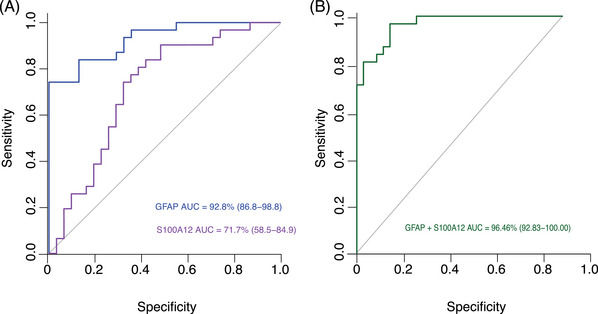
Results: After multiple-testing adjustments, glial fibrillary acidic protein (p < 0.001) and S100A12 (p < 0.001) were significantly changed in the presence of AD pathology. Furthermore, they correlated with cerebrospinal fluid biomarkers (phosphorylated tau-181 [p-tau181], tau, and Aβ42). Additional markers were nominally changed between groups. Five FTCs caused minimal changes in measurements with the NULISA inflammation panel.
Discussion: Monitoring of inflammation in AD, using the 200-plex NULISA panel, demonstrates changes in peripherally circulating inflammation-related proteins. Contrary to previous reports, FTCs had minimal impact on the quantification of inflammatory markers.
Highlights: The novel nucleic acid-linked immuno-sandwich assay (NULISA) inflammation panel, which includes 200 protein biomarkers, was used.The panel was used for the first time in serum from patients with Alzheimer's disease (AD).The protein S100A12 was identified as a potential biomarker for AD.Inflammation markers were stable in up to five freeze-thaw cycles.
期刊介绍:
Alzheimer''s & Dementia: Diagnosis, Assessment & Disease Monitoring (DADM) is an open access, peer-reviewed, journal from the Alzheimer''s Association® that will publish new research that reports the discovery, development and validation of instruments, technologies, algorithms, and innovative processes. Papers will cover a range of topics interested in the early and accurate detection of individuals with memory complaints and/or among asymptomatic individuals at elevated risk for various forms of memory disorders. The expectation for published papers will be to translate fundamental knowledge about the neurobiology of the disease into practical reports that describe both the conceptual and methodological aspects of the submitted scientific inquiry. Published topics will explore the development of biomarkers, surrogate markers, and conceptual/methodological challenges. Publication priority will be given to papers that 1) describe putative surrogate markers that accurately track disease progression, 2) biomarkers that fulfill international regulatory requirements, 3) reports from large, well-characterized population-based cohorts that comprise the heterogeneity and diversity of asymptomatic individuals and 4) algorithmic development that considers multi-marker arrays (e.g., integrated-omics, genetics, biofluids, imaging, etc.) and advanced computational analytics and technologies.






 京公网安备 11010802042870号
京ICP备2023020795号-1
京公网安备 11010802042870号
京ICP备2023020795号-1

 分享
分享
 求助内容:
求助内容: 应助结果提醒方式:
 扫码关注我们
