Fernanda de Almeida Batalha, Elizangela Farias da Silva, Paula Taquita Serra, Rafaella Oliveira Dos Santos, Zeca Manuel Salimo, Yury de Oliveira Chaves, Mirian Ívens Fagundes, Paulo Emílio Feuser, Victor Costa de Souza, Felipe Gomes Naveca, Ricardo A Machado de Ávila, Paulo Afonso Nogueira
{"title":"抗分裂子表面蛋白1-Block 2单倍型的IgM作为间日疟原虫感染的新工具","authors":"Fernanda de Almeida Batalha, Elizangela Farias da Silva, Paula Taquita Serra, Rafaella Oliveira Dos Santos, Zeca Manuel Salimo, Yury de Oliveira Chaves, Mirian Ívens Fagundes, Paulo Emílio Feuser, Victor Costa de Souza, Felipe Gomes Naveca, Ricardo A Machado de Ávila, Paulo Afonso Nogueira","doi":"10.4103/jgid.jgid_35_24","DOIUrl":null,"url":null,"abstract":"<p><strong>Introduction: </strong>The tools to distinguish relapse from reinfection are needed in malaria-endemic areas. We evaluated seroprevalence against sets of specific peptides to the block 2 region of <i>Plasmodium vivax</i>-merozoite surface protein-1 (PvMSP1) to detect parasite clones.</p><p><strong>Methods: </strong>We applied amplicon deep sequencing (ADS) of block 2 region of the MSP-1 gene (<i>pvmsp1</i>) to determine cocirculating parasite clones within eight <i>P. vivax</i>-infected individuals. Based on this, a seroprevalence of IgM and IgG antibodies against sets of peptides of different block-2 haplotypes was validated. After, we evaluated the seroprevalence in plasma of 72 pregnant women, from which 31 had recurrent <i>P. vivax</i> infections.</p><p><strong>Results: </strong>ADS revealed one block 2 haplotype clone infecting five of eight <i>P. vivax</i>-infected individuals. In all, IgM antibodies, not IgG, recognized only a set of peptides specific to the block 2 haplotype determined by ADS. In the other three patients, ADS determined three concurrent block 2 haplotype clones, among whom there was always one haplotype that predominated with more than 95% of high-quality reads and two other smaller haplotypes with up to 5% and the least was <1%. We observed higher IgM levels against haplotype-specific peptides corresponding to the predominant clone. The seroprevalence of pregnant women showed that anti-haplotype-specific IgM detected coinfection with parasite clones per pregnant woman and we also observed levels of anti-haplotype-specific IgM in primary infection increased in some recurrent episodes.</p><p><strong>Conclusion: </strong>IgM against sets of peptides specific to different <i>pvmsp1</i> haplotypes may be employed as a serological marker for parasite clones in vivax malaria.</p>","PeriodicalId":51581,"journal":{"name":"Journal of Global Infectious Diseases","volume":"16 4","pages":"152-159"},"PeriodicalIF":1.3000,"publicationDate":"2024-12-21","publicationTypes":"Journal Article","fieldsOfStudy":null,"isOpenAccess":false,"openAccessPdf":"https://www.ncbi.nlm.nih.gov/pmc/articles/PMC11775398/pdf/","citationCount":"0","resultStr":"{\"title\":\"IgM against Merozoite Surface Protein 1-Block 2 Haplotypes as New Tools for <i>Plasmodium vivax</i> Infections.\",\"authors\":\"Fernanda de Almeida Batalha, Elizangela Farias da Silva, Paula Taquita Serra, Rafaella Oliveira Dos Santos, Zeca Manuel Salimo, Yury de Oliveira Chaves, Mirian Ívens Fagundes, Paulo Emílio Feuser, Victor Costa de Souza, Felipe Gomes Naveca, Ricardo A Machado de Ávila, Paulo Afonso Nogueira\",\"doi\":\"10.4103/jgid.jgid_35_24\",\"DOIUrl\":null,\"url\":null,\"abstract\":\"<p><strong>Introduction: </strong>The tools to distinguish relapse from reinfection are needed in malaria-endemic areas. We evaluated seroprevalence against sets of specific peptides to the block 2 region of <i>Plasmodium vivax</i>-merozoite surface protein-1 (PvMSP1) to detect parasite clones.</p><p><strong>Methods: </strong>We applied amplicon deep sequencing (ADS) of block 2 region of the MSP-1 gene (<i>pvmsp1</i>) to determine cocirculating parasite clones within eight <i>P. vivax</i>-infected individuals. Based on this, a seroprevalence of IgM and IgG antibodies against sets of peptides of different block-2 haplotypes was validated. After, we evaluated the seroprevalence in plasma of 72 pregnant women, from which 31 had recurrent <i>P. vivax</i> infections.</p><p><strong>Results: </strong>ADS revealed one block 2 haplotype clone infecting five of eight <i>P. vivax</i>-infected individuals. In all, IgM antibodies, not IgG, recognized only a set of peptides specific to the block 2 haplotype determined by ADS. In the other three patients, ADS determined three concurrent block 2 haplotype clones, among whom there was always one haplotype that predominated with more than 95% of high-quality reads and two other smaller haplotypes with up to 5% and the least was <1%. We observed higher IgM levels against haplotype-specific peptides corresponding to the predominant clone. The seroprevalence of pregnant women showed that anti-haplotype-specific IgM detected coinfection with parasite clones per pregnant woman and we also observed levels of anti-haplotype-specific IgM in primary infection increased in some recurrent episodes.</p><p><strong>Conclusion: </strong>IgM against sets of peptides specific to different <i>pvmsp1</i> haplotypes may be employed as a serological marker for parasite clones in vivax malaria.</p>\",\"PeriodicalId\":51581,\"journal\":{\"name\":\"Journal of Global Infectious Diseases\",\"volume\":\"16 4\",\"pages\":\"152-159\"},\"PeriodicalIF\":1.3000,\"publicationDate\":\"2024-12-21\",\"publicationTypes\":\"Journal Article\",\"fieldsOfStudy\":null,\"isOpenAccess\":false,\"openAccessPdf\":\"https://www.ncbi.nlm.nih.gov/pmc/articles/PMC11775398/pdf/\",\"citationCount\":\"0\",\"resultStr\":null,\"platform\":\"Semanticscholar\",\"paperid\":null,\"PeriodicalName\":\"Journal of Global Infectious Diseases\",\"FirstCategoryId\":\"1085\",\"ListUrlMain\":\"https://doi.org/10.4103/jgid.jgid_35_24\",\"RegionNum\":0,\"RegionCategory\":null,\"ArticlePicture\":[],\"TitleCN\":null,\"AbstractTextCN\":null,\"PMCID\":null,\"EPubDate\":\"2024/10/1 0:00:00\",\"PubModel\":\"eCollection\",\"JCR\":\"Q4\",\"JCRName\":\"INFECTIOUS DISEASES\",\"Score\":null,\"Total\":0}","platform":"Semanticscholar","paperid":null,"PeriodicalName":"Journal of Global Infectious Diseases","FirstCategoryId":"1085","ListUrlMain":"https://doi.org/10.4103/jgid.jgid_35_24","RegionNum":0,"RegionCategory":null,"ArticlePicture":[],"TitleCN":null,"AbstractTextCN":null,"PMCID":null,"EPubDate":"2024/10/1 0:00:00","PubModel":"eCollection","JCR":"Q4","JCRName":"INFECTIOUS DISEASES","Score":null,"Total":0}
IgM against Merozoite Surface Protein 1-Block 2 Haplotypes as New Tools for Plasmodium vivax Infections.
Introduction: The tools to distinguish relapse from reinfection are needed in malaria-endemic areas. We evaluated seroprevalence against sets of specific peptides to the block 2 region of Plasmodium vivax-merozoite surface protein-1 (PvMSP1) to detect parasite clones.
Methods: We applied amplicon deep sequencing (ADS) of block 2 region of the MSP-1 gene (pvmsp1) to determine cocirculating parasite clones within eight P. vivax-infected individuals. Based on this, a seroprevalence of IgM and IgG antibodies against sets of peptides of different block-2 haplotypes was validated. After, we evaluated the seroprevalence in plasma of 72 pregnant women, from which 31 had recurrent P. vivax infections.
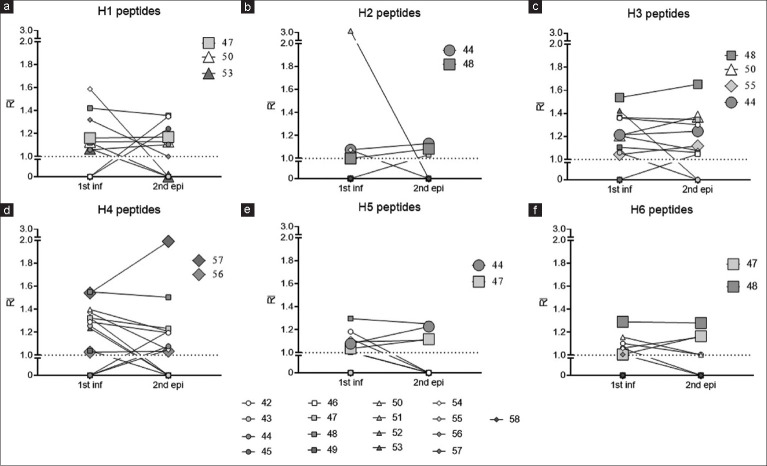
Results: ADS revealed one block 2 haplotype clone infecting five of eight P. vivax-infected individuals. In all, IgM antibodies, not IgG, recognized only a set of peptides specific to the block 2 haplotype determined by ADS. In the other three patients, ADS determined three concurrent block 2 haplotype clones, among whom there was always one haplotype that predominated with more than 95% of high-quality reads and two other smaller haplotypes with up to 5% and the least was <1%. We observed higher IgM levels against haplotype-specific peptides corresponding to the predominant clone. The seroprevalence of pregnant women showed that anti-haplotype-specific IgM detected coinfection with parasite clones per pregnant woman and we also observed levels of anti-haplotype-specific IgM in primary infection increased in some recurrent episodes.
Conclusion: IgM against sets of peptides specific to different pvmsp1 haplotypes may be employed as a serological marker for parasite clones in vivax malaria.
期刊介绍:
JGID encourages research, education and dissemination of knowledge in the field of Infectious Diseases across the world thus promoting translational research by striking a synergy between basic science, clinical medicine and public health. The Journal intends to bring together scientists and academicians in Infectious Diseases to promote translational synergy between Laboratory Science, Clinical Medicine and Public Health. The Journal invites Original Articles, Clinical Investigations, Epidemiological Analysis, Data Protocols, Case Reports, Clinical Photographs, review articles and special commentaries. Students, Residents, Academicians, Public Health experts and scientists are all encouraged to be a part of this initiative by contributing, reviewing and promoting scientific works and science.







 京公网安备 11010802042870号
京ICP备2023020795号-1
京公网安备 11010802042870号
京ICP备2023020795号-1

 分享
分享
 求助内容:
求助内容: 应助结果提醒方式:
 扫码关注我们
