Xiaoyu Guo, Zhedong Li, Jinfeng Shi, Chuanli Ren, Na Zhao, Zhibo Li
{"title":"通过添加催化磷酸盐作为助催化剂,将传统KOH催化环硅氧烷开环聚合提高到更高效的工艺","authors":"Xiaoyu Guo, Zhedong Li, Jinfeng Shi, Chuanli Ren, Na Zhao, Zhibo Li","doi":"10.1021/acs.macromol.4c02388","DOIUrl":null,"url":null,"abstract":"The development of efficient catalyst to overcome the limitation of equilibrium ring-opening polymerization (ROP) of cyclosiloxanes represents the most appealing solution to resolve the back-biting side reaction and high energy consumption during the traditional polysiloxane production. In this contribution, equilibrium polymerization of octamethylcyclotetrasiloxane (D<sub>4</sub>) catalyzed by KOH at high temperature was shifted to more efficient polymerization at ambient conditions via fast kinetics and back-biting suppressing by adding a catalytic amount of phosphazenium salt as cocatalyst. Polydimethylsiloxanes (PDMSs) were synthesized in high conversion (≥90%) by bulky phosphazenium salt P<sub>5</sub>Cl/KOH catalyzed ROP of D<sub>4</sub> at room temperature in THF solution. The ratio of P<sub>5</sub>Cl could be lowered to 0.001 mol % of D<sub>4</sub>, and the back-biting reactions were negligible as evaluated by <i>in situ</i> <sup>1</sup>H NMR characterization of the polymerization system. Kinetics investigations suggested that the fast and controlled manner of the ROP was promoted by the P<sub>5</sub>Cl/KOH combination. Furthermore, bulk ROP of D<sub>4</sub> and octaphenylcyclotetrasiloxane (P<sub>4</sub>) catalyzed by activated phosphazenium salt P<sub>5</sub>OMe conveniently afforded PDMSs with different molecular weights (up to 1616 kg mol<sup>–1</sup>) and poly(dimethylsiloxane-<i>co</i>-diphenylsiloxane) (PMPS) copolymers with different diphenylsiloxane contents (8.4–63.8 mol %) at 100 °C. The good random characteristic of PMPS copolymers were thoroughly verified by <sup>1</sup>H/<sup>29</sup>Si NMR and thermodynamic measurements.","PeriodicalId":51,"journal":{"name":"Macromolecules","volume":"157 1","pages":""},"PeriodicalIF":5.7000,"publicationDate":"2025-01-30","publicationTypes":"Journal Article","fieldsOfStudy":null,"isOpenAccess":false,"openAccessPdf":"","citationCount":"0","resultStr":"{\"title\":\"Upgrade Traditional KOH Catalyzed Ring-Opening Polymerization of Cyclosiloxanes to More Efficient Process by Adding Catalytic Phosphazenium Salt as Cocatalyst\",\"authors\":\"Xiaoyu Guo, Zhedong Li, Jinfeng Shi, Chuanli Ren, Na Zhao, Zhibo Li\",\"doi\":\"10.1021/acs.macromol.4c02388\",\"DOIUrl\":null,\"url\":null,\"abstract\":\"The development of efficient catalyst to overcome the limitation of equilibrium ring-opening polymerization (ROP) of cyclosiloxanes represents the most appealing solution to resolve the back-biting side reaction and high energy consumption during the traditional polysiloxane production. In this contribution, equilibrium polymerization of octamethylcyclotetrasiloxane (D<sub>4</sub>) catalyzed by KOH at high temperature was shifted to more efficient polymerization at ambient conditions via fast kinetics and back-biting suppressing by adding a catalytic amount of phosphazenium salt as cocatalyst. Polydimethylsiloxanes (PDMSs) were synthesized in high conversion (≥90%) by bulky phosphazenium salt P<sub>5</sub>Cl/KOH catalyzed ROP of D<sub>4</sub> at room temperature in THF solution. The ratio of P<sub>5</sub>Cl could be lowered to 0.001 mol % of D<sub>4</sub>, and the back-biting reactions were negligible as evaluated by <i>in situ</i> <sup>1</sup>H NMR characterization of the polymerization system. Kinetics investigations suggested that the fast and controlled manner of the ROP was promoted by the P<sub>5</sub>Cl/KOH combination. Furthermore, bulk ROP of D<sub>4</sub> and octaphenylcyclotetrasiloxane (P<sub>4</sub>) catalyzed by activated phosphazenium salt P<sub>5</sub>OMe conveniently afforded PDMSs with different molecular weights (up to 1616 kg mol<sup>–1</sup>) and poly(dimethylsiloxane-<i>co</i>-diphenylsiloxane) (PMPS) copolymers with different diphenylsiloxane contents (8.4–63.8 mol %) at 100 °C. The good random characteristic of PMPS copolymers were thoroughly verified by <sup>1</sup>H/<sup>29</sup>Si NMR and thermodynamic measurements.\",\"PeriodicalId\":51,\"journal\":{\"name\":\"Macromolecules\",\"volume\":\"157 1\",\"pages\":\"\"},\"PeriodicalIF\":5.7000,\"publicationDate\":\"2025-01-30\",\"publicationTypes\":\"Journal Article\",\"fieldsOfStudy\":null,\"isOpenAccess\":false,\"openAccessPdf\":\"\",\"citationCount\":\"0\",\"resultStr\":null,\"platform\":\"Semanticscholar\",\"paperid\":null,\"PeriodicalName\":\"Macromolecules\",\"FirstCategoryId\":\"92\",\"ListUrlMain\":\"https://doi.org/10.1021/acs.macromol.4c02388\",\"RegionNum\":1,\"RegionCategory\":\"化学\",\"ArticlePicture\":[],\"TitleCN\":null,\"AbstractTextCN\":null,\"PMCID\":null,\"EPubDate\":\"\",\"PubModel\":\"\",\"JCR\":\"Q1\",\"JCRName\":\"POLYMER SCIENCE\",\"Score\":null,\"Total\":0}","platform":"Semanticscholar","paperid":null,"PeriodicalName":"Macromolecules","FirstCategoryId":"92","ListUrlMain":"https://doi.org/10.1021/acs.macromol.4c02388","RegionNum":1,"RegionCategory":"化学","ArticlePicture":[],"TitleCN":null,"AbstractTextCN":null,"PMCID":null,"EPubDate":"","PubModel":"","JCR":"Q1","JCRName":"POLYMER SCIENCE","Score":null,"Total":0}
引用次数: 0
摘要
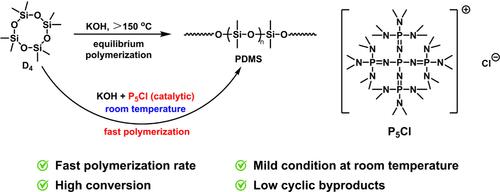
开发高效催化剂,克服环硅氧烷平衡开环聚合(ROP)的局限性,是解决传统聚硅氧烷生产中存在的反作用和高能耗问题的最佳途径。在本研究中,KOH催化的八甲基环四硅氧烷(D4)在高温下的平衡聚合通过快速动力学和添加一定量的磷盐作为助催化剂的反向抑制,转变为在环境条件下更有效的聚合。采用体积较大的磷酸盐P5Cl/KOH在室温下催化D4的ROP,在THF溶液中合成了高转化率(≥90%)的聚二甲基硅氧烷(pdms)。P5Cl与D4的比例可降至0.001 mol %,聚合体系的1H NMR原位表征表明,该反应可以忽略不计。动力学研究表明,P5Cl/KOH组合促进了快速可控的ROP。此外,D4和八苯基环四硅氧烷(P4)在活化磷磷盐P5OMe催化下的总体ROP可以在100℃下方便地获得不同分子量的pdms(最高1616 kg mol - 1)和不同二苯基硅氧烷含量的聚二甲基硅氧烷-共二苯基硅氧烷(PMPS)共聚物(8.4-63.8 mol %)。1H/29Si核磁共振和热力学测量充分验证了PMPS共聚物良好的随机特性。
Upgrade Traditional KOH Catalyzed Ring-Opening Polymerization of Cyclosiloxanes to More Efficient Process by Adding Catalytic Phosphazenium Salt as Cocatalyst
The development of efficient catalyst to overcome the limitation of equilibrium ring-opening polymerization (ROP) of cyclosiloxanes represents the most appealing solution to resolve the back-biting side reaction and high energy consumption during the traditional polysiloxane production. In this contribution, equilibrium polymerization of octamethylcyclotetrasiloxane (D4) catalyzed by KOH at high temperature was shifted to more efficient polymerization at ambient conditions via fast kinetics and back-biting suppressing by adding a catalytic amount of phosphazenium salt as cocatalyst. Polydimethylsiloxanes (PDMSs) were synthesized in high conversion (≥90%) by bulky phosphazenium salt P5Cl/KOH catalyzed ROP of D4 at room temperature in THF solution. The ratio of P5Cl could be lowered to 0.001 mol % of D4, and the back-biting reactions were negligible as evaluated by in situ1H NMR characterization of the polymerization system. Kinetics investigations suggested that the fast and controlled manner of the ROP was promoted by the P5Cl/KOH combination. Furthermore, bulk ROP of D4 and octaphenylcyclotetrasiloxane (P4) catalyzed by activated phosphazenium salt P5OMe conveniently afforded PDMSs with different molecular weights (up to 1616 kg mol–1) and poly(dimethylsiloxane-co-diphenylsiloxane) (PMPS) copolymers with different diphenylsiloxane contents (8.4–63.8 mol %) at 100 °C. The good random characteristic of PMPS copolymers were thoroughly verified by 1H/29Si NMR and thermodynamic measurements.
期刊介绍:
Macromolecules publishes original, fundamental, and impactful research on all aspects of polymer science. Topics of interest include synthesis (e.g., controlled polymerizations, polymerization catalysis, post polymerization modification, new monomer structures and polymer architectures, and polymerization mechanisms/kinetics analysis); phase behavior, thermodynamics, dynamic, and ordering/disordering phenomena (e.g., self-assembly, gelation, crystallization, solution/melt/solid-state characteristics); structure and properties (e.g., mechanical and rheological properties, surface/interfacial characteristics, electronic and transport properties); new state of the art characterization (e.g., spectroscopy, scattering, microscopy, rheology), simulation (e.g., Monte Carlo, molecular dynamics, multi-scale/coarse-grained modeling), and theoretical methods. Renewable/sustainable polymers, polymer networks, responsive polymers, electro-, magneto- and opto-active macromolecules, inorganic polymers, charge-transporting polymers (ion-containing, semiconducting, and conducting), nanostructured polymers, and polymer composites are also of interest. Typical papers published in Macromolecules showcase important and innovative concepts, experimental methods/observations, and theoretical/computational approaches that demonstrate a fundamental advance in the understanding of polymers.




 京公网安备 11010802042870号
京ICP备2023020795号-1
京公网安备 11010802042870号
京ICP备2023020795号-1

 分享
分享
 求助内容:
求助内容: 应助结果提醒方式:
 扫码关注我们
