Zhi-Xin Huang, Andrea M. Alexandre, Alessandro Pedicelli, Xuying He, Quanlong Hong, Yongkun Li, Ping Chen, Qiankun Cai, Aldobrando Broccolini, Luca Scarcia, Serena Abruzzese, Carlo Cirelli, Mauro Bergui, Andrea Romi, Erwah Kalsoum, Giulia Frauenfelder, Grzegorz Meder, Simona Scalise, Maria Porzia Ganimede, Luigi Bellini, Bruno Del Sette, Francesco Arba, Susanna Sammali, Andrea Salcuni, Sergio Lucio Vinci, Giacomo Cester, Luisa Roveri, Xianjun Huang, Wen Sun
{"title":"椎基底动脉闭塞合并心房颤动血管内治疗的AI预测模型","authors":"Zhi-Xin Huang, Andrea M. Alexandre, Alessandro Pedicelli, Xuying He, Quanlong Hong, Yongkun Li, Ping Chen, Qiankun Cai, Aldobrando Broccolini, Luca Scarcia, Serena Abruzzese, Carlo Cirelli, Mauro Bergui, Andrea Romi, Erwah Kalsoum, Giulia Frauenfelder, Grzegorz Meder, Simona Scalise, Maria Porzia Ganimede, Luigi Bellini, Bruno Del Sette, Francesco Arba, Susanna Sammali, Andrea Salcuni, Sergio Lucio Vinci, Giacomo Cester, Luisa Roveri, Xianjun Huang, Wen Sun","doi":"10.1038/s41746-025-01478-5","DOIUrl":null,"url":null,"abstract":"<p>Endovascular treatment (EVT) for vertebrobasilar artery occlusion (VBAO) with atrial fibrillation presents complex clinical challenges. This comprehensive multicenter study of 525 patients across 15 Chinese provinces investigated nuanced predictors beyond conventional metrics. While 45.1% achieved favorable outcomes at 90 days, our advanced machine learning approach unveiled subtle interaction effects among clinical variables not captured by traditional statistical methods. The predictive model distinguished high-risk subgroups by integrating multiple parameters, demonstrating superior prognostic precision compared to standard NIHSS-based assessments. Novel findings include nonlinear relationships between dyslipidemia, stroke severity, and functional recovery. The developed predictive algorithm (AUC 0.719 internally, 0.684 externally) offers a more sophisticated risk stratification tool, potentially guiding personalized treatment strategies in high-complexity VBAO patients with atrial fibrillation.</p>","PeriodicalId":19349,"journal":{"name":"NPJ Digital Medicine","volume":"84 1","pages":""},"PeriodicalIF":15.1000,"publicationDate":"2025-02-02","publicationTypes":"Journal Article","fieldsOfStudy":null,"isOpenAccess":false,"openAccessPdf":"","citationCount":"0","resultStr":"{\"title\":\"AI prediction model for endovascular treatment of vertebrobasilar occlusion with atrial fibrillation\",\"authors\":\"Zhi-Xin Huang, Andrea M. Alexandre, Alessandro Pedicelli, Xuying He, Quanlong Hong, Yongkun Li, Ping Chen, Qiankun Cai, Aldobrando Broccolini, Luca Scarcia, Serena Abruzzese, Carlo Cirelli, Mauro Bergui, Andrea Romi, Erwah Kalsoum, Giulia Frauenfelder, Grzegorz Meder, Simona Scalise, Maria Porzia Ganimede, Luigi Bellini, Bruno Del Sette, Francesco Arba, Susanna Sammali, Andrea Salcuni, Sergio Lucio Vinci, Giacomo Cester, Luisa Roveri, Xianjun Huang, Wen Sun\",\"doi\":\"10.1038/s41746-025-01478-5\",\"DOIUrl\":null,\"url\":null,\"abstract\":\"<p>Endovascular treatment (EVT) for vertebrobasilar artery occlusion (VBAO) with atrial fibrillation presents complex clinical challenges. This comprehensive multicenter study of 525 patients across 15 Chinese provinces investigated nuanced predictors beyond conventional metrics. While 45.1% achieved favorable outcomes at 90 days, our advanced machine learning approach unveiled subtle interaction effects among clinical variables not captured by traditional statistical methods. The predictive model distinguished high-risk subgroups by integrating multiple parameters, demonstrating superior prognostic precision compared to standard NIHSS-based assessments. Novel findings include nonlinear relationships between dyslipidemia, stroke severity, and functional recovery. The developed predictive algorithm (AUC 0.719 internally, 0.684 externally) offers a more sophisticated risk stratification tool, potentially guiding personalized treatment strategies in high-complexity VBAO patients with atrial fibrillation.</p>\",\"PeriodicalId\":19349,\"journal\":{\"name\":\"NPJ Digital Medicine\",\"volume\":\"84 1\",\"pages\":\"\"},\"PeriodicalIF\":15.1000,\"publicationDate\":\"2025-02-02\",\"publicationTypes\":\"Journal Article\",\"fieldsOfStudy\":null,\"isOpenAccess\":false,\"openAccessPdf\":\"\",\"citationCount\":\"0\",\"resultStr\":null,\"platform\":\"Semanticscholar\",\"paperid\":null,\"PeriodicalName\":\"NPJ Digital Medicine\",\"FirstCategoryId\":\"3\",\"ListUrlMain\":\"https://doi.org/10.1038/s41746-025-01478-5\",\"RegionNum\":1,\"RegionCategory\":\"医学\",\"ArticlePicture\":[],\"TitleCN\":null,\"AbstractTextCN\":null,\"PMCID\":null,\"EPubDate\":\"\",\"PubModel\":\"\",\"JCR\":\"Q1\",\"JCRName\":\"HEALTH CARE SCIENCES & SERVICES\",\"Score\":null,\"Total\":0}","platform":"Semanticscholar","paperid":null,"PeriodicalName":"NPJ Digital Medicine","FirstCategoryId":"3","ListUrlMain":"https://doi.org/10.1038/s41746-025-01478-5","RegionNum":1,"RegionCategory":"医学","ArticlePicture":[],"TitleCN":null,"AbstractTextCN":null,"PMCID":null,"EPubDate":"","PubModel":"","JCR":"Q1","JCRName":"HEALTH CARE SCIENCES & SERVICES","Score":null,"Total":0}
AI prediction model for endovascular treatment of vertebrobasilar occlusion with atrial fibrillation
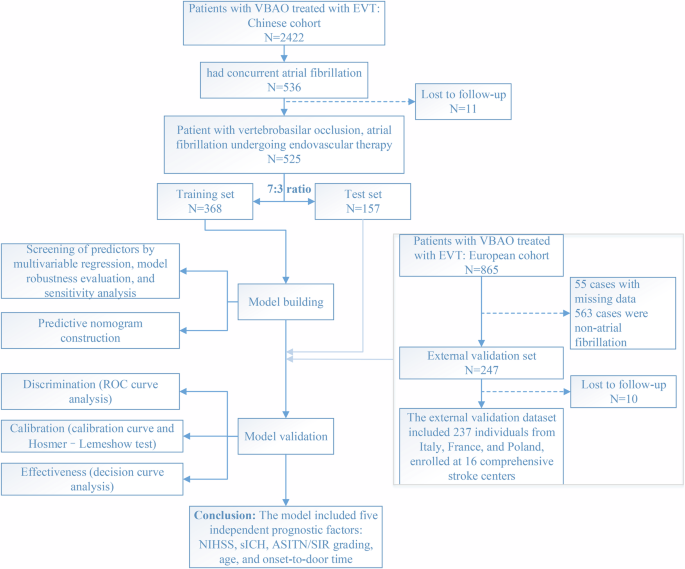
Endovascular treatment (EVT) for vertebrobasilar artery occlusion (VBAO) with atrial fibrillation presents complex clinical challenges. This comprehensive multicenter study of 525 patients across 15 Chinese provinces investigated nuanced predictors beyond conventional metrics. While 45.1% achieved favorable outcomes at 90 days, our advanced machine learning approach unveiled subtle interaction effects among clinical variables not captured by traditional statistical methods. The predictive model distinguished high-risk subgroups by integrating multiple parameters, demonstrating superior prognostic precision compared to standard NIHSS-based assessments. Novel findings include nonlinear relationships between dyslipidemia, stroke severity, and functional recovery. The developed predictive algorithm (AUC 0.719 internally, 0.684 externally) offers a more sophisticated risk stratification tool, potentially guiding personalized treatment strategies in high-complexity VBAO patients with atrial fibrillation.
期刊介绍:
npj Digital Medicine is an online open-access journal that focuses on publishing peer-reviewed research in the field of digital medicine. The journal covers various aspects of digital medicine, including the application and implementation of digital and mobile technologies in clinical settings, virtual healthcare, and the use of artificial intelligence and informatics.
The primary goal of the journal is to support innovation and the advancement of healthcare through the integration of new digital and mobile technologies. When determining if a manuscript is suitable for publication, the journal considers four important criteria: novelty, clinical relevance, scientific rigor, and digital innovation.





 京公网安备 11010802042870号
京ICP备2023020795号-1
京公网安备 11010802042870号
京ICP备2023020795号-1

 分享
分享
 求助内容:
求助内容: 应助结果提醒方式:
 扫码关注我们
