Isaac Y. Tian, Jason Liu, Michael C. Wong, Nisa N. Kelly, Yong E. Liu, Andrea K. Garber, Steven B. Heymsfield, Brian Curless, John A. Shepherd
{"title":"基于三维卷积深度学习的全身形态非线性估计","authors":"Isaac Y. Tian, Jason Liu, Michael C. Wong, Nisa N. Kelly, Yong E. Liu, Andrea K. Garber, Steven B. Heymsfield, Brian Curless, John A. Shepherd","doi":"10.1038/s41746-025-01469-6","DOIUrl":null,"url":null,"abstract":"<p>Body composition prediction from 3D optical imagery has previously been studied with linear algorithms. In this study, we present a novel application of deep 3D convolutional graph networks and nonlinear Gaussian process regression for human body shape parameterization and body composition estimation. We trained and tested linear and nonlinear models with ablation studies on a novel ensemble body shape dataset containing 4286 scans. Nonlinear GPR produced up to a 20% reduction in prediction error and up to a 30% increase in precision over linear regression for both sexes in 10 tested body composition variables. Deep shape features produced 6–8% reduction in prediction error over linear PCA features for males only, and a 4–14% reduction in precision error for both sexes. All coefficients of determination (<i>R</i><sup>2</sup>) for all predicted variables were above 0.86 and achieved lower estimation RMSEs than all previous work on 10 metrics of body composition.</p>","PeriodicalId":19349,"journal":{"name":"NPJ Digital Medicine","volume":"6 1","pages":""},"PeriodicalIF":18.0000,"publicationDate":"2025-02-02","publicationTypes":"Journal Article","fieldsOfStudy":null,"isOpenAccess":false,"openAccessPdf":"","citationCount":"0","resultStr":"{\"title\":\"3D convolutional deep learning for nonlinear estimation of body composition from whole body morphology\",\"authors\":\"Isaac Y. Tian, Jason Liu, Michael C. Wong, Nisa N. Kelly, Yong E. Liu, Andrea K. Garber, Steven B. Heymsfield, Brian Curless, John A. Shepherd\",\"doi\":\"10.1038/s41746-025-01469-6\",\"DOIUrl\":null,\"url\":null,\"abstract\":\"<p>Body composition prediction from 3D optical imagery has previously been studied with linear algorithms. In this study, we present a novel application of deep 3D convolutional graph networks and nonlinear Gaussian process regression for human body shape parameterization and body composition estimation. We trained and tested linear and nonlinear models with ablation studies on a novel ensemble body shape dataset containing 4286 scans. Nonlinear GPR produced up to a 20% reduction in prediction error and up to a 30% increase in precision over linear regression for both sexes in 10 tested body composition variables. Deep shape features produced 6–8% reduction in prediction error over linear PCA features for males only, and a 4–14% reduction in precision error for both sexes. All coefficients of determination (<i>R</i><sup>2</sup>) for all predicted variables were above 0.86 and achieved lower estimation RMSEs than all previous work on 10 metrics of body composition.</p>\",\"PeriodicalId\":19349,\"journal\":{\"name\":\"NPJ Digital Medicine\",\"volume\":\"6 1\",\"pages\":\"\"},\"PeriodicalIF\":18.0000,\"publicationDate\":\"2025-02-02\",\"publicationTypes\":\"Journal Article\",\"fieldsOfStudy\":null,\"isOpenAccess\":false,\"openAccessPdf\":\"\",\"citationCount\":\"0\",\"resultStr\":null,\"platform\":\"Semanticscholar\",\"paperid\":null,\"PeriodicalName\":\"NPJ Digital Medicine\",\"FirstCategoryId\":\"3\",\"ListUrlMain\":\"https://doi.org/10.1038/s41746-025-01469-6\",\"RegionNum\":1,\"RegionCategory\":\"医学\",\"ArticlePicture\":[],\"TitleCN\":null,\"AbstractTextCN\":null,\"PMCID\":null,\"EPubDate\":\"\",\"PubModel\":\"\",\"JCR\":\"Q1\",\"JCRName\":\"HEALTH CARE SCIENCES & SERVICES\",\"Score\":null,\"Total\":0}","platform":"Semanticscholar","paperid":null,"PeriodicalName":"NPJ Digital Medicine","FirstCategoryId":"3","ListUrlMain":"https://doi.org/10.1038/s41746-025-01469-6","RegionNum":1,"RegionCategory":"医学","ArticlePicture":[],"TitleCN":null,"AbstractTextCN":null,"PMCID":null,"EPubDate":"","PubModel":"","JCR":"Q1","JCRName":"HEALTH CARE SCIENCES & SERVICES","Score":null,"Total":0}
3D convolutional deep learning for nonlinear estimation of body composition from whole body morphology
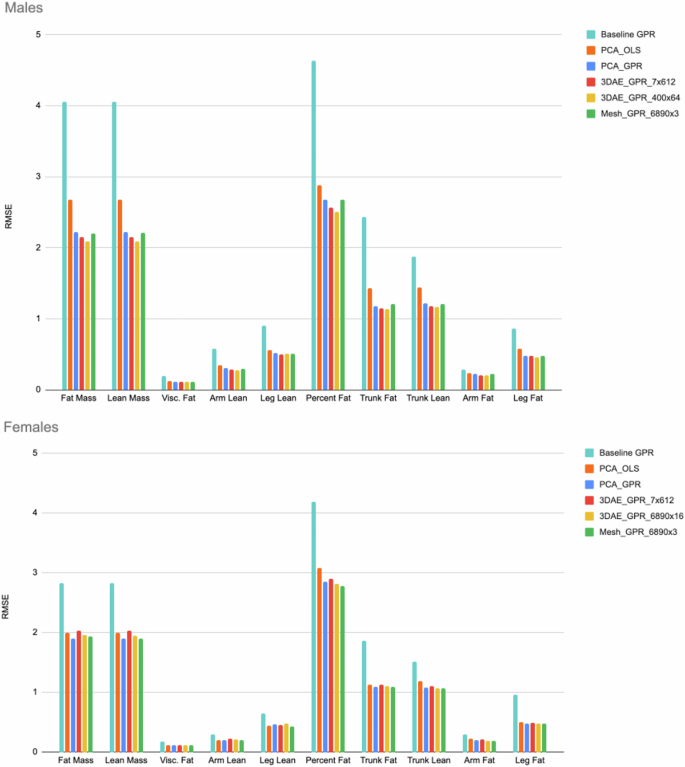
Body composition prediction from 3D optical imagery has previously been studied with linear algorithms. In this study, we present a novel application of deep 3D convolutional graph networks and nonlinear Gaussian process regression for human body shape parameterization and body composition estimation. We trained and tested linear and nonlinear models with ablation studies on a novel ensemble body shape dataset containing 4286 scans. Nonlinear GPR produced up to a 20% reduction in prediction error and up to a 30% increase in precision over linear regression for both sexes in 10 tested body composition variables. Deep shape features produced 6–8% reduction in prediction error over linear PCA features for males only, and a 4–14% reduction in precision error for both sexes. All coefficients of determination (R2) for all predicted variables were above 0.86 and achieved lower estimation RMSEs than all previous work on 10 metrics of body composition.
期刊介绍:
npj Digital Medicine is an online open-access journal that focuses on publishing peer-reviewed research in the field of digital medicine. The journal covers various aspects of digital medicine, including the application and implementation of digital and mobile technologies in clinical settings, virtual healthcare, and the use of artificial intelligence and informatics.
The primary goal of the journal is to support innovation and the advancement of healthcare through the integration of new digital and mobile technologies. When determining if a manuscript is suitable for publication, the journal considers four important criteria: novelty, clinical relevance, scientific rigor, and digital innovation.





 京公网安备 11010802042870号
京ICP备2023020795号-1
京公网安备 11010802042870号
京ICP备2023020795号-1

 分享
分享
 求助内容:
求助内容: 应助结果提醒方式:
 扫码关注我们
