Tania Alfaro, Kevin Martinez-Folgar, Dalia Stern, Maria A Wilches-Mogollon, María Pía Muñoz, Harrison Quick, Marcio Alazraqui, Manuel Ramirez-Zea, J Jaime Miranda, Mariana Lazo, Waleska Teixeira Caiaffa, Ana V Diez Roux, Usama Bilal
{"title":"拉丁美洲343个城市癌症死亡率的变异性和社会模式:一项生态学研究。","authors":"Tania Alfaro, Kevin Martinez-Folgar, Dalia Stern, Maria A Wilches-Mogollon, María Pía Muñoz, Harrison Quick, Marcio Alazraqui, Manuel Ramirez-Zea, J Jaime Miranda, Mariana Lazo, Waleska Teixeira Caiaffa, Ana V Diez Roux, Usama Bilal","doi":"10.1016/S2214-109X(24)00446-7","DOIUrl":null,"url":null,"abstract":"<p><strong>Background: </strong>Understanding between-city variations in cancer mortality is crucial to inform national and subnational cancer prevention strategies. However, studies at the city level in Latin America are scarce. As part of the Salud Urbana en América Latina (SALURBAL) project, we aimed to describe the variability in cancer mortality rates across 343 cities in nine Latin American countries and the associations of these rates with city-level socioeconomic development.</p><p><strong>Methods: </strong>This ecological study used data from cities in Argentina, Brazil, Chile, Colombia, Costa Rica, El Salvador, Guatemala, Mexico, and Panama. Vital registration and population data from Jan 1, 2015 to Dec 31, 2019 were used to estimate sex-specific and age-standardised cancer mortality rates for each city, overall and for seven cancer sites (breast, lung, colorectal, stomach, liver, prostate, and cervical), and the associations of these rates with city-level socioeconomic development.</p><p><strong>Findings: </strong>We found wide variability in cancer mortality by city (overall age-adjusted cancer mortality rates varied by almost three times), sex, and cancer site. Variability between cities within the same country was highest for cervical and prostate cancer. The most common causes of cancer deaths were breast cancer (305 cities) for females and prostate cancer (167 cities) and lung cancer (132 cities) for males. Liver and cervical cancer were the primary cause of cancer mortality in fewer than ten cities each, most of which were in Guatemala and Mexico. Lower city-level socioeconomic development was associated with higher mortality from liver, stomach, cervical, and prostate cancers and lower mortality from breast, colorectal, and lung cancers, with variations by sex.</p><p><strong>Interpretation: </strong>We found considerable heterogeneity in cancer mortality between cities, geographical patterning, and associations between cancer mortality rates and socioeconomic development. Our results highlight the need to consider city contexts when planning interventions to reduce cancer mortality and when guiding future cancer prevention and control efforts in urban areas within the region.</p><p><strong>Funding: </strong>Wellcome Trust.</p><p><strong>Translations: </strong>For the Spanish and Portuguese translations of the abstract see Supplementary Materials section.</p>","PeriodicalId":48783,"journal":{"name":"Lancet Global Health","volume":"13 2","pages":"e268-e276"},"PeriodicalIF":19.9000,"publicationDate":"2025-02-01","publicationTypes":"Journal Article","fieldsOfStudy":null,"isOpenAccess":false,"openAccessPdf":"https://www.ncbi.nlm.nih.gov/pmc/articles/PMC11782990/pdf/","citationCount":"0","resultStr":"{\"title\":\"Variability and social patterning of cancer mortality in 343 Latin American cities: an ecological study.\",\"authors\":\"Tania Alfaro, Kevin Martinez-Folgar, Dalia Stern, Maria A Wilches-Mogollon, María Pía Muñoz, Harrison Quick, Marcio Alazraqui, Manuel Ramirez-Zea, J Jaime Miranda, Mariana Lazo, Waleska Teixeira Caiaffa, Ana V Diez Roux, Usama Bilal\",\"doi\":\"10.1016/S2214-109X(24)00446-7\",\"DOIUrl\":null,\"url\":null,\"abstract\":\"<p><strong>Background: </strong>Understanding between-city variations in cancer mortality is crucial to inform national and subnational cancer prevention strategies. However, studies at the city level in Latin America are scarce. As part of the Salud Urbana en América Latina (SALURBAL) project, we aimed to describe the variability in cancer mortality rates across 343 cities in nine Latin American countries and the associations of these rates with city-level socioeconomic development.</p><p><strong>Methods: </strong>This ecological study used data from cities in Argentina, Brazil, Chile, Colombia, Costa Rica, El Salvador, Guatemala, Mexico, and Panama. Vital registration and population data from Jan 1, 2015 to Dec 31, 2019 were used to estimate sex-specific and age-standardised cancer mortality rates for each city, overall and for seven cancer sites (breast, lung, colorectal, stomach, liver, prostate, and cervical), and the associations of these rates with city-level socioeconomic development.</p><p><strong>Findings: </strong>We found wide variability in cancer mortality by city (overall age-adjusted cancer mortality rates varied by almost three times), sex, and cancer site. Variability between cities within the same country was highest for cervical and prostate cancer. The most common causes of cancer deaths were breast cancer (305 cities) for females and prostate cancer (167 cities) and lung cancer (132 cities) for males. Liver and cervical cancer were the primary cause of cancer mortality in fewer than ten cities each, most of which were in Guatemala and Mexico. Lower city-level socioeconomic development was associated with higher mortality from liver, stomach, cervical, and prostate cancers and lower mortality from breast, colorectal, and lung cancers, with variations by sex.</p><p><strong>Interpretation: </strong>We found considerable heterogeneity in cancer mortality between cities, geographical patterning, and associations between cancer mortality rates and socioeconomic development. Our results highlight the need to consider city contexts when planning interventions to reduce cancer mortality and when guiding future cancer prevention and control efforts in urban areas within the region.</p><p><strong>Funding: </strong>Wellcome Trust.</p><p><strong>Translations: </strong>For the Spanish and Portuguese translations of the abstract see Supplementary Materials section.</p>\",\"PeriodicalId\":48783,\"journal\":{\"name\":\"Lancet Global Health\",\"volume\":\"13 2\",\"pages\":\"e268-e276\"},\"PeriodicalIF\":19.9000,\"publicationDate\":\"2025-02-01\",\"publicationTypes\":\"Journal Article\",\"fieldsOfStudy\":null,\"isOpenAccess\":false,\"openAccessPdf\":\"https://www.ncbi.nlm.nih.gov/pmc/articles/PMC11782990/pdf/\",\"citationCount\":\"0\",\"resultStr\":null,\"platform\":\"Semanticscholar\",\"paperid\":null,\"PeriodicalName\":\"Lancet Global Health\",\"FirstCategoryId\":\"3\",\"ListUrlMain\":\"https://doi.org/10.1016/S2214-109X(24)00446-7\",\"RegionNum\":1,\"RegionCategory\":\"医学\",\"ArticlePicture\":[],\"TitleCN\":null,\"AbstractTextCN\":null,\"PMCID\":null,\"EPubDate\":\"\",\"PubModel\":\"\",\"JCR\":\"Q1\",\"JCRName\":\"PUBLIC, ENVIRONMENTAL & OCCUPATIONAL HEALTH\",\"Score\":null,\"Total\":0}","platform":"Semanticscholar","paperid":null,"PeriodicalName":"Lancet Global Health","FirstCategoryId":"3","ListUrlMain":"https://doi.org/10.1016/S2214-109X(24)00446-7","RegionNum":1,"RegionCategory":"医学","ArticlePicture":[],"TitleCN":null,"AbstractTextCN":null,"PMCID":null,"EPubDate":"","PubModel":"","JCR":"Q1","JCRName":"PUBLIC, ENVIRONMENTAL & OCCUPATIONAL HEALTH","Score":null,"Total":0}
引用次数: 0
摘要
背景:了解城市之间癌症死亡率的差异对国家和地方癌症预防战略至关重要。然而,在拉丁美洲城市一级的研究很少。作为Salud Urbana en amacria Latina (SALURBAL)项目的一部分,我们旨在描述拉丁美洲9个国家343个城市癌症死亡率的变化,以及这些死亡率与城市社会经济发展的关系。方法:这项生态研究使用了来自阿根廷、巴西、智利、哥伦比亚、哥斯达黎加、萨尔瓦多、危地马拉、墨西哥和巴拿马等国城市的数据。研究人员利用2015年1月1日至2019年12月31日的生命登记和人口数据,估计了每个城市、总体和七个癌症部位(乳腺癌、肺癌、结肠直肠癌、胃癌、肝癌、前列腺癌和宫颈癌)的性别特异性和年龄标准化癌症死亡率,以及这些死亡率与城市社会经济发展水平的关系。研究结果:我们发现癌症死亡率在城市(总体年龄调整后的癌症死亡率几乎相差三倍)、性别和癌症部位之间存在很大差异。同一国家不同城市间宫颈癌和前列腺癌的差异最大。最常见的癌症死亡原因是女性乳腺癌(305个城市),男性前列腺癌(167个城市)和肺癌(132个城市)。肝癌和子宫颈癌是导致癌症死亡的主要原因,各有不到10个城市,其中大多数在危地马拉和墨西哥。城市社会经济发展水平越低,肝癌、胃癌、宫颈癌和前列腺癌的死亡率越高,乳腺癌、结肠直肠癌和肺癌的死亡率越低,性别差异也越大。解释:我们发现癌症死亡率在城市之间、地理模式之间以及癌症死亡率与社会经济发展之间存在相当大的异质性。我们的研究结果强调,在规划降低癌症死亡率的干预措施时,以及在指导该地区城市地区未来癌症预防和控制工作时,需要考虑城市环境。资助:惠康信托基金。翻译:关于摘要的西班牙语和葡萄牙语翻译,请参阅补充资料部分。
Variability and social patterning of cancer mortality in 343 Latin American cities: an ecological study.
Background: Understanding between-city variations in cancer mortality is crucial to inform national and subnational cancer prevention strategies. However, studies at the city level in Latin America are scarce. As part of the Salud Urbana en América Latina (SALURBAL) project, we aimed to describe the variability in cancer mortality rates across 343 cities in nine Latin American countries and the associations of these rates with city-level socioeconomic development.
Methods: This ecological study used data from cities in Argentina, Brazil, Chile, Colombia, Costa Rica, El Salvador, Guatemala, Mexico, and Panama. Vital registration and population data from Jan 1, 2015 to Dec 31, 2019 were used to estimate sex-specific and age-standardised cancer mortality rates for each city, overall and for seven cancer sites (breast, lung, colorectal, stomach, liver, prostate, and cervical), and the associations of these rates with city-level socioeconomic development.
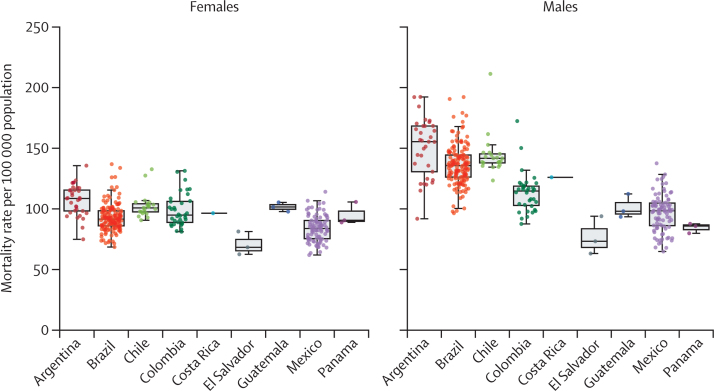
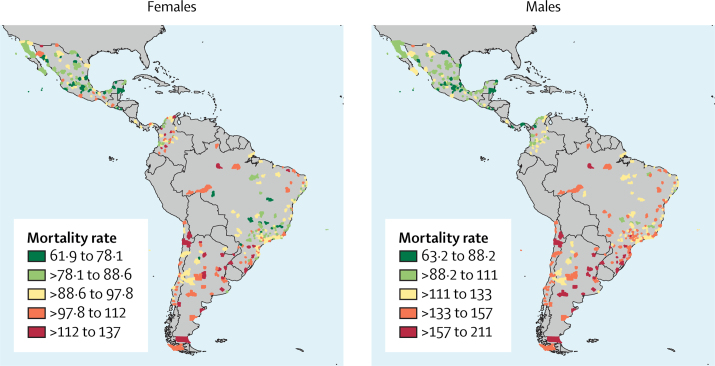
Findings: We found wide variability in cancer mortality by city (overall age-adjusted cancer mortality rates varied by almost three times), sex, and cancer site. Variability between cities within the same country was highest for cervical and prostate cancer. The most common causes of cancer deaths were breast cancer (305 cities) for females and prostate cancer (167 cities) and lung cancer (132 cities) for males. Liver and cervical cancer were the primary cause of cancer mortality in fewer than ten cities each, most of which were in Guatemala and Mexico. Lower city-level socioeconomic development was associated with higher mortality from liver, stomach, cervical, and prostate cancers and lower mortality from breast, colorectal, and lung cancers, with variations by sex.
Interpretation: We found considerable heterogeneity in cancer mortality between cities, geographical patterning, and associations between cancer mortality rates and socioeconomic development. Our results highlight the need to consider city contexts when planning interventions to reduce cancer mortality and when guiding future cancer prevention and control efforts in urban areas within the region.
Funding: Wellcome Trust.
Translations: For the Spanish and Portuguese translations of the abstract see Supplementary Materials section.
期刊介绍:
The Lancet Global Health is an online publication that releases monthly open access (subscription-free) issues.Each issue includes original research, commentary, and correspondence.In addition to this, the publication also provides regular blog posts.
The main focus of The Lancet Global Health is on disadvantaged populations, which can include both entire economic regions and marginalized groups within prosperous nations.The publication prefers to cover topics related to reproductive, maternal, neonatal, child, and adolescent health; infectious diseases (including neglected tropical diseases); non-communicable diseases; mental health; the global health workforce; health systems; surgery; and health policy.





 京公网安备 11010802042870号
京ICP备2023020795号-1
京公网安备 11010802042870号
京ICP备2023020795号-1

 分享
分享
 求助内容:
求助内容: 应助结果提醒方式:
 扫码关注我们
