G. Bratrud, C. L. Chang, R. Chen, E. Cudmore, E. Figueroa-Feliciano, Z. Hong, K. T. Kennard, S. Lewis, M. Lisovenko, L. O. Mateo, V. Novati, V. Novosad, E. Oliveri, R. Ren, J. A. Scarpaci, B. Schmidt, G. Wang, L. Winslow, V. G. Yefremenko, J. Zhang, D. Baxter, M. Hollister, C. James, P. Lukens, D. J. Temples
{"title":"首次演示基于TES的低温Li 2 MoO 4探测器用于中微子双衰变搜索。","authors":"G. Bratrud, C. L. Chang, R. Chen, E. Cudmore, E. Figueroa-Feliciano, Z. Hong, K. T. Kennard, S. Lewis, M. Lisovenko, L. O. Mateo, V. Novati, V. Novosad, E. Oliveri, R. Ren, J. A. Scarpaci, B. Schmidt, G. Wang, L. Winslow, V. G. Yefremenko, J. Zhang, D. Baxter, M. Hollister, C. James, P. Lukens, D. J. Temples","doi":"10.1140/epjc/s10052-025-13844-4","DOIUrl":null,"url":null,"abstract":"<div><p>Cryogenic calorimetric experiments to search for neutrinoless double-beta decay (<span>\\(0\\nu \\beta \\beta \\)</span>) are highly competitive, scalable and versatile in isotope. The largest planned detector array, CUPID, is comprised of about 1500 individual Li<span>\\(_{2}\\)</span> <span>\\(^{100}\\)</span>MoO<span>\\(_4\\)</span> detector modules with a further scale up envisioned for a follow up experiment (CUPID-1T). In this article, we present a novel detector concept targeting this second stage with a low impedance TES based readout for the Li<span>\\(_2\\)</span>MoO<span>\\(_4\\)</span> absorber that is easily mass-produced and lends itself to a multiplexed readout. We present the detector design and results from a first prototype detector operated at the NEXUS shallow underground facility at Fermilab. The detector is a 2-cm-side cube with 21 g mass that is strongly thermally coupled to its readout chip to allow rise-times of <span>\\(\\sim \\)</span>0.5 ms. This design is more than one order of magnitude faster than present NTD based detectors and is hence expected to effectively mitigate backgrounds generated through the pile-up of two independent two neutrino decay events coinciding close in time. Together with a baseline resolution of 1.95 keV (FWHM) these performance parameters extrapolate to a background index from pile-up as low as <span>\\(5\\cdot 10^{-6}\\)</span> counts/keV/kg/yr in CUPID size crystals. The detector was calibrated up to the MeV region showing sufficient dynamic range for <span>\\(0\\nu \\beta \\beta \\)</span> searches. In combination with a SuperCDMS HVeV detector this setup also allowed us to perform a precision measurement of the scintillation time constants of Li<span>\\(_2\\)</span>MoO<span>\\(_4\\)</span>, which showed a primary component with a fast O(20 <span>\\(\\upmu \\)</span>s) time scale.</p></div>","PeriodicalId":788,"journal":{"name":"The European Physical Journal C","volume":"85 2","pages":""},"PeriodicalIF":4.9000,"publicationDate":"2025-01-31","publicationTypes":"Journal Article","fieldsOfStudy":null,"isOpenAccess":false,"openAccessPdf":"https://www.ncbi.nlm.nih.gov/pmc/articles/PMC11785649/pdf/","citationCount":"0","resultStr":"{\"title\":\"First demonstration of a TES based cryogenic Li\\\\(_2\\\\)MoO\\\\(_4\\\\) detector for neutrinoless double beta decay search\",\"authors\":\"G. Bratrud, C. L. Chang, R. Chen, E. Cudmore, E. Figueroa-Feliciano, Z. Hong, K. T. Kennard, S. Lewis, M. Lisovenko, L. O. Mateo, V. Novati, V. Novosad, E. Oliveri, R. Ren, J. A. Scarpaci, B. Schmidt, G. Wang, L. Winslow, V. G. Yefremenko, J. Zhang, D. Baxter, M. Hollister, C. James, P. Lukens, D. J. Temples\",\"doi\":\"10.1140/epjc/s10052-025-13844-4\",\"DOIUrl\":null,\"url\":null,\"abstract\":\"<div><p>Cryogenic calorimetric experiments to search for neutrinoless double-beta decay (<span>\\\\(0\\\\nu \\\\beta \\\\beta \\\\)</span>) are highly competitive, scalable and versatile in isotope. The largest planned detector array, CUPID, is comprised of about 1500 individual Li<span>\\\\(_{2}\\\\)</span> <span>\\\\(^{100}\\\\)</span>MoO<span>\\\\(_4\\\\)</span> detector modules with a further scale up envisioned for a follow up experiment (CUPID-1T). In this article, we present a novel detector concept targeting this second stage with a low impedance TES based readout for the Li<span>\\\\(_2\\\\)</span>MoO<span>\\\\(_4\\\\)</span> absorber that is easily mass-produced and lends itself to a multiplexed readout. We present the detector design and results from a first prototype detector operated at the NEXUS shallow underground facility at Fermilab. The detector is a 2-cm-side cube with 21 g mass that is strongly thermally coupled to its readout chip to allow rise-times of <span>\\\\(\\\\sim \\\\)</span>0.5 ms. This design is more than one order of magnitude faster than present NTD based detectors and is hence expected to effectively mitigate backgrounds generated through the pile-up of two independent two neutrino decay events coinciding close in time. Together with a baseline resolution of 1.95 keV (FWHM) these performance parameters extrapolate to a background index from pile-up as low as <span>\\\\(5\\\\cdot 10^{-6}\\\\)</span> counts/keV/kg/yr in CUPID size crystals. The detector was calibrated up to the MeV region showing sufficient dynamic range for <span>\\\\(0\\\\nu \\\\beta \\\\beta \\\\)</span> searches. In combination with a SuperCDMS HVeV detector this setup also allowed us to perform a precision measurement of the scintillation time constants of Li<span>\\\\(_2\\\\)</span>MoO<span>\\\\(_4\\\\)</span>, which showed a primary component with a fast O(20 <span>\\\\(\\\\upmu \\\\)</span>s) time scale.</p></div>\",\"PeriodicalId\":788,\"journal\":{\"name\":\"The European Physical Journal C\",\"volume\":\"85 2\",\"pages\":\"\"},\"PeriodicalIF\":4.9000,\"publicationDate\":\"2025-01-31\",\"publicationTypes\":\"Journal Article\",\"fieldsOfStudy\":null,\"isOpenAccess\":false,\"openAccessPdf\":\"https://www.ncbi.nlm.nih.gov/pmc/articles/PMC11785649/pdf/\",\"citationCount\":\"0\",\"resultStr\":null,\"platform\":\"Semanticscholar\",\"paperid\":null,\"PeriodicalName\":\"The European Physical Journal C\",\"FirstCategoryId\":\"4\",\"ListUrlMain\":\"https://link.springer.com/article/10.1140/epjc/s10052-025-13844-4\",\"RegionNum\":2,\"RegionCategory\":\"物理与天体物理\",\"ArticlePicture\":[],\"TitleCN\":null,\"AbstractTextCN\":null,\"PMCID\":null,\"EPubDate\":\"\",\"PubModel\":\"\",\"JCR\":\"Q2\",\"JCRName\":\"PHYSICS, PARTICLES & FIELDS\",\"Score\":null,\"Total\":0}","platform":"Semanticscholar","paperid":null,"PeriodicalName":"The European Physical Journal C","FirstCategoryId":"4","ListUrlMain":"https://link.springer.com/article/10.1140/epjc/s10052-025-13844-4","RegionNum":2,"RegionCategory":"物理与天体物理","ArticlePicture":[],"TitleCN":null,"AbstractTextCN":null,"PMCID":null,"EPubDate":"","PubModel":"","JCR":"Q2","JCRName":"PHYSICS, PARTICLES & FIELDS","Score":null,"Total":0}
First demonstration of a TES based cryogenic Li\(_2\)MoO\(_4\) detector for neutrinoless double beta decay search
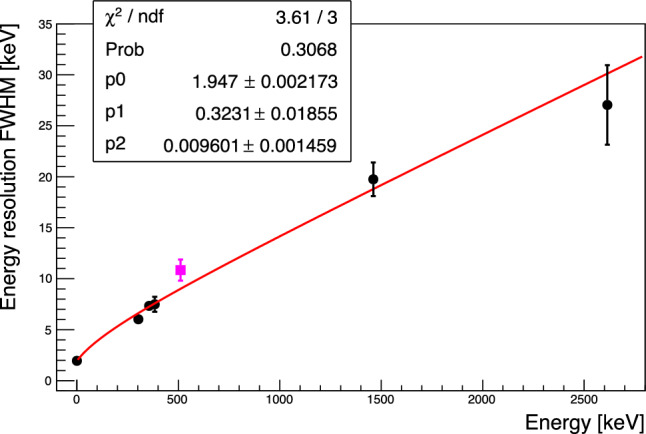
Cryogenic calorimetric experiments to search for neutrinoless double-beta decay (\(0\nu \beta \beta \)) are highly competitive, scalable and versatile in isotope. The largest planned detector array, CUPID, is comprised of about 1500 individual Li\(_{2}\)\(^{100}\)MoO\(_4\) detector modules with a further scale up envisioned for a follow up experiment (CUPID-1T). In this article, we present a novel detector concept targeting this second stage with a low impedance TES based readout for the Li\(_2\)MoO\(_4\) absorber that is easily mass-produced and lends itself to a multiplexed readout. We present the detector design and results from a first prototype detector operated at the NEXUS shallow underground facility at Fermilab. The detector is a 2-cm-side cube with 21 g mass that is strongly thermally coupled to its readout chip to allow rise-times of \(\sim \)0.5 ms. This design is more than one order of magnitude faster than present NTD based detectors and is hence expected to effectively mitigate backgrounds generated through the pile-up of two independent two neutrino decay events coinciding close in time. Together with a baseline resolution of 1.95 keV (FWHM) these performance parameters extrapolate to a background index from pile-up as low as \(5\cdot 10^{-6}\) counts/keV/kg/yr in CUPID size crystals. The detector was calibrated up to the MeV region showing sufficient dynamic range for \(0\nu \beta \beta \) searches. In combination with a SuperCDMS HVeV detector this setup also allowed us to perform a precision measurement of the scintillation time constants of Li\(_2\)MoO\(_4\), which showed a primary component with a fast O(20 \(\upmu \)s) time scale.
期刊介绍:
Experimental Physics I: Accelerator Based High-Energy Physics
Hadron and lepton collider physics
Lepton-nucleon scattering
High-energy nuclear reactions
Standard model precision tests
Search for new physics beyond the standard model
Heavy flavour physics
Neutrino properties
Particle detector developments
Computational methods and analysis tools
Experimental Physics II: Astroparticle Physics
Dark matter searches
High-energy cosmic rays
Double beta decay
Long baseline neutrino experiments
Neutrino astronomy
Axions and other weakly interacting light particles
Gravitational waves and observational cosmology
Particle detector developments
Computational methods and analysis tools
Theoretical Physics I: Phenomenology of the Standard Model and Beyond
Electroweak interactions
Quantum chromo dynamics
Heavy quark physics and quark flavour mixing
Neutrino physics
Phenomenology of astro- and cosmoparticle physics
Meson spectroscopy and non-perturbative QCD
Low-energy effective field theories
Lattice field theory
High temperature QCD and heavy ion physics
Phenomenology of supersymmetric extensions of the SM
Phenomenology of non-supersymmetric extensions of the SM
Model building and alternative models of electroweak symmetry breaking
Flavour physics beyond the SM
Computational algorithms and tools...etc.






 京公网安备 11010802042870号
京ICP备2023020795号-1
京公网安备 11010802042870号
京ICP备2023020795号-1

 分享
分享
 求助内容:
求助内容: 应助结果提醒方式:
 扫码关注我们
