Kanghyeon Kim , Sunhong Min , Ramar Thangam , Kyong-Ryol Tag , Hyun-Jeong Lee , Jeongyun Heo , Hwapyung Jung , Thet Thet Swe , Iman Zare , Guosheng Song , Alireza Hassani Najafabadi , Junmin Lee , Hyun-Do Jung , Jong Seung Kim , Sunghoon Hur , Hyun-Cheol Song , Sung-Gyu Park , Kunyu Zhang , Pengchao Zhao , Liming Bian , Heemin Kang
{"title":"体内巨噬细胞竞争调节的动态分层配体各向异性。","authors":"Kanghyeon Kim , Sunhong Min , Ramar Thangam , Kyong-Ryol Tag , Hyun-Jeong Lee , Jeongyun Heo , Hwapyung Jung , Thet Thet Swe , Iman Zare , Guosheng Song , Alireza Hassani Najafabadi , Junmin Lee , Hyun-Do Jung , Jong Seung Kim , Sunghoon Hur , Hyun-Cheol Song , Sung-Gyu Park , Kunyu Zhang , Pengchao Zhao , Liming Bian , Heemin Kang","doi":"10.1016/j.bioactmat.2025.01.009","DOIUrl":null,"url":null,"abstract":"<div><div>Diverse connective tissues exhibit hierarchical anisotropic structures that intricately regulate homeostasis and tissue functions for dynamic immune response modulation. In this study, remotely manipulable hierarchical nanostructures are tailored to exhibit multi-scale ligand anisotropy. Hierarchical nanostructure construction involves coupling liganded nanoscale isotropic/anisotropic Au (comparable to few integrin molecules-scale) to the surface of microscale isotropic/anisotropic magnetic Fe<sub>3</sub>O<sub>4</sub> (comparable to integrin cluster-scale) and then elastically tethering them to a substrate. Systematic independent tailoring of nanoscale or microscale ligand isotropy versus anisotropy in four different hierarchical nanostructures with constant liganded surface area demonstrates similar levels of integrin molecule bridging and macrophage adhesion on the nanoscale ligand isotropy versus anisotropy. Conversely, the levels of integrin cluster bridging across hierarchical nanostructures and macrophage adhesion are significantly promoted by microscale ligand anisotropy compared with microscale ligand isotropy. Furthermore, microscale ligand anisotropy dominantly activates the host macrophage adhesion and pro-regenerative M2 polarization <em>in vivo</em> over the nanoscale ligand anisotropy, which can be cyclically reversed by substrate-proximate versus substrate-distant magnetic manipulation. This unprecedented scale-specific regulation of cells can be diversified by unlimited tuning of the scale, anisotropy, dimension, shape, and magnetism of hierarchical structures to decipher scale-specific dynamic cell-material interactions to advance immunoengineering strategies.</div></div>","PeriodicalId":8762,"journal":{"name":"Bioactive Materials","volume":"47 ","pages":"Pages 121-135"},"PeriodicalIF":18.0000,"publicationDate":"2025-05-01","publicationTypes":"Journal Article","fieldsOfStudy":null,"isOpenAccess":false,"openAccessPdf":"https://www.ncbi.nlm.nih.gov/pmc/articles/PMC11787691/pdf/","citationCount":"0","resultStr":"{\"title\":\"Dynamic hierarchical ligand anisotropy for competing macrophage regulation in vivo\",\"authors\":\"Kanghyeon Kim , Sunhong Min , Ramar Thangam , Kyong-Ryol Tag , Hyun-Jeong Lee , Jeongyun Heo , Hwapyung Jung , Thet Thet Swe , Iman Zare , Guosheng Song , Alireza Hassani Najafabadi , Junmin Lee , Hyun-Do Jung , Jong Seung Kim , Sunghoon Hur , Hyun-Cheol Song , Sung-Gyu Park , Kunyu Zhang , Pengchao Zhao , Liming Bian , Heemin Kang\",\"doi\":\"10.1016/j.bioactmat.2025.01.009\",\"DOIUrl\":null,\"url\":null,\"abstract\":\"<div><div>Diverse connective tissues exhibit hierarchical anisotropic structures that intricately regulate homeostasis and tissue functions for dynamic immune response modulation. In this study, remotely manipulable hierarchical nanostructures are tailored to exhibit multi-scale ligand anisotropy. Hierarchical nanostructure construction involves coupling liganded nanoscale isotropic/anisotropic Au (comparable to few integrin molecules-scale) to the surface of microscale isotropic/anisotropic magnetic Fe<sub>3</sub>O<sub>4</sub> (comparable to integrin cluster-scale) and then elastically tethering them to a substrate. Systematic independent tailoring of nanoscale or microscale ligand isotropy versus anisotropy in four different hierarchical nanostructures with constant liganded surface area demonstrates similar levels of integrin molecule bridging and macrophage adhesion on the nanoscale ligand isotropy versus anisotropy. Conversely, the levels of integrin cluster bridging across hierarchical nanostructures and macrophage adhesion are significantly promoted by microscale ligand anisotropy compared with microscale ligand isotropy. Furthermore, microscale ligand anisotropy dominantly activates the host macrophage adhesion and pro-regenerative M2 polarization <em>in vivo</em> over the nanoscale ligand anisotropy, which can be cyclically reversed by substrate-proximate versus substrate-distant magnetic manipulation. This unprecedented scale-specific regulation of cells can be diversified by unlimited tuning of the scale, anisotropy, dimension, shape, and magnetism of hierarchical structures to decipher scale-specific dynamic cell-material interactions to advance immunoengineering strategies.</div></div>\",\"PeriodicalId\":8762,\"journal\":{\"name\":\"Bioactive Materials\",\"volume\":\"47 \",\"pages\":\"Pages 121-135\"},\"PeriodicalIF\":18.0000,\"publicationDate\":\"2025-05-01\",\"publicationTypes\":\"Journal Article\",\"fieldsOfStudy\":null,\"isOpenAccess\":false,\"openAccessPdf\":\"https://www.ncbi.nlm.nih.gov/pmc/articles/PMC11787691/pdf/\",\"citationCount\":\"0\",\"resultStr\":null,\"platform\":\"Semanticscholar\",\"paperid\":null,\"PeriodicalName\":\"Bioactive Materials\",\"FirstCategoryId\":\"5\",\"ListUrlMain\":\"https://www.sciencedirect.com/science/article/pii/S2452199X2500009X\",\"RegionNum\":1,\"RegionCategory\":\"医学\",\"ArticlePicture\":[],\"TitleCN\":null,\"AbstractTextCN\":null,\"PMCID\":null,\"EPubDate\":\"2025/1/19 0:00:00\",\"PubModel\":\"Epub\",\"JCR\":\"Q1\",\"JCRName\":\"ENGINEERING, BIOMEDICAL\",\"Score\":null,\"Total\":0}","platform":"Semanticscholar","paperid":null,"PeriodicalName":"Bioactive Materials","FirstCategoryId":"5","ListUrlMain":"https://www.sciencedirect.com/science/article/pii/S2452199X2500009X","RegionNum":1,"RegionCategory":"医学","ArticlePicture":[],"TitleCN":null,"AbstractTextCN":null,"PMCID":null,"EPubDate":"2025/1/19 0:00:00","PubModel":"Epub","JCR":"Q1","JCRName":"ENGINEERING, BIOMEDICAL","Score":null,"Total":0}
Dynamic hierarchical ligand anisotropy for competing macrophage regulation in vivo
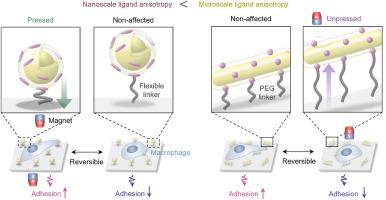
Diverse connective tissues exhibit hierarchical anisotropic structures that intricately regulate homeostasis and tissue functions for dynamic immune response modulation. In this study, remotely manipulable hierarchical nanostructures are tailored to exhibit multi-scale ligand anisotropy. Hierarchical nanostructure construction involves coupling liganded nanoscale isotropic/anisotropic Au (comparable to few integrin molecules-scale) to the surface of microscale isotropic/anisotropic magnetic Fe3O4 (comparable to integrin cluster-scale) and then elastically tethering them to a substrate. Systematic independent tailoring of nanoscale or microscale ligand isotropy versus anisotropy in four different hierarchical nanostructures with constant liganded surface area demonstrates similar levels of integrin molecule bridging and macrophage adhesion on the nanoscale ligand isotropy versus anisotropy. Conversely, the levels of integrin cluster bridging across hierarchical nanostructures and macrophage adhesion are significantly promoted by microscale ligand anisotropy compared with microscale ligand isotropy. Furthermore, microscale ligand anisotropy dominantly activates the host macrophage adhesion and pro-regenerative M2 polarization in vivo over the nanoscale ligand anisotropy, which can be cyclically reversed by substrate-proximate versus substrate-distant magnetic manipulation. This unprecedented scale-specific regulation of cells can be diversified by unlimited tuning of the scale, anisotropy, dimension, shape, and magnetism of hierarchical structures to decipher scale-specific dynamic cell-material interactions to advance immunoengineering strategies.
Bioactive MaterialsBiochemistry, Genetics and Molecular Biology-Biotechnology
CiteScore
28.00
自引率
6.30%
发文量
436
审稿时长
20 days
期刊介绍:
Bioactive Materials is a peer-reviewed research publication that focuses on advancements in bioactive materials. The journal accepts research papers, reviews, and rapid communications in the field of next-generation biomaterials that interact with cells, tissues, and organs in various living organisms.
The primary goal of Bioactive Materials is to promote the science and engineering of biomaterials that exhibit adaptiveness to the biological environment. These materials are specifically designed to stimulate or direct appropriate cell and tissue responses or regulate interactions with microorganisms.
The journal covers a wide range of bioactive materials, including those that are engineered or designed in terms of their physical form (e.g. particulate, fiber), topology (e.g. porosity, surface roughness), or dimensions (ranging from macro to nano-scales). Contributions are sought from the following categories of bioactive materials:
Bioactive metals and alloys
Bioactive inorganics: ceramics, glasses, and carbon-based materials
Bioactive polymers and gels
Bioactive materials derived from natural sources
Bioactive composites
These materials find applications in human and veterinary medicine, such as implants, tissue engineering scaffolds, cell/drug/gene carriers, as well as imaging and sensing devices.





 京公网安备 11010802042870号
京ICP备2023020795号-1
京公网安备 11010802042870号
京ICP备2023020795号-1

 分享
分享
 求助内容:
求助内容: 应助结果提醒方式:
 扫码关注我们
