Lynn Petukhova, Annelise Colvin, Nicole D K Koerts, Barbara Horváth
{"title":"利用基因型和表型在化脓性汗腺炎管理中实施精准医学。","authors":"Lynn Petukhova, Annelise Colvin, Nicole D K Koerts, Barbara Horváth","doi":"10.1093/bjd/ljae399","DOIUrl":null,"url":null,"abstract":"<p><p>Hidradenitis suppurativa (HS) is a chronic inflammatory skin condition with many unmet needs. It is characterized by significant clinical heterogeneity, which suggests that a diagnosis of HS captures multiple distinct disease entities and that research aimed at identifying medically relevant HS subtypes will improve its management. Precision medicine is an approach to disease management that uses information encoded in a patient's genome, and operationalized in clinical presentations and drug responses, to identify disease subtypes. Prior research aimed at identifying HS subtypes has largely focused on phenotypic classifications derived from clinical features of cutaneous lesions. Limitations of existing HS taxonomies emphasize a need for a more nuanced understanding of disease subtypes. Evidence that has emerged from initial genetic studies of HS suggests the presence of at least three HS subtypes, each of which has different clinical implications in terms of disease risks and drug responses. These preliminary findings are instructive in terms of expanding our definitions of HS phenotypes to not only include characteristics of skin lesions, but also disease comorbidities and molecular and cellular phenotypes. Here we provide a comprehensive review of HS phenotype and genotype knowledge, and propose a strategic framework for implementing precision medicine in HS management. Future research should focus on expanding phenotype assessments to include data on multiple scales. Iterative research designs performed with phenotype and genotype data from large diverse cohorts are needed to rigorously define clinically relevant HS subtypes.</p>","PeriodicalId":9238,"journal":{"name":"British Journal of Dermatology","volume":"192 Supplement_1","pages":"i22-i29"},"PeriodicalIF":9.6000,"publicationDate":"2025-02-03","publicationTypes":"Journal Article","fieldsOfStudy":null,"isOpenAccess":false,"openAccessPdf":"https://www.ncbi.nlm.nih.gov/pmc/articles/PMC11788593/pdf/","citationCount":"0","resultStr":"{\"title\":\"Leveraging genotypes and phenotypes to implement precision medicine in hidradenitis suppurativa management.\",\"authors\":\"Lynn Petukhova, Annelise Colvin, Nicole D K Koerts, Barbara Horváth\",\"doi\":\"10.1093/bjd/ljae399\",\"DOIUrl\":null,\"url\":null,\"abstract\":\"<p><p>Hidradenitis suppurativa (HS) is a chronic inflammatory skin condition with many unmet needs. It is characterized by significant clinical heterogeneity, which suggests that a diagnosis of HS captures multiple distinct disease entities and that research aimed at identifying medically relevant HS subtypes will improve its management. Precision medicine is an approach to disease management that uses information encoded in a patient's genome, and operationalized in clinical presentations and drug responses, to identify disease subtypes. Prior research aimed at identifying HS subtypes has largely focused on phenotypic classifications derived from clinical features of cutaneous lesions. Limitations of existing HS taxonomies emphasize a need for a more nuanced understanding of disease subtypes. Evidence that has emerged from initial genetic studies of HS suggests the presence of at least three HS subtypes, each of which has different clinical implications in terms of disease risks and drug responses. These preliminary findings are instructive in terms of expanding our definitions of HS phenotypes to not only include characteristics of skin lesions, but also disease comorbidities and molecular and cellular phenotypes. Here we provide a comprehensive review of HS phenotype and genotype knowledge, and propose a strategic framework for implementing precision medicine in HS management. Future research should focus on expanding phenotype assessments to include data on multiple scales. Iterative research designs performed with phenotype and genotype data from large diverse cohorts are needed to rigorously define clinically relevant HS subtypes.</p>\",\"PeriodicalId\":9238,\"journal\":{\"name\":\"British Journal of Dermatology\",\"volume\":\"192 Supplement_1\",\"pages\":\"i22-i29\"},\"PeriodicalIF\":9.6000,\"publicationDate\":\"2025-02-03\",\"publicationTypes\":\"Journal Article\",\"fieldsOfStudy\":null,\"isOpenAccess\":false,\"openAccessPdf\":\"https://www.ncbi.nlm.nih.gov/pmc/articles/PMC11788593/pdf/\",\"citationCount\":\"0\",\"resultStr\":null,\"platform\":\"Semanticscholar\",\"paperid\":null,\"PeriodicalName\":\"British Journal of Dermatology\",\"FirstCategoryId\":\"3\",\"ListUrlMain\":\"https://doi.org/10.1093/bjd/ljae399\",\"RegionNum\":1,\"RegionCategory\":\"医学\",\"ArticlePicture\":[],\"TitleCN\":null,\"AbstractTextCN\":null,\"PMCID\":null,\"EPubDate\":\"\",\"PubModel\":\"\",\"JCR\":\"Q1\",\"JCRName\":\"DERMATOLOGY\",\"Score\":null,\"Total\":0}","platform":"Semanticscholar","paperid":null,"PeriodicalName":"British Journal of Dermatology","FirstCategoryId":"3","ListUrlMain":"https://doi.org/10.1093/bjd/ljae399","RegionNum":1,"RegionCategory":"医学","ArticlePicture":[],"TitleCN":null,"AbstractTextCN":null,"PMCID":null,"EPubDate":"","PubModel":"","JCR":"Q1","JCRName":"DERMATOLOGY","Score":null,"Total":0}
Leveraging genotypes and phenotypes to implement precision medicine in hidradenitis suppurativa management.
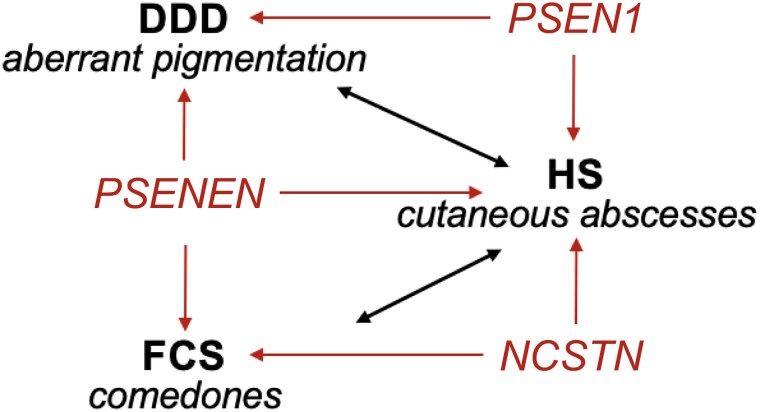
Hidradenitis suppurativa (HS) is a chronic inflammatory skin condition with many unmet needs. It is characterized by significant clinical heterogeneity, which suggests that a diagnosis of HS captures multiple distinct disease entities and that research aimed at identifying medically relevant HS subtypes will improve its management. Precision medicine is an approach to disease management that uses information encoded in a patient's genome, and operationalized in clinical presentations and drug responses, to identify disease subtypes. Prior research aimed at identifying HS subtypes has largely focused on phenotypic classifications derived from clinical features of cutaneous lesions. Limitations of existing HS taxonomies emphasize a need for a more nuanced understanding of disease subtypes. Evidence that has emerged from initial genetic studies of HS suggests the presence of at least three HS subtypes, each of which has different clinical implications in terms of disease risks and drug responses. These preliminary findings are instructive in terms of expanding our definitions of HS phenotypes to not only include characteristics of skin lesions, but also disease comorbidities and molecular and cellular phenotypes. Here we provide a comprehensive review of HS phenotype and genotype knowledge, and propose a strategic framework for implementing precision medicine in HS management. Future research should focus on expanding phenotype assessments to include data on multiple scales. Iterative research designs performed with phenotype and genotype data from large diverse cohorts are needed to rigorously define clinically relevant HS subtypes.
期刊介绍:
The British Journal of Dermatology (BJD) is committed to publishing the highest quality dermatological research. Through its publications, the journal seeks to advance the understanding, management, and treatment of skin diseases, ultimately aiming to improve patient outcomes.







 京公网安备 11010802042870号
京ICP备2023020795号-1
京公网安备 11010802042870号
京ICP备2023020795号-1

 分享
分享
 求助内容:
求助内容: 应助结果提醒方式:
 扫码关注我们
