Jiaolin Zhou, Xiao Zhang, Qian Liu, Yongheng Li, Guoju Wu, Wei Fu, Hongwei Yao, Zhenjun Wang, Huadan Xue, Tao Xu, Weijie Chen, Junyang Lu, Guannan Zhang, Bin Wu, Yang An, Xiaoyuan Qiu, Yi Xiao, Guole Lin
{"title":"循环肿瘤dna引导局部晚期直肠癌(CINTS-R)新辅助治疗策略的多中心随机对照试验的基本原理和设计","authors":"Jiaolin Zhou, Xiao Zhang, Qian Liu, Yongheng Li, Guoju Wu, Wei Fu, Hongwei Yao, Zhenjun Wang, Huadan Xue, Tao Xu, Weijie Chen, Junyang Lu, Guannan Zhang, Bin Wu, Yang An, Xiaoyuan Qiu, Yi Xiao, Guole Lin","doi":"10.1136/bmjopen-2024-090765","DOIUrl":null,"url":null,"abstract":"<p><strong>Background: </strong>The traditional neoadjuvant chemoradiotherapy (nCRT) combined with total mesorectal excision has been widely accepted as the standard treatment for patients with locally advanced rectal cancer (LARC). New strategies such as total neoadjuvant therapy (TNT) and neoadjuvant immunotherapy have shown great promise in certain patient populations. Currently, there is an urgent need to stratify patients before treatment to adopt the appropriate neoadjuvant strategies. Our previous study has shown that circulating tumour DNA (ctDNA) effectively reflects tumour burden and genetic characteristics and has significant predictive value for tumour recurrence, demonstrating great potential in guiding the choice of neoadjuvant strategies.</p><p><strong>Methods and analysis: </strong>The CINTS-R trial is a multicentre, open-label, randomised controlled trial designed to evaluate the efficacy and safety of a ctDNA-guided neoadjuvant treatment strategy compared with conventional neoadjuvant therapy regime in patients with LARC. The trial will enrol 470 patients diagnosed with LARC (staged cT3-4N0 or cTanyN1-2) with tumours located ≤12 cm from the anal verge across seven centres in China. Patients will be randomly assigned in a 2:1 ratio to the experimental group or the control group. Patients in the experimental group will receive different intensities of neoadjuvant chemoradiotherapy (TNT or modified nCRT) or neoadjuvant immunotherapy based on the molecular features of the tumour, baseline ctDNA concentration and changes in ctDNA status early in treatment. Patients in the control group will receive modified nCRT. The primary endpoint is the 2-year disease-related treatment failure rate. The secondary endpoints include time to recurrence, 2-year overall survival, 2-year disease-free survival, clinical complete response (cCR) rate, near cCR rate and pathologically complete response rate, pathological tumour regression grade and quality of life.</p><p><strong>Ethics and dissemination: </strong>This protocol has been approved by the ethics committee of Peking Union Medical College Hospital, with approval number I-23PJ157, and by the institutional review boards of all the participating centres. All data will be collected and stored in a specially designed database. The results of our trial will be disseminated through peer-reviewed publications and presented at national and international academic conferences.</p><p><strong>Trial registration number: </strong>This trial is registered on ClinicalTrials.gov and the registration ID is NCT05601505.</p>","PeriodicalId":9158,"journal":{"name":"BMJ Open","volume":"15 1","pages":"e090765"},"PeriodicalIF":2.3000,"publicationDate":"2025-02-02","publicationTypes":"Journal Article","fieldsOfStudy":null,"isOpenAccess":false,"openAccessPdf":"https://www.ncbi.nlm.nih.gov/pmc/articles/PMC11792281/pdf/","citationCount":"0","resultStr":"{\"title\":\"Rationale and design of a multicentre randomised controlled trial on circulating tumour DNA-guided neoadjuvant treatment strategy for locally advanced rectal cancer (CINTS-R).\",\"authors\":\"Jiaolin Zhou, Xiao Zhang, Qian Liu, Yongheng Li, Guoju Wu, Wei Fu, Hongwei Yao, Zhenjun Wang, Huadan Xue, Tao Xu, Weijie Chen, Junyang Lu, Guannan Zhang, Bin Wu, Yang An, Xiaoyuan Qiu, Yi Xiao, Guole Lin\",\"doi\":\"10.1136/bmjopen-2024-090765\",\"DOIUrl\":null,\"url\":null,\"abstract\":\"<p><strong>Background: </strong>The traditional neoadjuvant chemoradiotherapy (nCRT) combined with total mesorectal excision has been widely accepted as the standard treatment for patients with locally advanced rectal cancer (LARC). New strategies such as total neoadjuvant therapy (TNT) and neoadjuvant immunotherapy have shown great promise in certain patient populations. Currently, there is an urgent need to stratify patients before treatment to adopt the appropriate neoadjuvant strategies. Our previous study has shown that circulating tumour DNA (ctDNA) effectively reflects tumour burden and genetic characteristics and has significant predictive value for tumour recurrence, demonstrating great potential in guiding the choice of neoadjuvant strategies.</p><p><strong>Methods and analysis: </strong>The CINTS-R trial is a multicentre, open-label, randomised controlled trial designed to evaluate the efficacy and safety of a ctDNA-guided neoadjuvant treatment strategy compared with conventional neoadjuvant therapy regime in patients with LARC. The trial will enrol 470 patients diagnosed with LARC (staged cT3-4N0 or cTanyN1-2) with tumours located ≤12 cm from the anal verge across seven centres in China. Patients will be randomly assigned in a 2:1 ratio to the experimental group or the control group. Patients in the experimental group will receive different intensities of neoadjuvant chemoradiotherapy (TNT or modified nCRT) or neoadjuvant immunotherapy based on the molecular features of the tumour, baseline ctDNA concentration and changes in ctDNA status early in treatment. Patients in the control group will receive modified nCRT. The primary endpoint is the 2-year disease-related treatment failure rate. The secondary endpoints include time to recurrence, 2-year overall survival, 2-year disease-free survival, clinical complete response (cCR) rate, near cCR rate and pathologically complete response rate, pathological tumour regression grade and quality of life.</p><p><strong>Ethics and dissemination: </strong>This protocol has been approved by the ethics committee of Peking Union Medical College Hospital, with approval number I-23PJ157, and by the institutional review boards of all the participating centres. All data will be collected and stored in a specially designed database. The results of our trial will be disseminated through peer-reviewed publications and presented at national and international academic conferences.</p><p><strong>Trial registration number: </strong>This trial is registered on ClinicalTrials.gov and the registration ID is NCT05601505.</p>\",\"PeriodicalId\":9158,\"journal\":{\"name\":\"BMJ Open\",\"volume\":\"15 1\",\"pages\":\"e090765\"},\"PeriodicalIF\":2.3000,\"publicationDate\":\"2025-02-02\",\"publicationTypes\":\"Journal Article\",\"fieldsOfStudy\":null,\"isOpenAccess\":false,\"openAccessPdf\":\"https://www.ncbi.nlm.nih.gov/pmc/articles/PMC11792281/pdf/\",\"citationCount\":\"0\",\"resultStr\":null,\"platform\":\"Semanticscholar\",\"paperid\":null,\"PeriodicalName\":\"BMJ Open\",\"FirstCategoryId\":\"3\",\"ListUrlMain\":\"https://doi.org/10.1136/bmjopen-2024-090765\",\"RegionNum\":3,\"RegionCategory\":\"医学\",\"ArticlePicture\":[],\"TitleCN\":null,\"AbstractTextCN\":null,\"PMCID\":null,\"EPubDate\":\"\",\"PubModel\":\"\",\"JCR\":\"Q1\",\"JCRName\":\"MEDICINE, GENERAL & INTERNAL\",\"Score\":null,\"Total\":0}","platform":"Semanticscholar","paperid":null,"PeriodicalName":"BMJ Open","FirstCategoryId":"3","ListUrlMain":"https://doi.org/10.1136/bmjopen-2024-090765","RegionNum":3,"RegionCategory":"医学","ArticlePicture":[],"TitleCN":null,"AbstractTextCN":null,"PMCID":null,"EPubDate":"","PubModel":"","JCR":"Q1","JCRName":"MEDICINE, GENERAL & INTERNAL","Score":null,"Total":0}
Rationale and design of a multicentre randomised controlled trial on circulating tumour DNA-guided neoadjuvant treatment strategy for locally advanced rectal cancer (CINTS-R).
Background: The traditional neoadjuvant chemoradiotherapy (nCRT) combined with total mesorectal excision has been widely accepted as the standard treatment for patients with locally advanced rectal cancer (LARC). New strategies such as total neoadjuvant therapy (TNT) and neoadjuvant immunotherapy have shown great promise in certain patient populations. Currently, there is an urgent need to stratify patients before treatment to adopt the appropriate neoadjuvant strategies. Our previous study has shown that circulating tumour DNA (ctDNA) effectively reflects tumour burden and genetic characteristics and has significant predictive value for tumour recurrence, demonstrating great potential in guiding the choice of neoadjuvant strategies.
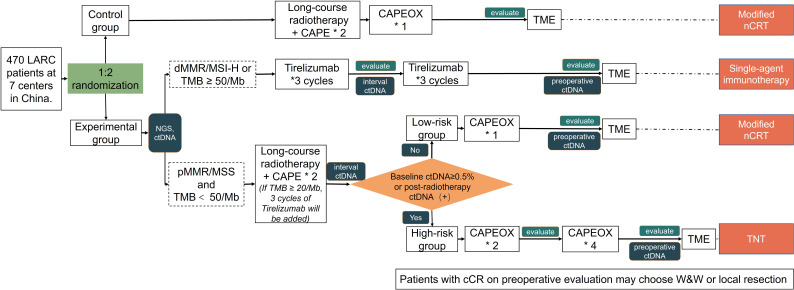
Methods and analysis: The CINTS-R trial is a multicentre, open-label, randomised controlled trial designed to evaluate the efficacy and safety of a ctDNA-guided neoadjuvant treatment strategy compared with conventional neoadjuvant therapy regime in patients with LARC. The trial will enrol 470 patients diagnosed with LARC (staged cT3-4N0 or cTanyN1-2) with tumours located ≤12 cm from the anal verge across seven centres in China. Patients will be randomly assigned in a 2:1 ratio to the experimental group or the control group. Patients in the experimental group will receive different intensities of neoadjuvant chemoradiotherapy (TNT or modified nCRT) or neoadjuvant immunotherapy based on the molecular features of the tumour, baseline ctDNA concentration and changes in ctDNA status early in treatment. Patients in the control group will receive modified nCRT. The primary endpoint is the 2-year disease-related treatment failure rate. The secondary endpoints include time to recurrence, 2-year overall survival, 2-year disease-free survival, clinical complete response (cCR) rate, near cCR rate and pathologically complete response rate, pathological tumour regression grade and quality of life.
Ethics and dissemination: This protocol has been approved by the ethics committee of Peking Union Medical College Hospital, with approval number I-23PJ157, and by the institutional review boards of all the participating centres. All data will be collected and stored in a specially designed database. The results of our trial will be disseminated through peer-reviewed publications and presented at national and international academic conferences.
Trial registration number: This trial is registered on ClinicalTrials.gov and the registration ID is NCT05601505.
期刊介绍:
BMJ Open is an online, open access journal, dedicated to publishing medical research from all disciplines and therapeutic areas. The journal publishes all research study types, from study protocols to phase I trials to meta-analyses, including small or specialist studies. Publishing procedures are built around fully open peer review and continuous publication, publishing research online as soon as the article is ready.





 京公网安备 11010802042870号
京ICP备2023020795号-1
京公网安备 11010802042870号
京ICP备2023020795号-1

 分享
分享
 求助内容:
求助内容: 应助结果提醒方式:
 扫码关注我们
