Renae C Fernandez, Vivienne Moore, Jacqueline Boyle, Alice R Rumbold, Michael Davies, Danielle Mazza, Luke E Grzeskowiak
{"title":"在澳大利亚全科诊所就诊的妇女中,不孕症的临床遭遇和管理趋势:一项使用MedicineInsight的全国性纵向研究,2011年至2021年。","authors":"Renae C Fernandez, Vivienne Moore, Jacqueline Boyle, Alice R Rumbold, Michael Davies, Danielle Mazza, Luke E Grzeskowiak","doi":"10.1136/bmjopen-2024-085149","DOIUrl":null,"url":null,"abstract":"<p><strong>Objective: </strong>To examine longitudinal trends in infertility management in women attending general practice.</p><p><strong>Design: </strong>Cohort study using the national general practice dataset, MedicineInsight.</p><p><strong>Setting: </strong>Australian general practice.</p><p><strong>Interventions: </strong>Not applicable.</p><p><strong>Participants: </strong>The cohort included 2 552 339 women aged 18-49 years with one or more general practice clinical encounters between January 2011 and December 2021.</p><p><strong>Primary and secondary outcome measuress: </strong>The primary outcome assessed was the proportion of women who had a clinical encounter related to infertility, stratified by year and age group. Second, the proportions of women receiving relevant clinical management actions, including selected pathology tests, imaging ordered and selected medications, were calculated. Univariable logistic regression analyses compared the likelihood of women having a documented clinical encounter related to infertility and receiving selected management actions based on individual characteristics. We also examined practice-level variation in the proportion receiving selected management for infertility by stratifying proportions based on practice site.</p><p><strong>Results: </strong>A total of 2 552 339 women had one or more clinical encounters with their general practitioner (GP) between January 2011 and December 2021, of which 27 671 (1.1%) had a clinical encounter related to infertility management. The rate of infertility encounters increased from 3.4 per 1000 in 2011 to 5.7 per 1000 in 2021. Over episodes of care, half (50.9%) of women presenting for an infertility encounter had at least one specified pathology test, and almost a quarter (23.1%) had a specified imaging test. A relatively small proportion of infertility encounters (5.4%) resulted in prescribing of a selected infertility medication by the GP.Large variation in clinical management (pathology, imaging and medication prescribing) was evident according to both individual characteristics and also at the clinical-practice level. Factors associated with increased likelihood of being provided infertility medications included younger age, holding a Commonwealth concession card (indicating low income), lower socioeconomic status and living outside a major city.</p><p><strong>Conclusions: </strong>Clinical encounters related to infertility are increasing in primary care, with large variation evident in corresponding clinical management. These findings support the development of clinical practice guidelines to enhance standardised and equitable approaches towards the management of infertility in primary care.</p>","PeriodicalId":9158,"journal":{"name":"BMJ Open","volume":"15 2","pages":"e085149"},"PeriodicalIF":2.5000,"publicationDate":"2025-02-02","publicationTypes":"Journal Article","fieldsOfStudy":null,"isOpenAccess":false,"openAccessPdf":"https://www.ncbi.nlm.nih.gov/pmc/articles/PMC11795361/pdf/","citationCount":"0","resultStr":"{\"title\":\"Trends in clinical encounters and management for infertility among women attending Australian general practice: a national longitudinal study using MedicineInsight, 2011 to 2021.\",\"authors\":\"Renae C Fernandez, Vivienne Moore, Jacqueline Boyle, Alice R Rumbold, Michael Davies, Danielle Mazza, Luke E Grzeskowiak\",\"doi\":\"10.1136/bmjopen-2024-085149\",\"DOIUrl\":null,\"url\":null,\"abstract\":\"<p><strong>Objective: </strong>To examine longitudinal trends in infertility management in women attending general practice.</p><p><strong>Design: </strong>Cohort study using the national general practice dataset, MedicineInsight.</p><p><strong>Setting: </strong>Australian general practice.</p><p><strong>Interventions: </strong>Not applicable.</p><p><strong>Participants: </strong>The cohort included 2 552 339 women aged 18-49 years with one or more general practice clinical encounters between January 2011 and December 2021.</p><p><strong>Primary and secondary outcome measuress: </strong>The primary outcome assessed was the proportion of women who had a clinical encounter related to infertility, stratified by year and age group. Second, the proportions of women receiving relevant clinical management actions, including selected pathology tests, imaging ordered and selected medications, were calculated. Univariable logistic regression analyses compared the likelihood of women having a documented clinical encounter related to infertility and receiving selected management actions based on individual characteristics. We also examined practice-level variation in the proportion receiving selected management for infertility by stratifying proportions based on practice site.</p><p><strong>Results: </strong>A total of 2 552 339 women had one or more clinical encounters with their general practitioner (GP) between January 2011 and December 2021, of which 27 671 (1.1%) had a clinical encounter related to infertility management. The rate of infertility encounters increased from 3.4 per 1000 in 2011 to 5.7 per 1000 in 2021. Over episodes of care, half (50.9%) of women presenting for an infertility encounter had at least one specified pathology test, and almost a quarter (23.1%) had a specified imaging test. A relatively small proportion of infertility encounters (5.4%) resulted in prescribing of a selected infertility medication by the GP.Large variation in clinical management (pathology, imaging and medication prescribing) was evident according to both individual characteristics and also at the clinical-practice level. Factors associated with increased likelihood of being provided infertility medications included younger age, holding a Commonwealth concession card (indicating low income), lower socioeconomic status and living outside a major city.</p><p><strong>Conclusions: </strong>Clinical encounters related to infertility are increasing in primary care, with large variation evident in corresponding clinical management. These findings support the development of clinical practice guidelines to enhance standardised and equitable approaches towards the management of infertility in primary care.</p>\",\"PeriodicalId\":9158,\"journal\":{\"name\":\"BMJ Open\",\"volume\":\"15 2\",\"pages\":\"e085149\"},\"PeriodicalIF\":2.5000,\"publicationDate\":\"2025-02-02\",\"publicationTypes\":\"Journal Article\",\"fieldsOfStudy\":null,\"isOpenAccess\":false,\"openAccessPdf\":\"https://www.ncbi.nlm.nih.gov/pmc/articles/PMC11795361/pdf/\",\"citationCount\":\"0\",\"resultStr\":null,\"platform\":\"Semanticscholar\",\"paperid\":null,\"PeriodicalName\":\"BMJ Open\",\"FirstCategoryId\":\"3\",\"ListUrlMain\":\"https://doi.org/10.1136/bmjopen-2024-085149\",\"RegionNum\":3,\"RegionCategory\":\"医学\",\"ArticlePicture\":[],\"TitleCN\":null,\"AbstractTextCN\":null,\"PMCID\":null,\"EPubDate\":\"\",\"PubModel\":\"\",\"JCR\":\"Q1\",\"JCRName\":\"MEDICINE, GENERAL & INTERNAL\",\"Score\":null,\"Total\":0}","platform":"Semanticscholar","paperid":null,"PeriodicalName":"BMJ Open","FirstCategoryId":"3","ListUrlMain":"https://doi.org/10.1136/bmjopen-2024-085149","RegionNum":3,"RegionCategory":"医学","ArticlePicture":[],"TitleCN":null,"AbstractTextCN":null,"PMCID":null,"EPubDate":"","PubModel":"","JCR":"Q1","JCRName":"MEDICINE, GENERAL & INTERNAL","Score":null,"Total":0}
Trends in clinical encounters and management for infertility among women attending Australian general practice: a national longitudinal study using MedicineInsight, 2011 to 2021.
Objective: To examine longitudinal trends in infertility management in women attending general practice.
Design: Cohort study using the national general practice dataset, MedicineInsight.
Setting: Australian general practice.
Interventions: Not applicable.
Participants: The cohort included 2 552 339 women aged 18-49 years with one or more general practice clinical encounters between January 2011 and December 2021.
Primary and secondary outcome measuress: The primary outcome assessed was the proportion of women who had a clinical encounter related to infertility, stratified by year and age group. Second, the proportions of women receiving relevant clinical management actions, including selected pathology tests, imaging ordered and selected medications, were calculated. Univariable logistic regression analyses compared the likelihood of women having a documented clinical encounter related to infertility and receiving selected management actions based on individual characteristics. We also examined practice-level variation in the proportion receiving selected management for infertility by stratifying proportions based on practice site.
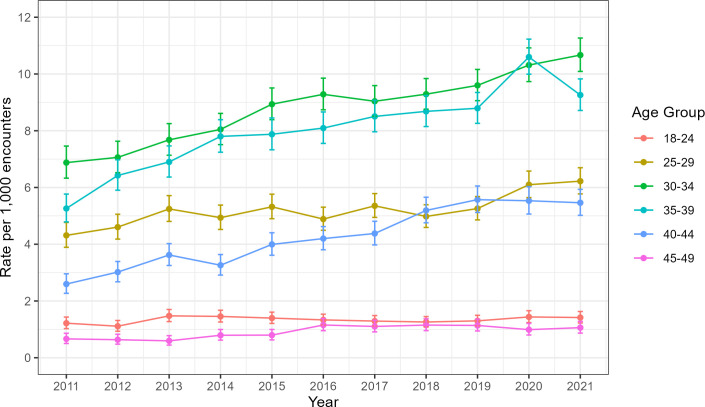
Results: A total of 2 552 339 women had one or more clinical encounters with their general practitioner (GP) between January 2011 and December 2021, of which 27 671 (1.1%) had a clinical encounter related to infertility management. The rate of infertility encounters increased from 3.4 per 1000 in 2011 to 5.7 per 1000 in 2021. Over episodes of care, half (50.9%) of women presenting for an infertility encounter had at least one specified pathology test, and almost a quarter (23.1%) had a specified imaging test. A relatively small proportion of infertility encounters (5.4%) resulted in prescribing of a selected infertility medication by the GP.Large variation in clinical management (pathology, imaging and medication prescribing) was evident according to both individual characteristics and also at the clinical-practice level. Factors associated with increased likelihood of being provided infertility medications included younger age, holding a Commonwealth concession card (indicating low income), lower socioeconomic status and living outside a major city.
Conclusions: Clinical encounters related to infertility are increasing in primary care, with large variation evident in corresponding clinical management. These findings support the development of clinical practice guidelines to enhance standardised and equitable approaches towards the management of infertility in primary care.
期刊介绍:
BMJ Open is an online, open access journal, dedicated to publishing medical research from all disciplines and therapeutic areas. The journal publishes all research study types, from study protocols to phase I trials to meta-analyses, including small or specialist studies. Publishing procedures are built around fully open peer review and continuous publication, publishing research online as soon as the article is ready.





 京公网安备 11010802042870号
京ICP备2023020795号-1
京公网安备 11010802042870号
京ICP备2023020795号-1

 分享
分享
 求助内容:
求助内容: 应助结果提醒方式:
 扫码关注我们
