Eleonora E. Assarioti, Robert J. van Beers, Jeroen B. J. Smeets, Bernadette C. M. van Wijk
{"title":"距离影响感知决策。","authors":"Eleonora E. Assarioti, Robert J. van Beers, Jeroen B. J. Smeets, Bernadette C. M. van Wijk","doi":"10.1111/ejn.70006","DOIUrl":null,"url":null,"abstract":"<p>Decision making is an integral part of everyday life. Recently, there has been a growing interest in the potential influence of action on perceptual decisions, following ideas of embodied decision making. Studies examining decisions regarding the direction of noisy visual motion have found a bias towards the least effortful response option in experiments in which the differences in motor costs associated with alternative response actions were implicit, but not in an experiment in which these differences were made explicit. It remains unclear whether the biasing effect generalizes to other perceptual tasks than motion perception and whether consciously experiencing motor costs prevents such biases. To test the generalizability of effects across perceptual tasks, we used a within-subjects design where 24 participants performed both a motion discrimination task and an orientation discrimination task. Motor costs were manipulated by presenting response buttons for the two alternative choices at different reaching distances. By varying distances randomly, we avoided implicit biases linked to specific decisions. Our findings revealed a bias towards closer response options in both tasks, indicating that explicit information of motor costs significantly impacts perceptual decisions beyond motion discrimination. Contrary to prevailing theories that consider the motor system as a mere effector of the decision, our study implies that the actions that are associated with the response options influence the decision process itself.</p>","PeriodicalId":11993,"journal":{"name":"European Journal of Neuroscience","volume":"61 3","pages":""},"PeriodicalIF":2.4000,"publicationDate":"2025-02-02","publicationTypes":"Journal Article","fieldsOfStudy":null,"isOpenAccess":false,"openAccessPdf":"https://onlinelibrary.wiley.com/doi/epdf/10.1111/ejn.70006","citationCount":"0","resultStr":"{\"title\":\"Reaching Distance Influences Perceptual Decisions\",\"authors\":\"Eleonora E. Assarioti, Robert J. van Beers, Jeroen B. J. Smeets, Bernadette C. M. van Wijk\",\"doi\":\"10.1111/ejn.70006\",\"DOIUrl\":null,\"url\":null,\"abstract\":\"<p>Decision making is an integral part of everyday life. Recently, there has been a growing interest in the potential influence of action on perceptual decisions, following ideas of embodied decision making. Studies examining decisions regarding the direction of noisy visual motion have found a bias towards the least effortful response option in experiments in which the differences in motor costs associated with alternative response actions were implicit, but not in an experiment in which these differences were made explicit. It remains unclear whether the biasing effect generalizes to other perceptual tasks than motion perception and whether consciously experiencing motor costs prevents such biases. To test the generalizability of effects across perceptual tasks, we used a within-subjects design where 24 participants performed both a motion discrimination task and an orientation discrimination task. Motor costs were manipulated by presenting response buttons for the two alternative choices at different reaching distances. By varying distances randomly, we avoided implicit biases linked to specific decisions. Our findings revealed a bias towards closer response options in both tasks, indicating that explicit information of motor costs significantly impacts perceptual decisions beyond motion discrimination. Contrary to prevailing theories that consider the motor system as a mere effector of the decision, our study implies that the actions that are associated with the response options influence the decision process itself.</p>\",\"PeriodicalId\":11993,\"journal\":{\"name\":\"European Journal of Neuroscience\",\"volume\":\"61 3\",\"pages\":\"\"},\"PeriodicalIF\":2.4000,\"publicationDate\":\"2025-02-02\",\"publicationTypes\":\"Journal Article\",\"fieldsOfStudy\":null,\"isOpenAccess\":false,\"openAccessPdf\":\"https://onlinelibrary.wiley.com/doi/epdf/10.1111/ejn.70006\",\"citationCount\":\"0\",\"resultStr\":null,\"platform\":\"Semanticscholar\",\"paperid\":null,\"PeriodicalName\":\"European Journal of Neuroscience\",\"FirstCategoryId\":\"3\",\"ListUrlMain\":\"https://onlinelibrary.wiley.com/doi/10.1111/ejn.70006\",\"RegionNum\":4,\"RegionCategory\":\"医学\",\"ArticlePicture\":[],\"TitleCN\":null,\"AbstractTextCN\":null,\"PMCID\":null,\"EPubDate\":\"\",\"PubModel\":\"\",\"JCR\":\"Q3\",\"JCRName\":\"NEUROSCIENCES\",\"Score\":null,\"Total\":0}","platform":"Semanticscholar","paperid":null,"PeriodicalName":"European Journal of Neuroscience","FirstCategoryId":"3","ListUrlMain":"https://onlinelibrary.wiley.com/doi/10.1111/ejn.70006","RegionNum":4,"RegionCategory":"医学","ArticlePicture":[],"TitleCN":null,"AbstractTextCN":null,"PMCID":null,"EPubDate":"","PubModel":"","JCR":"Q3","JCRName":"NEUROSCIENCES","Score":null,"Total":0}
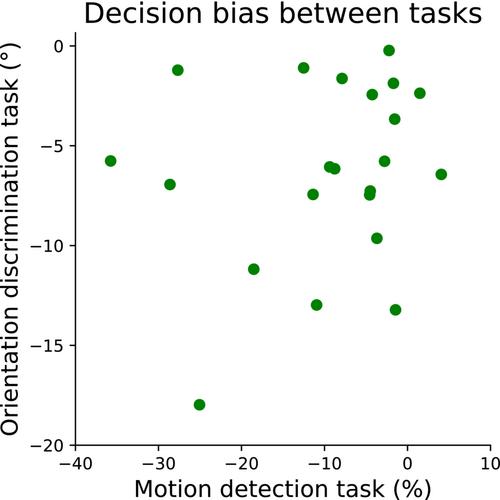
Decision making is an integral part of everyday life. Recently, there has been a growing interest in the potential influence of action on perceptual decisions, following ideas of embodied decision making. Studies examining decisions regarding the direction of noisy visual motion have found a bias towards the least effortful response option in experiments in which the differences in motor costs associated with alternative response actions were implicit, but not in an experiment in which these differences were made explicit. It remains unclear whether the biasing effect generalizes to other perceptual tasks than motion perception and whether consciously experiencing motor costs prevents such biases. To test the generalizability of effects across perceptual tasks, we used a within-subjects design where 24 participants performed both a motion discrimination task and an orientation discrimination task. Motor costs were manipulated by presenting response buttons for the two alternative choices at different reaching distances. By varying distances randomly, we avoided implicit biases linked to specific decisions. Our findings revealed a bias towards closer response options in both tasks, indicating that explicit information of motor costs significantly impacts perceptual decisions beyond motion discrimination. Contrary to prevailing theories that consider the motor system as a mere effector of the decision, our study implies that the actions that are associated with the response options influence the decision process itself.
期刊介绍:
EJN is the journal of FENS and supports the international neuroscientific community by publishing original high quality research articles and reviews in all fields of neuroscience. In addition, to engage with issues that are of interest to the science community, we also publish Editorials, Meetings Reports and Neuro-Opinions on topics that are of current interest in the fields of neuroscience research and training in science. We have recently established a series of ‘Profiles of Women in Neuroscience’. Our goal is to provide a vehicle for publications that further the understanding of the structure and function of the nervous system in both health and disease and to provide a vehicle to engage the neuroscience community. As the official journal of FENS, profits from the journal are re-invested in the neuroscientific community through the activities of FENS.




 京公网安备 11010802042870号
京ICP备2023020795号-1
京公网安备 11010802042870号
京ICP备2023020795号-1

 分享
分享
 求助内容:
求助内容: 应助结果提醒方式:
 扫码关注我们
